Archive for the ‘Taxation’ Category
Posted by William Byrnes on May 10, 2013
Types of Entities
The Foreign Account Tax Compliance Act (“FATCA”) provides for withholding taxes to enforce reporting requirements on specified foreign accounts owned by specified U.S. persons or by U.S. owned foreign entities.
FATCA requires specified U.S. persons (U.S. citizen, residents and certain non-resident aliens) and specified domestic entities to report interests in specified foreign financial assets (SFFAs) if the aggregate value of those assets exceeds certain threshold. The regulations apply to domestic entities formed or availed of to hold, directly or indirectly, specified foreign financial assets. These specified entities include certain closely held corporations and partnerships that meet certain conditions and aggregation rules. Specified entities include domestic trusts if they meet certain criteria and exceed certain reporting threshold.
A U.S. owned foreign entity is an entity with one or more substantial U.S. owners. With certain exceptions, a substantial U.S. owner is any U.S. person with greater than 10% direct or indirect ownership interest in the foreign entity.
FATCA applies to U.S. persons who have specified foreign financial assets (SFFAs) whose value exceeds certain thresholds. The IRS announced in January 2013 that reporting by domestic entities with interests in specified foreign financial assets will not be required to file the IRS reporting form for FATCA, Form 8938, until after the date specified by final regulations, which will not be earlier than taxable years beginning after December 31, 2012.1
All foreign entities and foreign trusts are potentially subject to FATCA, in addition to the current Qualified Intermediary (QI) rules. Withholding rules and reporting requirements under FATCA depend upon the entity’s classification. FATCA classifies foreign entities as either financial entities or non-financial entities. Financial entities are classified as Foreign Financial Institutions (FFIs) [see infra. Chapter 7] while non-financial entities are classified as Non-Financial Foreign Entities (NFFEs) [see infra. Chapter 8].
Entities and trusts are very different under U.S. law. Entities include partnerships, limited liability companies (LLCs), international business companies (IBCs), foundations, usufructs, and corporations. In entities, the title to the property owned is not divided.
In a trust, however, U.S. law splits the ownership of the title into two parts, legal and equitable. The trustee of the trust owns the legal title for the benefit of the beneficiary, who owns the equitable title. A trust is a relationship, not an entity, and is treated differently under both the existing QI rules and FATCA.
Specified Foreign Financial Assets (SFFAs)
Financial Accounts
The most common type of SFFA that banks will encounter is a financial account such as any depository or custodial account that is maintained by an FFI.2 A financial account also includes non-publically traded equity or debt interest in a depository or custodial institution, an insurance company, or an investment entity.3 …
Moreover, a financial account includes a non-publically traded equity or debt interest in a holding company or treasury center in an expanded affiliated group [See infra. Chapter 8]. This applies if the holding company or treasury center has at least one investment entity or passive NFFE and the income of the investment entity or passive NFFE in the group exceeds 50% of the group’s aggregate income.4 …
Assets
SFFAs include assets not held in an account. Stocks and securities issued by a non-U.S. person that are held for investment are SFFAs whether they are held in an account with a FFI or not. The same holds true for capital or profits interests in a foreign partnership, any form of debt issued by a non-U.S. person, or a beneficial interest in a foreign trust, foreign estate, or foreign entity. A litany of financial instruments collectively referred to as “swaps” are also SFFAs whether held in an account or not. Options and derivative instruments that have any non-U.S. parties or are issued by a non-U.S. issuer are also SFFAs.5 …
Exemptions from SFFA Definitions
FATCA does provide exemptions. An interest in a foreign security or social insurance program is not a SFFA. A stock of precious metals held in a foreign safe deposit box is not a SFFA. Any security or partnership interest used or held in the conduct of normal trade or business is considered not to be held for investment under FATCA. Stock, however, cannot be considered to be held in the conduct of normal trade or business for purposes of FATCA. Therefore, foreign stock is a SFFA.6 …
Example of SFFA
To clarify what may be considered an SFFA, consider the following example. Mr. Smith, a U.S. person resident in the U.S., has $1 million in a Swiss bank account. He owns a partnership interest in a hedge fund established in the Cayman Islands, and directly owns 5,000 shares of a publically traded Japanese corporation, JapanCo. He also has social security benefits in a foreign country. …
1. IRS Notice 2013-10, “Information Reporting by Domestic Entities under Section 6038D with Respect to Specified Foreign Financial Assets”.
2. IRC §1471(d)(2), Treas Reg §1.1471-5(b)(1)(i), (ii).
3. IRC §1471(d)(2), Treas Reg §1.1471-5(b)(1)(iii)(A). “Investment entity” is defined in Treas Reg §1.1471-5(e)(4)(i).
4. IRC §1471(d)(2), Treas Reg §1.1471-5(b)(1)(iii)(B)(1). “Treasury center” is defined in Treas Reg §1.1471-5(e)(1)(v).
5. See generally IRS Form 8938, Statement of Specified Foreign Financial Assets.
6. See generally IRS Form 8938, Statement of Specified Foreign Financial Assets.
7. Foreign social security or social insurance programs are not specified as FFA, so they are not subject to FATCA reporting. Instructions to IRS Form 8938, Statement of Specified Foreign Financial Assets, p. 4.
Posted in Compliance, Reporting, Tax Policy, Taxation, Uncategorized | Tagged: Cayman Islands, FATCA, FFI, Finance, Foreign Account Tax Compliance Act, Internal Revenue Service, international tax, IRS, LexisNexis, Limited liability company, NFFE, tax | Leave a Comment »
Posted by William Byrnes on May 3, 2013
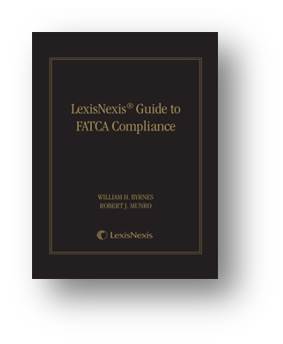
Over 400 pages of compliance analysis !! now available with the 20% discount code link in this flier –> LN Guide to FATCA_flier.
The LexisNexis® Guide to FATCA Compliance was designed in consultation, via numerous interviews and meetings, with government officials, NGO staff, large financial institution compliance officers, investment fund compliance officers, and trust companies, in consultation with contributors who are leading industry experts. The contributors hail from several countries and an offshore financial center and include attorneys, accountants, information technology engineers, and risk managers from large, medium and small firms and from large financial institutions. A sample chapter from the 25 is available on LexisNexis: http://www.lexisnexis.com/store/images/samples/9780769853734.pdf
 Contributing FATCA Expert Practitioners
Kyria Ali, FCCA is a member of the Association of Chartered Certified Accountants (“ACCA”) of Baker Tilly (BVI) Limited.
Michael Alliston, Esq. is a solicitor in the London office of Herbert Smith Freehills LLP.
Ariene d’Arc Diniz e Amaral, Adv. is a Brazilian tax attorney of Rolim, Viotti & Leite Campos Advogados.
Maarten de Bruin, Esq. is a partner of Stibbe Simont.
Jean-Paul van den Berg, Esq. is a tax partner of Stibbe Simont.
Amanda Castellano, Esq. spent three years as an auditor with the Internal Revenue Service.
Luzius Cavelti, Esq. is an associate at Tappolet & Partner in Zurich.
Bruno Da Silva, LL.M. works at Loyens & Loeff, European Direct Tax Law team and is a tax treaty adviser for the Macau special administrative region of the People’s Republic of China.
Prof. J. Richard Duke, Esq. is an attorney admitted in Alabama and Florida specializing over forty years in income and estate tax planning and compliance, as well as asset protection, for high net wealth families. He served as Counsel to the Ludwig von Mises Institute for Austrian Economics 1983-1989.
Dr. Jan Dyckmans, Esq. is a German attorney at Flick Gocke Schaumburg in Frankfurt am Main.
Arne Hansen is a legal trainee of the Hanseatisches Oberlandesgericht (Higher Regional Court of Hamburg), Germany.
Mark Heroux, J.D. is a Principal in the Tax Services Group at Baker Tilly who began his career in 1986 with the IRS Office of Chief Counsel.
Rob. H. Holt, Esq. is a practicing attorney of thirty years licensed in New York and Texas representing real estate investment companies.
Richard Kando, CPA (New York) is a Director at Navigant Consulting and served as a Special Agent with the IRS Criminal Investigation Division where he received the U.S. Department of Justice – Tax Division Assistant Attorney General’s Special Contribution Award.
Denis Kleinfeld, Esq., CPA. is a renown tax author over four decades specializing in international tax planning of high net wealth families. He is Of Counsel to Fuerst Ittleman David & Joseph, PL, in Miami, Florida and was employed as an attorney with the Internal Revenue Service in the Estate and Gift Tax Division.
Richard L. Knickerbocker, Esq. is the senior partner in the Los Angeles office of the Knickerbocker Law Group and the former City Attorney of the City of Santa Monica.
Saloi Abou-Jaoude’ Knickerbocker Saloi Abou-Jaoude’ Knickerbocker is a Legal Administrator in the Los Angeles office of the Knickerbocker Law Group concentrated on shari’a finance.
Jeffrey Locke, Esq. is Director at Navigant Consulting.
Josh Lom works at Herbert Smith Freehills LLP.
Prof. Stephen Polak is a Tax Professor at Thomas Jefferson School of Law’s International Tax & Financial Services Graduate Program where he lectures on Financial Products, Tax Procedure and Financial Crimes. As a U.S. Senior Internal Revenue Agent, Financial Products and Transaction Examiner he examined exotic financial products of large multi-national corporations. Currently, Prof. Polak is assigned to U.S. Internal Revenue Service’s three year National Research Program’s as a Federal State and Local Government Specialist where he examines states, cities, municipalities, and other governmental entities.
Dr. Maji C. Rhee is a professor of Waseda University located in Tokyo.
Jean Richard, Esq. a Canadian attorney, previously worked for the Quebec Tax Department, as a Senior Tax Manager with a large international accounting firm and as a Tax & Estate consultant for a pre-eminent Canadian insurance company. He is currently the Vice President and Sr. Wealth Management Consultant of the BMO Financial Group.
Michael J. Rinaldi, II, CPA. is a renown international tax accountant and author, responsible for the largest independent audit firm in Washington, D.C.
Edgardo Santiago-Torres, Esq., CPA, is also a Certified Public Accountant and a Chartered Global Management Accountant, pursuant to the AICPA and CIMA rules and regulations, admitted by the Puerto Rico Board of Accountancy to practice Public Accounting in Puerto Rico, and an attorney.
Hope M. Shoulders, Esq. is a licensed attorney in the State of New Jersey whom has previously worked for General Motors, National Transportation Safety Board and the Department of Commerce.
Jason Simpson, CAMS is the Director of the Miami office for Global Atlantic Partners, overseeing all operations in Florida, the Caribbean and most of Latin America. He has worked previously as a bank compliance employee at various large and mid-sized financial institutions over the past ten years. He has been a key component in the removal of Cease and Desist Orders as well as other written regulatory agreements within a number of Domestic and International Banks, and designed complete AML units for domestic as well as international banks with over three million clients.
Dr. Alberto Gil Soriano, Esq. worked at the European Commission’s Anti-Fraud Office in Brussels, and most recently at the Legal Department of the International Monetary Fund’s Financial Integrity Group in Washington, D.C. He currently works at the Fiscal Department of Uría Menéndez Abogados, S.L.P in Barcelona (Spain).
Lily L. Tse, CPA. is a partner of Rinaldi & Associates (Washington, D.C.).
Dr. Oliver Untersander, Esq. is partner at Tappolet & Partner in Zurich.
Mauricio Cano del Valle, Esq. is a Mexican attorney who previously worked for the Mexican Ministry of Finance (Secretaría de Hacienda) and Deloitte and Touche Mexico. He was Managing Director of the Amicorp Group Mexico City and San Diego offices, and now has his own law firm.
John Walker, Esq. is an accomplished attorney with a software engineering and architecture background.
Bruce Zagaris, Esq. is a partner at the Washington, D.C. law firm Berliner, Corcoran & Rowe, LLP.
Prof. William Byrnes was a Senior Manager then Associate Director at Coopers & Lybrand, before joining academia wherein he became a renowned author of 38 book and compendium volumes, 93 book & treatise chapters and supplements, and 800+ articles. He is Associate Dean of Thomas Jefferson School of Law’s International Taxation & Financial Services Program.
Dr. Robert J. Munro is the author of 35 published books is a Senior Research Fellow and Director of Research for North America of CIDOEC at Jesus College, Cambridge University, and head of the anti money laundering studies of Thomas Jefferson School of Law’s International Taxation & Financial Services Program.
Posted in Compliance, Estate Tax, Financial Crimes, information exchange, Money Laundering, OECD, Reporting, Tax Policy, Taxation, Wealth Management | Tagged: Compliance, FATCA, Internal Revenue Service, LexisNexis, tax, Tax Evasion, tax reporting | 1 Comment »
Posted by William Byrnes on March 4, 2013
As the world becomes “smaller,” the dynamics of global financial transactions are intensifying. This is why the Foreign Account Tax Compliance Act (FATCA) is one of the most important awareness issues in today’s tax policy and compliance arena. As new developments emerge almost daily in this ever-changing environment, the importance of working knowledge is increasingly pronounced. The LexisNexis® Guide to FATCA Compliance, scheduled for release in May 2013, will be an invaluable resource of insight into FATCA principles, the reasons behind them, and the best practice steps financial institutions must follow in order to comply. Comprehensive coverage in this work, authored by Professor William Byrnes and Dr. Robert Munro, is complemented by content provided by highly qualified international contributors to render meaningful information about all aspects of FATCA.
The impact of FATCA is far-reaching: Affected financial institutions of many descriptions must navigate complex and challenging regulations to maintain compliance. In broad terms, foreign banks, brokerages, pension funds, insurance companies and a host of other foreign businesses that disburse payments to U.S. citizens and residents are all subject to FATCA compliance. As agreements between nations are consummated and other FATCA developments unfold, the importance of awareness will only grow.
– See more at: http://www.lexisnexis.com/community/taxlaw/blogs/fatca/archive/2013/02/28/lexisnexis-174-guide-to-fatca-compliance.aspx#sthash.Xtf40oCq.megzVJco.dpuf
Posted in Compliance, information exchange, Reporting, Tax Policy, Taxation | Tagged: FATCA, Financial institution, Financial transaction, Foreign Account Tax Compliance Act, Government, Internal Revenue Service, LexisNexis, United States | Leave a Comment »
Posted by William Byrnes on March 1, 2013
The LexisNexis® Guide to FATCA Compliance was designed in consultation, via numerous interviews and meetings, with government officials, NGO staff, large financial institution compliance officers, investment fund compliance officers, and trust companies, from North and South America, Europe, South Africa, and Asia, and in consultation with contributors who are leading industry experts. The contributors hail from several countries and an offshore financial center and include attorneys, accountants, information technology engineers, and risk managers from large, medium and small firms and from large financial institutions. Thus, the challenges of the FATCA Compliance Officer are approached from several perspectives and contextual backgrounds.
This edition will provide the financial enterprise’s FATCA compliance officer the tools for developing a best practices compliance strategy, starting with determining what information is needed for planning the meetings with outside FATCA experts.
This 330 page Guide contains three chapters written specifically to guide a financial institution’s lead FATCA compliance officer in designing a plan of internal action within the enterprise and interaction with outside FATCA advisors with a view of best leveraging available resources and budget [see Chapters 2, 3, and 4].
This Guide includes a practical outline of the information that should be requested by, and provided to, FATCA advisors who will be working with the enterprise, and a guide to the work flow and decision processes.
Click here to pre-order the LexisNexis® Guide to FATCA Compliance! Remember that only US customers can buy on the US Lexis store.
Chapter 1 Introduction
Chapter 2 Practical Considerations for Developing a FATCA Compliance Program
Chapter 3 FATCA Compliance and Integration of Information Technology
Chapter 4 Financial Institution Account Remediation
Chapter 5 FBAR & 8938 FATCA Reporting
Chapter 6 Determining U.S. Ownership Under FATCA
Chapter 7 Foreign Financial Institutions
Chapter 8 Non-Financial Foreign Entities
Chapter 9 FACTA and the Insurance Industry
Chapter 10 Withholding and Qualified Intermediary Reporting
Chapter 11 Withholding and FATCA
Chapter 12 ”Withholdable” Payments
Chapter 13 Determining and Documenting the Payee
Chapter 14 Framework of Intergovernmental Agreements
Chapter 15 Analysis of Current Intergovernmental Agreements
Chapter 16 UK-U.S. Intergovernmental Agreement and Its Implementation
Chapter 17 Mexico-U.S. Intergovernmental Agreement and Its Implementation
Chapter 18 Japan-U.S. Intergovernmental Agreement and Its Implementation
Chapter 19 Switzerland-U.S. Intergovernmental Agreement and Its Implementation
Chapter 20 Exchange of Tax Information and the Impact of FATCA for Germany
Chapter 21 Exchange of Tax Information and the Impact of FATCA for The Netherlands
Chapter 22 Exchange of Tax Information and the Impact of FATCA for Canada
Chapter 23 Exchange of Tax Information and the Impact of FATCA for The British
Virgin Islands
Chapter 24 European Union Cross Border Information Reporting
Chapter 25 The OECD, TRACE Program, FATCA and Beyond
Index
Posted in Compliance, information exchange, OECD, Reporting, Tax Policy, Taxation | Tagged: Canada, Chapter 11 Title 11 United States Code, Chapter 13 Title 11 United States Code, FATCA, Financial institution, Internal Revenue Service, LexisNexis, United States | 1 Comment »
Posted by William Byrnes on January 2, 2013
In the first moments of 2013, Congress eased the fiscal cliff tax increases for taxpayers earning less than $450,000 by enacting the American Taxpayer Relief Act (Act), permanently extending the Bush-era income tax cuts for this group. … While the legislation extends the current income tax rates for taxpayers earning less than $450,000 ($400,000 for single filers) per year, it allowed the Bush-era tax cuts to expire for all higher-income taxpayers. Similarly, taxes on capital gains, dividends, and estates were increased for the wealthiest taxpayers.
How Were Income Taxes Increased by the Fiscal Cliff Compromise?
How Does the Act Impact the Current System for Tax Deductions and Exemptions?
Were Capital Gains and Dividend Rates Impacted by the Act?
How Are Estate and Gift Tax Rates Affected?
What Other Changes Were Made?
Beyond the Act: What is the “Investment Income Tax”?
Planning Under the Act: How Should Clients Plan for Higher Taxes in 2013?
Read the analysis at National Underwriters’ Advanced Markets – http://nationalunderwriteradvancedmarkets.com/articles/fc010113-a.aspx?action=16
Posted in Estate Tax, Retirement Planning, Tax Policy, Taxation, Wealth Management | Tagged: Bush Tax Cuts, Capital gain, fiscal cliff, Fiscal conservatism, income tax, tax, Tax rate, United States, United States Congress | Leave a Comment »
Posted by William Byrnes on December 5, 2012
2013 Tax Facts on Investments in PRINT and E-Book format  provides clear, concise answers to often complex tax questions concerning investments. Pertinent planning points are provided throughout.
Organized in a convenient Q&A format to speed you to the information you need, 2013 Tax Facts on Investments delivers the latest guidance on:
- Mutual Funds, Unit Trusts, REITs
- Incentive Stock Options
- Options & Futures
- Real Estate
- Stocks, Bonds
- Oil & Gas
- Precious Metals & Collectibles
- And much more!
Key updates for 2013:
- New section on captive insurance
- New section on reverse mortgages
- Expanded section on ETFs
- Expanded section on precious metals & collectibles
- More than 30 new Planning Points, written by practitioners for practitioners, in the following areas:
- Real Estate
- Limited Partnerships
- Stocks
- Interest and Expenses
- Options
- Mutual Funds
Posted in Estate Tax, Retirement Planning, Taxation, Trusts, Wealth Management | Tagged: 2013 Tax Facts, Business, Economy, Exchange-traded fund, futures real estate, incentive stock options, Investing, Investment, Mutual fund, Precious metal, Real estate investment trust, real estate limited partnerships, stocks bonds, tax, Wealth Management | Leave a Comment »
Posted by William Byrnes on November 30, 2012
An increasing number of your clients are facing the novel possibility of choosing a lump sum payout from their pensions instead of the traditional annuity option. See the full article at –http://www.lifehealthpro.com/2012/08/16/when-clients-get-lump-sum-pension-offers-what-to-a
Posted in Insurance, Pensions, Taxation, Wealth Management | Tagged: Life annuity, Pension, Retirement, Retirement planning | Leave a Comment »
Posted by William Byrnes on November 28, 2012
One question financial advisors are asking themselves today is whether life settlements have returned to the fold as a viable tool in their clients’ planning strategies. Read the entire article at http://www.lifehealthpro.com/2012/09/05/life-settlements-are-they-back
Posted in Insurance, Retirement Planning, Taxation, Wealth Management | Tagged: life settlements, Retirement, Retirement planning | Leave a Comment »
Posted by William Byrnes on November 26, 2012
… the PPACA provisions proposing an additional 3.8 percent tax on investment income will shortly become effective … and your high-income clients will need advice on how to reposition their investments today to minimize its effect. Read the full article at http://www.lifehealthpro.com/2012/07/19/preparing-clients-for-the-reality-of-ppacas-invest
Posted in Pensions, Retirement Planning, Taxation | Tagged: Patient Protection and Affordable Care Act, PPACA, tax | Leave a Comment »
Posted by William Byrnes on November 23, 2012
… While most compromise legislation has focused on allowing some of these rates to rise while maintaining current rates for lower-income groups, Congress may beable to leave most tax rates in place if they focus on capping deductions and reducing spending for all taxpayers. Of course,

US Tax Rates (Taxes on riches/wealth) (Photo credit: mSeattle)
Read the entire article at National Underwriters’ –> Life Health Pro <–
Posted in Estate Tax, Tax Policy, Taxation | Tagged: Bush Tax Cuts, tax, Tax rate | Leave a Comment »
Posted by William Byrnes on November 21, 2012

http://www.nationalunderwriter.com/2013-tax-facts-on-insurance-employee-benefits-269.html
Organized in a convenient Q&A format to speed you to the information you need, 2013 Tax Facts on Insurance & Employee Benefits delivers the latest guidance on:
- Estate & Gift Tax Planning
- Roth IRAs
- HSAs
- Capital Gains, Qualifying Dividends
- Non-qualified Deferred Compensation Under IRC Section 409A
- And much more!
Key updates for 2013:
- Enhanced explanation of the Disclosure Regulations for Retirement Plan Service Providers
- Expanded section on the taxation of annuities
- More than 30 new Planning Points, written by practitioners for practitioners, in the following areas:
- Life Insurance
- Health Insurance
- Federal Income Taxation
- Estate Taxation
Plus, you’re kept up-to-date with online supplements for critical developments.
Posted in Estate Tax, Pensions, Retirement Planning, Taxation, Wealth Management | Tagged: Capital gain, Deferred compensation, estate planning, Internal Revenue Code section 409A, life insurance, Pension, Roth, Roth IRA, tax | Leave a Comment »
Posted by William Byrnes on November 21, 2012
For your clients who have been playing the wait-and-see game in estate planning this year, the time for waiting is over. Absent congressional action, the current $5.12 million exemption will revert to $1 million in less than three months, and the current 35% maximum estate tax rate will jump to 55%. The entire article is available at http://www.lifehealthpro.com/2012/10/17/the-ticking-estate-tax-time-bomb-less-than-90-days
Posted in Estate Tax, Pensions, Retirement Planning, Taxation, Trusts, Wealth Management | Tagged: estate planning, Inheritance tax, tax, Tax exemption | Leave a Comment »
Posted by William Byrnes on November 19, 2012
…insurance companies have begun building annuity products in a variety of shapes and sizes, and the latest crop of deferred income annuity products could pave the way for clients seeking to maximize retirement income security in the years leading up to retirement. Read the full article on AdvisorOne – http://www.advisorone.com/2012/11/08/how-new-deferred-annuities-provide-income-early-in
Posted in Estate Tax, Pensions, Retirement Planning, Taxation, Wealth Management | Tagged: annuities, Financial services, insurance, Life annuity, Pension, Retirement, tax | Leave a Comment »
Posted by William Byrnes on November 15, 2012

Tax (Photo credit: 401(K) 2012)
With the election behind us, it is time for your clients to turn their attention to the looming tax reforms that should take shape over the next two months, and how these reforms can affect their retirement planning. Both arms of Congress will be working to reach a compromise on tax code provisions as basic as income tax rates before Jan. 1, after which the Bush-era tax cuts will expire, and rates could revert to pre-2001 levels.
Though President Obama spent little time discussing his views on tax-favored retirement accounts during his campaign, the plans he did set forth are indicative of the consequences for retirement savings. While this impact may not be immediately apparent to your clients, it is something that they need to consider as they plan for retirement this year and beyond. See the full article on National Underwriters’ Life Health Pro http://www.lifehealthpro.com/2012/11/13/retirement-planning-for-the-next-4-years-under-pre
Posted in Estate Tax, Tax Policy, Taxation, Wealth Management | Tagged: Barack Obama, Retirement, Social Security, tax | Leave a Comment »
Posted by William Byrnes on October 31, 2011
The Dodd-Frank Wall Street Reform and Consumer Protection Act (Dodd-Frank) was endorsed by President Obama as an asset providing the “strongest consumer financial protections in history.” However, almost a year after the Act was introduced, implementation of its broad reforms is slowing
The complexity of the Act is the root of it’s first problem: The bill came in at an overwhelming 2,319 pages, or 300,000 words, about half the length of the entire Christian Bible. By comparison, other paradigm-shifting financial acts were short-stories; the Federal Reserve Act was 31 pages, Glass-Steagall was 37 pages, and Sarbanes-Oxley was 66 pages long. Even the gargantuan Health Reform Act was shorter than Dodd-Frank. Consequently, even the Federal government can’t fully ascertain the Act.
Read this complete analysis of the impact at AdvisorFX (sign up for a free trial subscription with full access to all of the planning libraries and client presentations if you are not already a subscriber).
For previous coverage of the debt limit fight in Advisor’s Journal, see Storm Clouds over U.S. Debt (CC 11-85).
Posted in Taxation, Uncategorized, Wealth Management | Tagged: Barack Obama, Dodd-Frank, Dodd–Frank Wall Street Reform and Consumer Protection Act, Federal government, Federal Reserve Act, Glass–Steagall Act, Obama, Wall Street reform | Leave a Comment »
Posted by William Byrnes on October 21, 2011
As an advisor, your clients look to you for competent advice in planning their charitable giving. It would be terrible to find out that the gift you thoughtful suggest cannot be deducted due to an avoidable paperwork mistake. Although the IRS sometimes forgives these minor errors, others are unforgivable, as illustrated in recent IRS email advice.
The IRS was not so forgiving with a taxpayer, who made what would otherwise qualify as a tax-deductible charitable gift. The problem was that the taxpayer “failed to get a contemporaneous written acknowledgment” from the charitable organization. In its advice the IRS said it will deny the taxpayer’s charitable deduction even if the taxpayer takes remedial measures and the charity amends its Form 990 (Return of Organization Exempt from Income Tax) to acknowledge the donation and include the information required by the Code.
Read this complete analysis of the impact at AdvisorFX (sign up for a free trial subscription with full access to all the planning libraries and client presentations if you are not already a subscriber).
For previous coverage of charitable deductions in Advisor’s Journal, see Qualified Charitable Distributions from an IRA (CC 11-03) & IRS Takes Qualified IRA Charitable Distributions off the Table for 2010 (CC 11-15).
For in-depth analysis of the charitable deduction under Section 170, see Advisor’s Main Library: B6—The Income Tax Charitable Deduction—I.R.C. §170.
Posted in Tax Policy, Taxation, Wealth Management | Tagged: Charitable organization, income tax, Internal Revenue Code, Internal Revenue Service, IRS, IRS tax forms, Standard deduction, tax | Leave a Comment »
Posted by William Byrnes on October 19, 2011
Although at least 25 percent of all US retirement assets are held in personal retirement accounts (IRAs), until now, only limited data existed on asset allocations in IRAs. Consequently, the retirement prospects of retirees owning IRAs have been a mystery.
New developments from the Employee Benefit Research Institute (EBRI) gives us a preview into self-directed accounts like IRAs, providing hard data on the investing behavior of account owners and giving us insight into common problem areas in these accounts.
EBRI’s database includes information on 11.1 million individuals’ 14.1 million individual retirement accounts. Assets in the tracked accounts amount to $732.9 billion.
Read this complete analysis of the impact at AdvisorFX (sign up for a free trial subscription with full access to all of the planning libraries and client presentations if you are not already a subscriber).
For previous coverage of IRAs in Advisor’s Journal, see Maximize IRA Stretch with Individual Inherited IRA Accounts (CC 10-69) and To Convert or Not to Convert, That is the Question (CC 07-40).
For in-depth analysis of IRAs, see Advisor’s Main Library: A – Introduction to Individual Retirement Plans (IRAs).
Posted in Taxation, Wealth Management | Tagged: Business, Individual Retirement Account, Pension, Retirement, Roth IRA, tax, Traditional IRA, TurboTax | Leave a Comment »
Posted by William Byrnes on October 5, 2011
Both sides of the political spectrum agree that corporate tax reform is a priority.For reform to happen, tough choices are needed from Washington. Reform would develop a system that forces multinational corporations to pay their fair share without hurting US competitiveness in the world markets. Overtax multinational corporations, and they’ll move their operations overseas; under-tax and you’ll reduce revenue that is sorely needed by the US government.
As part of the ongoing debate and investigation of the US corporate tax system, the U.S. House Committee on Ways and Means is hearing testimony from tax experts on the US tax system and alternatives.
Read this complete analysis of the impact at AdvisorFX (sign up for a free trial subscription with full access to all of the planning libraries and client presentations if you are not already a subscriber).
For previous coverage of corporate tax reform issues in Advisor’s Journal, see Obama’s Blue Ribbon Debt Commission Proposes Complete Overhaul of the Tax Code (CC 10-95).
For in-depth analysis of US Corporate Tax, see Advisor’s Main Library: A – The Corporate Income Tax.
Posted in Taxation, Wealth Management | Tagged: Corporate tax, Multinational corporation, Republicans, tax, United States, United States Congress, Washington, White House | Leave a Comment »
Posted by William Byrnes on September 26, 2011
The Obama Administration’s 2012 federal budget proposal has revived two budget proposals that recent scandals have directed a slew of regulatory attention on private placement. Considering examinations of private placements recently being characterized by a FINRA executive as a “major, major initiative, it would seem strange for the Securities and Exchange Commission (“SEC”) to consider relaxing rules for marketing private placements.
Nevertheless, that’s exactly what SEC Chairman Mary Schapiro told members of Congress the agency is planning.
Speaking before the U.S. House of Representatives Committee on Oversight and Government Reform, Shapiro said that the SEC is going to “take a fresh look” at rules relating to private placements and other securities offerings, both public and private. Specifically, she said that the agency will reconsider the private placement public marketing ban and the 500-investor threshold that categorizes a company as “public.”
Read this complete analysis of the impact at AdvisorFX (sign up for a free trial subscription with full access to all of the planning libraries and client presentations if you are not already a subscriber).
For previous coverage of private placements in Advisor’s Journal, see Private Placements Becoming Much Riskier for Firms (CC 11-78) and Private Placements Becoming Much Riskier for Firms (CC 11-78).
Posted in Tax Policy, Taxation, Wealth Management | Tagged: Chairman, law, Mary Schapiro, Private placement, SEC, Securities and Exchange Commission, U.S. Securities and Exchange Commission, United States Congress | Leave a Comment »
Posted by William Byrnes on July 29, 2011
In recent years, the IRS has increased its search for taxpayers who fail to disclose a gift tax return for reportable transactions. Now, the Justice Department’s Tax Division is getting in on the action, initiating an unprecedented fishing expedition and scouring state government records for information that may lead to taxpayers who have failed to file a gift tax return.
The Justice Department hopes to collect the identities of taxpayers who have gifted real property to relatives without reporting the transaction to the IRS. Read this complete analysis of the impact at AdvisorFX (sign up for a free trial subscription with full access to all of the planning libraries and client presentations if you are not already a subscriber).
Posted in Taxation, Wealth Management | Tagged: accounting, Audit, gift tax, Internal Revenue Service, IRS, tax, TurboTax, United States | Leave a Comment »
Posted by William Byrnes on July 21, 2011
The Tax Court has reopened the question of whether status as a limited partner entitles them to an exemption from self-employment taxes—an issue that’s been idle for over 13 years. The Tax Court recently declared that status as a limited partner does not necessarily exempt a partner from self-employment taxes. Instead, the exemption is derivative on how substantial of a role the partner played in the partnership business. Read this complete analysis of the impact at AdvisorFX (sign up for a free trial subscription with full access to all of the planning libraries and client presentations if you are not already a subscriber).
For previous coverage of small businesses in Advisor’s Journal, see IRS Announces Lenient Lien Program for Small Business (CC 11-48)
For in-depth analysis of partnership taxation, see Advisor’s Main Library: H–Partnership Taxation
Posted in Taxation, Wealth Management | Tagged: Business, Internal Revenue Service, IRS tax forms, Limited partnership, Self-employment, Small business, tax, TurboTax | Leave a Comment »
Posted by William Byrnes on July 18, 2011
A recent IRS Revenue Ruling provides an important reminder for us of the rules for deducting interest that’s paid or accrued on a business life insurance policy loans. Knowing how and when policy loan interest is properly deductible can mean the difference between closing the sale in the first instance and an IRS audit down line if these rules are ignored.
In general, interest paid on a life insurance policy loan is not deductible for income tax purposes; but there are some exceptions for life insurance purchased for business purposes. The deductibility of policy loan interest has changed significantly over the past 20 years, so an intimate knowledge of the specifics is imperative when selling or transacting on a policy that’s issued to a business. Read this complete analysis of the impact at AdvisorFX (sign up for a free trial subscription with full access to all of the planning libraries and client presentations if you are not already a subscriber).
For previous Advisor’s Journal coverage of the exception to the pro rata limitation on interest deduction, see Obama Budget Would Undercut Utility of Life Insurance in Small Business Planning (CC-11-41).
For in-depth analysis of corporate-owned life insurance, see Advisor’s Main Library: D—Deductibility Of Business Insurance Premiums, E—Premiums As Taxable Income To The Insured & F—Taxability Of Corporate Owned Life Insurance Proceeds At Death.
Posted in Taxation, Wealth Management | Tagged: Agents and Marketers, Business, Financial services, insurance, Insurance policy, Internal Revenue Service, life insurance, Taxable income | Leave a Comment »
Posted by William Byrnes on July 11, 2011
If you have small business clients who are struggling with back taxes and/or tax liens, you can tell them help is on the way. The IRS is offering assistance for both individuals and small businesses that are struggling to “meet their tax obligations, without adding unnecessary burden to [the] taxpayers.” The new program includes a number of features discussed in today’s Advanced Markets Journal. Read this complete analysis of the impact at AdvisorFX (sign up for a free trial subscription with full access to all of the planning libraries and client presentations if you are not already a subscriber).
Posted in Taxation, Wealth Management | Tagged: accounting, Business, Internal Revenue Service, IRS, Small business, tax, Tax lien, TurboTax | Leave a Comment »
Posted by William Byrnes on May 9, 2011
As we have discussed in the past at AdvisorFYI, there is no specific Federal law that prohibits an individual from owning any interest in a financial account in foreign jurisdictions. “However, because offshore financial accounts can be used to hide criminal proceeds or evade taxes, federal law does require disclosure of such accounts.”
Generally, “Congress has directed the Secretary of the Treasury to require residents and citizens of the U.S., or persons in and doing business in the U.S., to maintain records and file reports of transactions and relations with foreign financial agencies.”
Specifically, every “U.S. citizen, resident and businessperson who has a financial interest in, or signatory authority over, one or more bank accounts, securities accounts or other financial accounts in a foreign country”, must “report that relationship to the U.S. Department of the Treasury if the aggregate value of the accounts exceeds $10,000 at any time during the calendar year”, annually through Form TD F 90-22.1. Read the analysis at AdvisorFYI
Posted in Compliance, Financial Crimes, Taxation | Tagged: Bank account, Finance, Internal Revenue Service, Offshore bank, Teachta Dála, U.S. Treasury Department, United States, United States Treasury Department | Leave a Comment »
Posted by William Byrnes on May 2, 2011
A recent report by the Internal Revenue Service shows that total return filings are down this year as compared to the same time last year. The report shows that over 51.927 million individual taxpayers have filed through the end of February 2011. During this same period for the 2009 taxable year/2010 filing year the total number of returns by the end of February was around 53.556 million. The difference between the two years amounts to approximately a decrease of three percent.
What’s more, the average refund for the 2010 tax year/2011 filing season is also down from calculations from the same time last year. This year’s average individual refund is currently $3,129, down $20 from $3,149 in 2010. Read the analysis at AdvisorFYI
Posted in Taxation | Tagged: accounting, Fiscal year, Government, Internal Revenue Service, tax, Tax refund, Tax return (United States), United States | Leave a Comment »
Posted by William Byrnes on April 29, 2011
Today we re-examine the case in-depth, focusing on how the IRS utilizes the step transaction doctrine to deny taxpayers valuation discounts. The case is yet another example of how important the dating of transactions is when you’re looking to secure a valuation discount. A single date on a document can mean the difference between a substantial valuation discount on a gift and the expense of fighting the IRS through the court system. Read this complete analysis of the impact at AdvisorFX (sign up for a free trial subscription with full access to all of the planning libraries and client presentations if you are not already a subscriber).
For previous coverage of valuation discounts in Advisor’s Journal, see IRS Rebuffed by Federal Court of Appeals in Valuation Discount Case (CC 11-21), Vigorous Debate over Qualified Appraisal Standard for Valuation of Donated Policies (CC 10-92) & Valuation Discounts: Only for a Bona Fide Business (CC 10-60).
For in-depth analysis of gift tax valuation discounts, see Advisor’s Main Library: A—Family Limited Partnerships and Estate & Gift Tax Valuation Discounting.
Posted in Estate Tax, Taxation | Tagged: Business, Discounting, Facebook, Foursquare, Internal Revenue Service, IRS, tax, valuation | Leave a Comment »
Posted by William Byrnes on April 28, 2011
In the midst of the tax filing season, the Internal Revenue Service released the 2011 version of its discussion of many of the more common “frivolous” tax arguments made by individuals and groups that oppose compliance with federal tax laws.
The Service suggested that “anyone who contemplates arguing on legal grounds against paying their fair share of taxes should first read their 84-page document, The Truth About Frivolous Tax Arguments.” At AdvisorFYI, we are not contemplating any particular legal grounds for not paying a “fair share of taxes”, whatever that may be, but rather are interested in presenting some of the frivolous positions argued and how the Government generally responds. We’ve presented a few select ones below.
The 2011 IRS document explains many of the common “frivolous” arguments made in recent years and it presents a legal position that attempts to refute these claims. The IRS claims, the document “will help taxpayers avoid wasting their time and money with frivolous arguments and incurring penalties.”
Congress in 2006 increased the amount of the penalty for frivolous tax returns from $500 to $5,000. The increased penalty amount applies when a person submits a tax return or other specified submission, and any portion of the submission is based on a position the IRS identifies as frivolous.
Here are some of positions we found to be commonly marketed to the public, and how the IRS responds to the positions: Read the analysis at AdvisorFYI
Posted in Taxation | Tagged: Internal Revenue Service, IRS tax forms, law, Offer in compromise, tax, TurboTax, United States, United States Congress | Leave a Comment »
Posted by William Byrnes on April 9, 2011
Is hedge fund investment without capital gains or estate taxation possible for your high net worth clients? Yes, through the medium of private placement life insurance (“PPLI”). Read this complete analysis of the impact at AdvisorFX (sign up for a free trial subscription with full access to all of the planning libraries and client presentations if you are not already a subscriber).
For previous coverage of topics relevant to estate planning for high net worth clients in Advisor’s Journal, see High Net Worth Clients: How to Find Them, How to Service Them (CC 10-07).
For in-depth analysis of state tax laws that are favorable for PPLI purposes, see Advisor’s Main Library: Estate Planning and the State Premium Tax.
Posted in Insurance, Retirement Planning, Taxation, Wealth Management | Tagged: Business, estate planning, Funds, Hedge fund, Inheritance tax, Investing, Net worth, Private placement life insurance | Leave a Comment »
Posted by William Byrnes on March 30, 2011
Why is this Topic Important to Wealth Managers? This topic presents discussion on the individual and nonbusiness deductions offered under the Internal Revenue Code. Since April 15th is fast approaching, it is important to review common tax positions with regards to client planning.
In addition this blogticle presents a excerpted preview of new, updated material from Advanced Markets which will be available soon (see www.advisorfx.com). Over the coming 9 months, the entire AUS service is being revised and will be rolling out monthly. The updating will include many new areas and a sharper focus with practical explanations and client presentation aides for current areas. We look forward to helping you secure your next sale.
An expense of an individual may be business, nonbusiness, or personal, depending upon which of the individual’s spheres of activity gave rise to the expense. This Blogticle discusses personal and nonbusiness expenses generally.
Personal Expenses
Personal expenses are all expenses incurred by an individual that are not business or nonbusiness expenses. These would include, for example, food and clothing for the individual and his family, repairs on the family home, and premiums paid on the individual’s personal life insurance. Generally, no deduction is permitted for personal expenses.[1] By specific statutory provision, however, deductions are allowed for some personal expenses, such as certain personal taxes, a limited amount of charitable contributions, medical expenses, certain interest on a principal residence, and alimony.
Most deductible personal expenses are “itemized deductions” and thus may be taken only if the taxpayer chooses to itemize his deductions instead of claiming the standard deduction.
Nonbusiness Expenses
A nonbusiness expense is generally an investment expense incurred in connection with the production of income, other than a trade, business or profession. Expenses of this type would include, for example, fees for tax or investment advice, and the cost of a safe deposit box used to store taxable securities. The deduction of nonbusiness expenses is governed by Code section 212. Specifically, Section 212 allows a deduction for expenses incurred in connection with: (1) the production or collection of income; (2) the management, conservation, or maintenance of property held for production of income; or (3) the determination, collection or refund of any tax.
The deductibility of nonbusiness expenses may be limited or deferred if they arise in connection with a “passive activity” or are interest expenses. Very generally, a “passive activity” is any activity which involves the conduct of a trade or business in which the taxpayer does not “materially participate.” [2] A passive activity also includes any rental activity, without regard to whether the taxpayer materially participates in the activity. Special rules apply to rental real estate activities. Aggregate losses from “passive activities” may generally be deducted in a year only to the extent they do not exceed aggregate income from passive activities in that year; credits from passive activities may be taken only against tax liability allocated to passive activities. Disallowed losses and credits may be carried over to offset passive income in later years. [3]
Once other limitations have been applied to the deductibility of nonbusiness expenses (e.g., the passive loss rule), they are generally deductible only to the extent that the aggregate of these and other “miscellaneous itemized deductions” exceeds 2% of adjusted gross income. “Miscellaneous itemized deductions” are deductions from adjusted gross income other than deductions for (1) interest, (2) taxes, (3) non-business casualty losses and gambling losses, (4) charitable contributions (including charitable remainder interests), (5) medical and dental expenses, (6) impairment-related work expenses for handicapped employees, (7) estate taxes on income in respect of a decedent, (8) certain short sale expenses, (9) certain adjustments under the Code’s claim of right provisions, (10) unrecovered investment in an annuity contract, (11) amortizable bond premium, and (12) certain expenses of cooperative housing corporations. [4]
A nonbusiness expense must also be “ordinary and necessary” to be deductible. [5] It must, therefore, be reasonable in amount and must bear a reasonable and proximate relation to (a) the production or collection of taxable income, or (b) the management, conservation, or maintenance of property held for the production of income. [6]
Tomorrow’s blogticle will discuss important planning aspects of 2011.
We invite your opinions and comments by posting them below, or by calling the Panel of Experts
Posted in Taxation | Tagged: accounting, Adjusted Gross Income, Business, Expense, Itemized deduction, tax, Tax deduction, United States | Leave a Comment »
Posted by William Byrnes on March 22, 2011
Tax and insurance advisors looking for answers on how the new Tax Relief Act of 2010 will impact their clients are finding them in The National Underwriter Company’s just-published Selected Provisions and Analysis of the Tax Relief Act of 2010. The proprietary analysis is the only practitioners’ guide in Q&A format that answers the most critical questions asked by clients on insurance, estate and gift tax law changes.
Copies of the 64-page report are available for only $12.95 plus shipping and handling here. Producers and their companies can also license use of their logos and contact information directly on the cover of the guide for a marketing and client-management tool.
National Underwriter’s wealth management experts and report authors, Professor William H. Byrnes, Esq., LL.M, CWM and Robert Bloink, Esq., LL.M., noted, “While most media attention has focused on the Act’s retention of existing tax rates on the highest-earning Americans, tax, insurance and investment advisors are finding that the most important changes, from their perspective, are likely to be found in insurance, estate and gift tax provisions that will drive client decisions on investment strategy and wealth management priorities in 2011 and beyond.”
Rick Kravitz, Vice President & Managing Director of Summit Business Media’s Reference Division, said, “This proprietary analysis – compiled by leading experts in the field – demonstrates National Underwriter’s commitment to bringing timely and critical updates to advisors and financial planners so that they can successfully build their practices and better serve their clients.”
Prof. Byrnes, a former Coopers & Lybrand associate director in international tax and now Dean of the wealth management graduate program at Thomas Jefferson School of Law, noted that the 64-page analysis has answers to more than 100 important questions in these areas:
- Income Tax
- Estate and Gift Tax
- Generation Skipping Transfer Tax
- Deduction for State and Local Sales Taxes
- Alternative Minimum Tax
- Tax Credits
- Payroll Tax Holiday
- Wage Credit for Employees Who Are Active Duty Members of the Military
- Charitable Distributions from Retirement Accounts
- Bonus Depreciation and Section 179 Expensing
- Basis Reporting Requirements for Brokers and Mutual Funds
- Regulated Investment Company Modernization Act of 2010
- Health Care Act
- Form 1099 Reporting Requirement for Businesses
- American Jobs and Closing Tax Loopholes Act of 2010
- Requirements for Tax Return Preparers
“This is the only guide available on the market today that gives financial planners and producers issue-specific, time-critical information in Q&A format that addresses their most important technical questions with content that can also be used directly in client presentations,” Prof. Byrnes added. “The unique combination of The National Underwriter Company’s editorial staff and the resources and professional experience of the wealth management faculty at Thomas Jefferson School of Law provides assurance that these are answers that can be counted on.”
About The National Underwriter Company
For over 110 years, The National Underwriter Company has been the first in line with the targeted tax, insurance, and financial planning information you need to make critical business decisions. With respected resources available in print, on CD, and online, National Underwriter remains at the forefront of the evolving insurance industry, delivering the thorough and easy-to-use resources you rely on for success. National Underwriter is a Summit Business Media company.
About Summit Business Media
Summit Business Media is the leading B2B media and information company serving the insurance, investment advisory, professional services and mining investment markets through a variety of channels, including print, online and live events. Summit provides breaking news and analysis, in-depth practice management strategies, business-building techniques and actionable data to the markets it serves. Through its Media and Reference Divisions, Summit publishes 16 magazines, 20 websites and 150 reference titles. Summit’s Event Division hosts a dozen conferences across the spectrum of markets the company services. Summit’s Data Division is the leading data provider of financial, marketing and benefits information on corporations, insurance companies and life, benefits and property-casualty agents.
Summit employs nearly 400 employees in ten offices across the United States. For more information, please visitsummitbusinessmedia.com.
Posted in Taxation | Tagged: Employment, income tax, insurance, Summit Business Media, Tax credit, Tax law, Thomas Jefferson School of Law, United States | Leave a Comment »
Posted by William Byrnes on March 18, 2011
Company is an accrual basis fiscal year taxpayer. Company pays severance benefits in its discretion on an ad hoc basis, and vacation benefits pursuant to its established policy.
Historically, Company has paid both severance and vacation pay from its general assets. Due to a decline in the Market over the past few years, Company has paid significant severance and expects to continue to pay additional severance over the next few years. Effective Jan 1, 2009 Company established Trust to pay this anticipated severance and vacation pay. Trust intends to submit an application for recognition of exempt status in 2010. On 1/1/2009 Company contributed over $1,000,000 to the Trust and deducted that amount on its tax return for 2009. Company indicates that beginning in 2010, Company will make payments for vacation and severance and will seek reimbursement from the Trust.
Company computed the amount deducted based on the limitation set forth in the Code.
Company has not provided any information documenting any severance claims incurred in 2009 that it expects to pay in 2010. Company indicates that because the Trust was established “to pay severance that they anticipate they will have to pay over the next few years …”, and because the amount deducted is within the limit set forth in the Code that the deduction is proper. Read the analysis at AdvisorFYI
Posted in Retirement Planning, Taxation | Tagged: Employment, Fiscal year, Internal Revenue Service, IRS tax forms, Severance package, tax, Tax deduction, TurboTax | Leave a Comment »
Posted by William Byrnes on March 14, 2011
Tax and insurance advisors looking for answers on how the new Tax Relief Act of 2010 will impact their clients are finding them in The National Underwriter Company’s just-published Selected Provisions and Analysis of the Tax Relief Act of 2010. The proprietary analysis is the only practitioners’ guide in Q&A format that answers the most critical questions asked by clients on insurance, estate and gift tax law changes.
Copies of the 64-page book are available for only $12.95 plus shipping and handling here. Producers and their companies can also license use of their logos and contact information directly on the cover of the guide for a marketing and client-management tool.
National Underwriter’s wealth management experts and report authors, Professor William H. Byrnes, Esq., LL.M, CWM and Robert Bloink, Esq., LL.M., noted, “While most media attention has focused on the Act’s retention of existing tax rates on the highest-earning Americans, tax, insurance and investment advisors are finding that the most important changes, from their perspective, are likely to be found in insurance, estate and gift tax provisions that will drive client decisions on investment strategy and wealth management priorities in 2011 and beyond.”
Rick Kravitz, Vice President & Managing Director of Summit Business Media’s Reference Division, said, “This proprietary analysis – compiled by leading experts in the field – demonstrates National Underwriter’s commitment to bringing timely and critical updates to advisors and financial planners so that they can successfully build their practices and better serve their clients.”
Prof. Byrnes, a former Coopers & Lybrand associate director in international tax and now Dean of the wealth management graduate program at Thomas Jefferson School of Law, noted that the 64-page analysis has answers to more than 100 important questions in these areas:
- Income Tax
- Estate and Gift Tax
- Generation Skipping Transfer Tax
- Deduction for State and Local Sales Taxes
- Alternative Minimum Tax
- Tax Credits
- Payroll Tax Holiday
- Wage Credit for Employees Who Are Active Duty Members of the Military
- Charitable Distributions from Retirement Accounts
- Bonus Depreciation and Section 179 Expensing
- Basis Reporting Requirements for Brokers and Mutual Funds
- Regulated Investment Company Modernization Act of 2010
- Health Care Act
- Form 1099 Reporting Requirement for Businesses
- American Jobs and Closing Tax Loopholes Act of 2010
- Requirements for Tax Return Preparers
“This is the only guide available on the market today that gives financial planners and producers issue-specific, time-critical information in Q&A format that addresses their most important technical questions with content that can also be used directly in client presentations,” Prof. Byrnes added. “The unique combination of The National Underwriter Company’s editorial staff and the resources and professional experience of the wealth management faculty at Thomas Jefferson School of Law provides assurance that these are answers that can be counted on.”
About The National Underwriter Company
For over 110 years, The National Underwriter Company has been the first in line with the targeted tax, insurance, and financial planning information you need to make critical business decisions. With respected resources available in print, on CD, and online, National Underwriter remains at the forefront of the evolving insurance industry, delivering the thorough and easy-to-use resources you rely on for success. National Underwriter is a Summit Business Media company.
About Summit Business Media
Summit Business Media is the leading B2B media and information company serving the insurance, investment advisory, professional services and mining investment markets through a variety of channels, including print, online and live events. Summit provides breaking news and analysis, in-depth practice management strategies, business-building techniques and actionable data to the markets it serves. Through its Media and Reference Divisions, Summit publishes 16 magazines, 20 websites and 150 reference titles. Summit’s Event Division hosts a dozen conferences across the spectrum of markets the company services. Summit’s Data Division is the leading data provider of financial, marketing and benefits information on corporations, insurance companies and life, benefits and property-casualty agents.
Summit employs nearly 400 employees in ten offices across the United States. For more information, please visitsummitbusinessmedia.com.
Posted in Taxation | Tagged: Employment, income tax, insurance, Summit Business Media, Tax credit, Tax law, Thomas Jefferson School of Law, United States | Leave a Comment »
Posted by William Byrnes on March 12, 2011
How does the average gambler determine wagering gains and losses for tax purposes?
Mrs. X is a casual gambler. She uses the cash receipts and disbursements method of accounting and files her returns on a calendar year basis. Mrs. X’s gaming practice is to commit only $100 to slot machine play on any visit to a casino. She wagers until she loses the original $100 committed to gambling or until she stops gambling and “cashes out.”
Upon cashing out, there are three possibilities, that she have $100 (the basis of her wagers), less than $100 (a wagering loss), or more than $100 (a wagering gain). She went to a casino to play the slot machines on ten separate occasions throughout the year. On each visit to the casino, she exchanged $100 of cash for $100 in slot machine tokens and used the tokens to gamble. On five occasions, the she lost her entire $100 in tokens before terminating play. On the other five occasions, the she redeemed her remaining tokens for the following amounts of cash: $20, $70, $150, $200 and $300.
Under the Internal Revenue Code, gross income means all income from whatever source derived, which has been determined to include wagering gains. [1]
The Code further allows a deduction for any loss sustained during the taxable year and not compensated for by insurance or otherwise. [2] In the case of losses from wagering transactions, losses are allowed only to the extent of gains from such transactions. [3]
In ordinary practice, a wagering “gain” means the amount won in excess of the amount bet (basis). [4] That is, the wagering gain is the total winnings less the amount of the wager. The term wagering “loss” means the amount of the wager (basis) lost.
Generally, gamblers may not carry over excess wagering losses to offset wagering gains in another taxable year or offset non-wagering income. [5] Nor may casual gamblers net their gains and losses from play throughout the year and report only the net amount for the year. [6]
It is accepted that fluctuating wins and losses left in play are not accessions to wealth until the taxpayer redeems her tokens and can definitively calculate the amount above or below basis (the wager) realized. [7]
Under the facts presented above, Mrs. X purchased and subsequently lost $100 worth of tokens on five separate occasions. As a result, the taxpayer sustained $500 of wagering losses. She also sustained losses on two other occasions, when she redeemed tokens in an amount less than the $100 (basis) of tokens originally purchased.
Therefore, on the day the taxpayer redeemed $20 worth of tokens, the taxpayer incurred an $80 wagering loss. On the day the taxpayer redeemed $70 worth of tokens, the taxpayer incurred a $30 wagering loss. On three occasions, the taxpayer redeemed tokens in an amount greater than the $100 of tokens originally purchased. The amount redeemed less the $100 basis of the wager constitutes a wagering gain. [8] On the day the taxpayer redeemed $150 worth of tokens, the taxpayer had a $50 wagering gain. On the day the taxpayer redeemed $200 worth of tokens, the taxpayer had a $100 wagering gain. And on the day the taxpayer redeemed $300 worth of tokens, the taxpayer had a $200 wagering gain.
For the year, the taxpayer had total wagering gains of $350 ($50 + $100 + $200) and total wagering losses of $610, ($500 from losing the entire basis of $100 on five occasions + $80 and $30 from two other occasions). Mrs. X’s wagering losses exceeded her wagering gains for the taxable year by $260 ($610 – $350). She must report the $350 of wagering gains as gross income under IRC § 61. However, under IRC §165(d), she may deduct only $350 of the $610 wagering losses. In this case, the taxpayer may deduct only $350 of her $610 of wagering losses as an itemized deduction. Generally, a casual gambler who takes the standard deduction rather than electing to itemize may not deduct any wagering losses. [9]
[1] IRC Section 61; Rev. Rul. 54-339; Umstead v. Commissioner, T.C. Memo. 1982-573, 44 TCM 1294, 1295 (1982).
[2] IRC Section 165(a).
[3] IRC Section 165(d); Treasury Regulations Section 1.165-10.
[4] See Rev. Rul. 83-103.
[5] Skeeles v. United States, 118 Ct. Cl. 362 (1951), cert. denied, 341 U.S. 948 (1951).
[6] See United States v. Scholl, 166 F.3d 964 (9thCir. 1999).
[7] See Commissioner v. Glenshaw Glass Co., 348 U.S. 426 (1955).
[8] See Rev. Rul. 83-130.
[9] See Rev. Rul. 54-339.
We invite your opinions and comments by posting them below, or by calling the Panel of Experts.
Posted in Taxation | Tagged: Gambling, Games, Internal Revenue Code, Internal Revenue Service, Itemized deduction, Shopping, Slot machine, tax | Leave a Comment »
Posted by William Byrnes on March 8, 2011
A Limited Liability Company (LLC) is a business structure allowed by state statute. LLCs are popular because, similar to a corporation, owners have limited personal liability for the debts and actions of the LLC. Other features of LLCs are more like a partnership, providing management flexibility and the benefit of pass-through taxation.
Owners of an LLC are called members. Since most states do not restrict ownership, members may include individuals, corporations, other LLCs and foreign entities. There is no maximum number of members. Most states also permit “single member” LLCs, those having only one owner.
A few types of businesses generally cannot be LLCs, such as banks and insurance companies. Check your state’s requirements and the federal tax regulations for further information. There are special rules for foreign LLCs.
Read the analysis at AdvisorFYI
Posted in Taxation | Tagged: Business, Business Formation, Corporation, insurance, Limited liability company, Small business, Start Up, United States | Leave a Comment »
Posted by William Byrnes on March 3, 2011
Late last year the IRS published proposed regulations regarding the classification for Federal tax purposes a domestic series limited liability company (LLC), a domestic cell company, or a foreign series or cell that conducts an insurance business.
A number of States, such as Delaware, have enacted statutes providing for the creation of entities that may establish series, including limited liability companies (series LLCs). In general, most series LLC statutes provide that a limited liability company may establish separate series.
Although the series LLC generally are not treated as separate entities for State law purposes, the treatment of rights and obligations is similar to separate entities, creating in essence “associated members”. Members’ association with one or more particular series is comparable to direct ownership by the members in such series, in that their rights, duties, and powers with respect to the series are direct and specifically identified. If the conditions enumerated in the relevant statute are satisfied, the debts, liabilities, and obligations of one series generally are enforceable only against the assets of that series and not against assets of other series or of the series LLC.
Read the analysis at AdvisorFYI
Posted in Taxation | Tagged: Business, Delaware, insurance, Internal Revenue Service, IRS, Limited liability company, Small business, United States | Leave a Comment »
Posted by William Byrnes on February 12, 2011
The Tax Relief, Unemployment Insurance Reauthorization, and Job Creation Act of 2010 (Tax Relief Act) extended the income tax deduction for state and local sales taxes through December 31, 2011. The deduction expired on January 1, 2009, but Congress amended the provision retroactively, which will allow taxpayers to take the deduction on their 2010 taxes. The deduction, which has been slated to expire a number of times, has been revived by Congress repeatedly since it was introduced but has not yet been made a permanent part of the Code. Read this complete analysis of the impact at AdvisorFX (sign up for a free trial subscription with full access to all of the planning libraries and client presentations if you are not already a subscriber).
For previous coverage of the Tax Relief Act of 2010 in Advisor’s Journal, see Obama Tax Compromise Provides 100 Percent Bonus Depreciation of Business Assets Through 2011 (CC 11-01), Obama’s Social Security Tax Holiday: Penny Wise and Pound Foolish? (CC 10-119), Does the New Estate Tax Make the Bypass Trust Obsolete? (CC-10-122), & 2010 Estates: To Elect or Not to Elect (CC 10-124).
For in-depth analysis of income tax deductions, see Advisor’s Main Library: B4—Business Income and Deductions.
We invite your questions and comments by posting them or by calling the Panel of Experts.
Posted in Taxation | Tagged: accounting, Internal Revenue Service, Itemized deduction, January 1 2009, tax, Tax deduction, Unemployment benefits, United States | Leave a Comment »
Posted by William Byrnes on February 9, 2011
Although trusts can be taxpayers, Sections 671 to 679 of the Internal Revenue Code contain the so-called ‘grantor trust rules’, which treat certain trust settlors (and sometimes persons other than the settlor) as the owner of a portion or all of a trust’s income, deductions and credits for US tax purposes. A trust where the settlor (or other person) is treated as the owner of the trust assets for US tax purposes is referred to as a ‘grantor trust’. The grantor trust rules apply to both foreign and domestic trusts, but in different ways.
Under the grantor trust rules, a US person who transfers property to a foreign trust is generally treated for income tax purposes as the owner of that portion of the trust attributable to the transferred property, even if the trust would not have been a grantor trust had it been domestic.
This is the result for any tax year in which any portion of the foreign trust has a US beneficiary. A foreign trust is treated as having a US beneficiary for a tax year unless (i) under the terms of the trust, no part of the trust’s income or corpus may be paid or accumulated during the tax year to or for the benefit of a US person, and (ii) if the trust is terminated at any time during the tax year, no part of the income or corpus could be paid to or for the benefit of a US person. The Internal Revenue Service (IRS) regulations under Section 679 of the Internal Revenue Code generally treat a foreign trust as having a US beneficiary if any current, future or contingent beneficiary of the trust is a US person. To read this article excerpted above, please access AdvisorFYI.
Posted in Taxation | Tagged: Fiscal year, income tax, Internal Revenue Code, Internal Revenue Service, IRS tax forms, tax, Taxation, United States | Leave a Comment »
Posted by William Byrnes on February 7, 2011
NEW YORK, Feb. 4, 2011 /PRNewswire/ — Tax and insurance advisors looking for answers on how the new Tax Relief Act of 2010 will impact their clients are finding them in The National Underwriter Company’s just-published Selected Provisions and Analysis of the Tax Relief Act of 2010. The proprietary analysis is the only practitioners’ guide in Q&A format that answers the most critical questions asked by clients on insurance, estate and gift tax law changes.
Copies of the 64-page report are available for only $12.95 plus shipping and handling here. Producers and their companies can also license use of their logos and contact information directly on the cover of the guide for a marketing and client-management tool.
National Underwriter’s wealth management experts and report authors, Professor William H. Byrnes, Esq., LL.M, CWM and Robert Bloink, Esq., LL.M., noted, “While most media attention has focused on the Act’s retention of existing tax rates on the highest-earning Americans, tax, insurance and investment advisors are finding that the most important changes, from their perspective, are likely to be found in insurance, estate and gift tax provisions that will drive client decisions on investment strategy and wealth management priorities in 2011 and beyond.”
Rick Kravitz, Vice President & Managing Director of Summit Business Media’s Reference Division, said, “This proprietary analysis — compiled by leading experts in the field — demonstrates National Underwriter’s commitment to bringing timely and critical updates to advisors and financial planners so that they can successfully build their practices and better serve their clients.”
Prof. Byrnes, a former Coopers & Lybrand associate director in international tax and now Dean of the wealth management graduate program at Thomas Jefferson School of Law, noted that the 64-page analysis has answers to more than 100 important questions in these areas:
- Income Tax
- Estate and Gift Tax
- Generation Skipping Transfer Tax
- Deduction for State and Local Sales Taxes
- Alternative Minimum Tax
- Tax Credits
- Payroll Tax Holiday
- Wage Credit for Employees Who Are Active Duty Members of the Military
- Charitable Distributions from Retirement Accounts
- Bonus Depreciation and Section 179 Expensing
- Basis Reporting Requirements for Brokers and Mutual Funds
- Regulated Investment Company Modernization Act of 2010
- Health Care Act
- Form 1099 Reporting Requirement for Businesses
- American Jobs and Closing Tax Loopholes Act of 2010
- Requirements for Tax Return Preparers
“This is the only guide available on the market today that gives financial planners and producers issue-specific, time-critical information in Q&A format that addresses their most important technical questions with content that can also be used directly in client presentations,” Prof. Byrnes added. “The unique combination of The National Underwriter Company’s editorial staff and the resources and professional experience of the wealth management faculty at Thomas Jefferson School of Law provides assurance that these are answers that can be counted on.”
About The National Underwriter Company
For over 110 years, The National Underwriter Company has been the first in line with the targeted tax, insurance, and financial planning information you need to make critical business decisions. With respected resources available in print, on CD, and online, National Underwriter remains at the forefront of the evolving insurance industry, delivering the thorough and easy-to-use resources you rely on for success. National Underwriter is a Summit Business Media company.
About Summit Business Media
Summit Business Media is the leading B2B media and information company serving the insurance, investment advisory, professional services and mining investment markets through a variety of channels, including print, online and live events. Summit provides breaking news and analysis, in-depth practice management strategies, business-building techniques and actionable data to the markets it serves. Through its Media and Reference Divisions, Summit publishes 16 magazines, 20 websites and 150 reference titles. Summit’s Event Division hosts a dozen conferences across the spectrum of markets the company services. Summit’s Data Division is the leading data provider of financial, marketing and benefits information on corporations, insurance companies and life, benefits and property-casualty agents.
Summit employs nearly 400 employees in ten offices across the United States. For more information, please visit summitbusinessmedia.com.
Posted in Taxation | Tagged: Employment, income tax, PR Newswire, Summit Business Media, Tax credit, Tax law, Thomas Jefferson School of Law | Leave a Comment »
Posted by William Byrnes on February 5, 2011
Some taxpayers are going to have to wait until mid-to-late February to file their 2010 income tax returns, delaying much needed refunds and potentially clogging up the system for other taxpayers. The IRS is blaming the filing delay on Congress waiting until the end of December to pass the Tax Relief, Unemployment Insurance Reauthorization and Job Creation Act of 2010, H.R. 4853 (Tax Relief Act), which includes a bevy of tax provision extensions, a new two-year estate tax, and a one-year, 2 percent Social Security tax holiday. Read this complete analysis of the impact at AdvisorFX (sign up for a free trial subscription with full access to all of the planning libraries and client presentations if you are not already a subscriber).
For previous coverage of the Tax Relief Act of 2010 in Advisor’s Journal, see Obama Tax Compromise Provides 100 Percent Bonus Depreciation of Business Assets Through 2011 (CC 11-01), Obama’s Social Security Tax Holiday: Penny Wise and Pound Foolish? (CC 10-119), Does the New Estate Tax Make the Bypass Trust Obsolete? (CC-10-122), and 2010 Estates: To Elect or Not to Elect (CC 10-124).
Posted in Taxation | Tagged: Congress, Internal Revenue Service, IRS, tax, Tax return (United States), Unemployment benefits, United States, United States Congress | Leave a Comment »
Posted by William Byrnes on February 2, 2011
Child Tax Credit—for taxable years beginning in 2011, the value used in 24(d)(1)(B)(i) to determine the amount of credit under § 24 that may be refundable is $3,000.
Hope Scholarship, American Opportunity, and Lifetime Learning Credits—for taxable years beginning in 2011, the Hope Scholarship Credit under § 25A(b)(1), as increased under § 25A(i) (the American Opportunity Tax Credit), is an amount equal to 100 percent of qualified tuition and related expenses not in excess of $2,000 plus 25 percent of those expenses in excess of $2,000, but not in excess of $4,000. Accordingly, the maximum Hope Scholarship Credit allowable under § 25A(b)(1) for taxable years beginning in 2011 is $2,500.
In addition, for taxable years beginning in 2011, a taxpayer’s modified adjusted gross income in excess of $80,000 ($160,000 for a joint return) is used to determine the reduction under § 25A(d)(2) in the amount of the Hope Scholarship Credit otherwise allowable under § 25A(a)(1). For taxable years beginning in 2011, a taxpayer’s modified adjusted gross income in excess of $51,000 ($102,000 for a joint return) is used to determine the reduction under § 25A(d)(2) in the amount of the Lifetime Learning Credit otherwise allowable under § 25A(a)(2).
Standard Deduction—In general, for taxable years beginning in 2011, the standard deduction amounts under § 63(c)(2) are as follows: To read this article excerpted above, please access AdvisorFYI
Posted in Taxation | Tagged: Adjusted Gross Income, American Opportunity Tax Credit, Hope credit, Hope Scholarship Credit, Lifetime Learning Credit, tax, Tax credit, United States | Leave a Comment »
Posted by William Byrnes on January 29, 2011
President Obama’s tax compromise—the Tax Relief, Unemployment Insurance Reauthorization, and Job Creation Act of 2010 (Tax Relief Act)—includes a provision that permits qualified charitable distributions to be made directly from an individual retirement account.
Generally, to make a charitable contribution from an IRA, the account owner has to take a distribution from the account, pay any tax due on the contribution, and then make the charitable contribution. An account owner can also name a charity as a beneficiary of the retirement account. Direct qualified charitable distributions take out the middle step, keeping the distribution out of the taxpayer’s taxable income … Read this complete analysis of the impact at AdvisorFX (sign up for a free trial subscription with full access to all of the planning libraries and client presentations if you are not already a subscriber).
For previous coverage of individual retirement accounts in Advisor’s Journal, see Maximize IRA Stretch with Individual Inherited IRA Accounts (CC 10-69) and The Automatic IRA Act of 2010: Boon for Advisors? (CC 10-56).
For in-depth analysis of individual retirement accounts, see Advisor’s Main Library: IRAs and SEPs.
We invite your questions and comments by posting them in our blog AdvisorFYI or by calling the Panel of Experts.
Posted in Taxation | Tagged: Barack Obama, Boon, Individual Retirement Account, Internal Revenue Service, Retirement, Roth IRA, tax, Unemployment benefits | Leave a Comment »
Posted by William Byrnes on January 27, 2011
Although some items purchased by a business can be written off 100% for income tax purposes in the year of purchase, many types of property are not eligible to be deducted fully in the year they are purchased. The tax deduction for purchase of a piece of depreciable property is spread out over the life of the property.
Each year during the depreciation period the business is allowed to take a tax deduction for some portion of the purchase price of the property. The Tax Relief Act includes a provision allowing 100% bonus depreciation for some business assets. It also extends for an additional year the 50% bonus depreciation provisions previously scheduled to expire at the end of 2011. Read this complete analysis of the impact at AdvisorFX (sign up for a free trial subscription with full access to all of the planning libraries and client presentations if you are not already a subscriber).
Posted in Taxation | Tagged: accounting, Business, Depreciation, Section 179 depreciation deduction, tax, Tax deduction, United States, Write-off | Leave a Comment »
Posted by William Byrnes on January 26, 2011
During 2010, President Obama realized his goal of providing health care coverage to all Americans when Congress passed the Patient Protection and Affordable Care Act and the Health Care and Education Reconciliation Act of 2010.
Under the new health care legislation many new changes will affect taxpayers beginning last year. This week’s blogticles are dedicated to the discussion of the health care legislation and the impact it is projected to have. We begin with a discussion of the Small Business Tax Credit.
Under the new law, the Small Business Tax Credit allows qualified small employers to elect, beginning in 2010 a tax credit for some percentage of their employee health care coverage expenses. Generally, a “qualified small employer” is an employer who has the equivalent of 25 full-time workers or less (e.g., a firm with fewer than 50 half-time workers would be eligible), pay average annual wages below $50,000, and cover at least 50 percent of the cost of health care coverage for their workers.
Further, the tax credit will cover up to 35 percent of the premiums a small business pays to cover its workers until 2014, when the rate will increase to 50 percent. Nevertheless, the credit has phase out provisions which gradually reduce the credit amount for businesses with average wages between $25,000 and $50,000 and for businesses with the equivalent of between 10 and 25 full-time workers. To read this article excerpted above, please access AdvisorFYI.
Posted in Taxation | Tagged: Employment, Health care, Health insurance, Laborer, Patient Protection and Affordable Care Act, Small business, Tax credit, United States | Leave a Comment »
Posted by William Byrnes on January 19, 2011
Life insurance policies are granted preferred tax treatment, with death benefits distributable tax-free to beneficiaries, but some distributions from a life insurance policy are subject to income tax. For instance, although inside buildup of policy value occurs tax-free, when that value is tapped through policy withdrawals, the policy owner may be taxed on the distribution. Current income taxation can also result when a policy is cancelled or otherwise terminated when a policy loan is outstanding, as illustrated by a recent Tax Court case.
For previous coverage of life insurance developments in Advisor’s Journal, see Life Insurance: Iron-Clad Asset Protection or Chink in the Armor? (CC 10-114) and IRS Blesses Life Insurance Policy Held by Profit-Sharing Plan (CC 10-96). Read this complete article at AdvisorFX (sign up for a free trial subscription with full access to all of the planning libraries and client presentations if you are not already a subscriber).
For in-depth analysis of policy loans and withdrawals, see Advisor’s Main Library: Section 19.1 G—Tax Treatment Of Policy Loan Interest and Section 19.1 C—Taxation of Amounts Payable During Life.
Posted in Insurance, Taxation | Tagged: insurance, Insurance policy, Internal Revenue Service, life insurance, Policy, tax, term life insurance, United States | Leave a Comment »
Posted by William Byrnes on January 18, 2011
Written by the foremost experts in the field, Robert Bloink, Esq., LL.M and Professor William H. Byrnes, Esq., LL.M, CWM
Understand the Act’s Implications for You and Your Clients
- Analyzes important insurance, estate, gift, and other elements of the Act
- Provides pertinent information on other important 2010 tax developments
- Convenient Q&A format speeds you to the information you need – with answers to over 100 important questions
Summary Table of Contents
- Analysis of the Tax Relief Act of 2010
- Income Tax Provisions
- Estate Tax Provisions
- Generation Skipping Transfer Tax
- Deduction for State and Local Sales Taxes
- Alternative Minimum Tax
- Tax Credits
- Payroll Tax Holiday
- Wage Credit for Employees who are Active Duty Members of the Military
- Charitable Distributions from Retirement Accounts
- Bonus Depreciation and Section 179 Expensing
- Basis Reporting Requirements for Brokers and Mutual Funds
- Regulated Investment Company Modernization Act of 2010
- Health Care Act
- Form 1099 Reporting Requirement for Businesses
- American Jobs and Closing Tax Loopholes Act of 2010
- Requirements for Tax Return Preparers
Product Information:
Softcover/64 pages total; 42 pages of questions and answers
Publication Date: January 2011
Publication Number: 1350011
Price: $12.95 + shipping & handling and applicable sales tax
To order:
With our Custom Imprint program, you can place your company’s logo on the cover of this analysis and you’ll leave a lasting impression. Call 1-800-543-0874 for additional information.
Posted in Taxation | Tagged: accounting, Alternative Minimum Tax, income tax, IRS tax forms, Section 179 depreciation deduction, tax, Taxation, United States | Leave a Comment »
Posted by William Byrnes on January 15, 2011
“For more than three decades, the individual income tax has consisted of two parallel tax systems: the regular tax and an alternative tax that was originally intended to impose taxes on high-income individuals who have no liability under the regular income tax.” [1]
Current law imposes an alternative minimum tax (AMT) only on individuals. “The stated purpose of the alternative minimum tax (AMT) is to keep taxpayers with high incomes from paying little or no income tax by taking advantage of various preferences in the tax code.” [2]
The parallel tax structure to the regular income tax law requires individuals “to recalculate their taxes under alternative rules that include certain forms of income exempt from regular tax and that do not allow specific exemptions, deductions, and other preferences.” [3]
Generally, the AMT is an amount that is the excess of the “tentative minimum tax” over the regular income tax.
Tentative minimum tax is equal to the sum of (1) 26 percent of so much of the taxable excess as does not exceed $175,000 ($87,500 in the case of a married individual filing a separate return) and (2) 28 percent of the remaining taxable excess, which is essentially an individual’s taxable income adjusted to take into account certain specified preferences and adjustments (also known as alternative minimum taxable income (“AMTI”)) minus the exemption amount. To read this article excerpted above, please access http://www.advisorfyi.com/2010/12/obama-tax-cuts-alternative-minimum-tax-exemption-extensions/
Posted in Taxation | Tagged: Alternative Minimum Tax, AMT, Incentive stock option, Income, income tax, Itemized deduction, tax, Taxable income | Leave a Comment »
Posted by William Byrnes on January 14, 2011

Image via Wikipedia
In 2001, the Economic Growth and Tax Relief Reconciliation Act first created a new 10-percent regular income tax bracket for a portion of taxable income that was previously taxed at 15 percent. That law also reduced the other regular income tax rates. The otherwise applicable regular income tax rates of 28 percent, 31 percent, 36 percent and 39.6 percent were reduced to 25 percent, 28 percent, 33 percent, and 35 percent, respectively.
Under Section 101 of the new Tax Relief, Unemployment Insurance Reauthorization, And Job Creation Act of 2010, the law creates an extension of the taxable income brackets created almost a decade ago.
Generally, a taxpayer determines his or her tax liability by applying the tax rate schedules (or the tax tables) to his or her taxable income. The rate schedules are broken into several ranges of income, known as income brackets, and the marginal tax rate increases as a taxpayer’s income increases. Separate rate schedules apply based on an individual’s filing status.
Below are the new tax rate tables for those filing as single taxpayers, married filing jointly, as well as head of household.
To read this article excerpted above, please access http://www.advisorfyi.com/2010/12/new-tax-brackets-under-the-obama-tax-cuts/
Posted in Taxation | Tagged: income tax, Inflation, Rate schedule (federal income tax), tax, Tax bracket, Tax rate, Taxable income, United States | Leave a Comment »
Posted by William Byrnes on January 4, 2011

Image via Wikipedia
Why is this Topic Important to Wealth Managers? Reviews the National Health Care Legislation’s revenues and expense provisions. Discusses one area in particular where high income earners are subject to additional tax liability provided by the new law.
There are many new questions being raised by the national health care legislation that was passed into law earlier this year. The Patient Protection and Affordable Care Act, [1] and the, Health Care and Education Reconciliation Act of 2010,[2] created a number of significant changes to the landscape of the health care system in the United States. The total cost of the program, is estimated at approximately $356 Billion dollars over the ten year period from 2010-2019. [3]However, revenue projections from taxes incorporated into the legislation are actually estimated upwards of $437 Billion dollars over that same ten year period. [4]
Now that we can reasonably be assured the health care bill’s cost is properly allocated and encumbered, let’s see how and where the revenue generating provisions will affect American taxpayers.
The largest single line item that will contribute to the funding of the health care legislation is a new surtax for Medicare. Estimates that over $200 billion will be raised over 10 years, is a burden carried by only a small percentage of high income taxpayers, estimated at approximately the top 2% of all taxpayers, or those taxpayers who will earn more than $200,000 or $250,000 filing jointly. [5] This means approximately 98% of the population will not be required to contribute to the new surtax with regards to Medicare. To read this article excerpted above, please access www.AdvisorFYI.com
Posted in Taxation | Tagged: Health care, Health Care and Education Reconciliation Act of 2010, Health care reform, insurance, Medicare, Patient Protection and Affordable Care Act | Leave a Comment »
Posted by William Byrnes on December 29, 2010

Image via Wikipedia
Why is this Topic Important to Wealth Managers? We examine the IRS requirements set out in its Publication 587 for determining when a “part” of a home is used and whether that use qualifies as “exclusively and regularly as your principal place of business”.
Yesterday we opened the discussion by what authority of the Code a taxpayer may be allowed to deduct a business expense for use of part of his home in the pursuit of a trade or business. Today we turn to the following questions: What type of residence qualifies for this deduction? And the requirements for determining when a “part” of a home is used and whether that use qualifies as “exclusively and regularly as your principal place of business”.
What type of residence qualifies for this deduction? Many taxpayers narrowly consider that the “home office” deduction only applies for the traditional house with the white picket fence. But the Code’s section does not use the word “home”. Yesterday we noted that Congress chose the phrase “dwelling unit”. So what is a dwelling unit? The Section toward its end contains this definition: “The term ”dwelling unit” includes a house, apartment, condominium, mobile home, boat, or similar property ….” Thus, taxpayers who are homeowners, condo-owners, renters of apartments, even a boat owner or renter, may potentially leverage this deduction.
What constitutes a “portion” of the dwelling unit? To read this article excerpted above, please access www.AdvisorFX.com
Posted in Taxation | Tagged: Business, Earned Income Tax Credit, Internal Revenue Service, Itemized deduction, tax, Tax credit, Tax deduction, TurboTax | Leave a Comment »
Posted by William Byrnes on December 28, 2010

Image via Wikipedia
Why is this Topic Important to Wealth Managers? Americans are increasingly using their personal residence as their office. This trend has picked up much steam since the financial crisis began. Businesses cut costs during this period by not just allowing, but requiring, employees to telecommute. In fact, government, including the IRS, has also jumped on the bandwagon.
Yesterday we opened the discussion of when may a taxpayer be allowed to deduct a business expense from his gross income. That article noted that Congress grants the authority to the Treasury department to write corresponding “Regulations” to address the administration and enforcement surrounding the ability of taxpayers to take such deductions allowed by the Code. Treasury, being the Internal Revenue Service in this case, promulgated such regulations for Section 162 to guide taxpayers through its morass, and provide some example scenarios and the IRS’ application of the Code to those scenarios.
By example, Treasury’s Regulation for Section 162 states that: “Among the items included in business expenses are management expenses, commissions …, labor, supplies, incidental repairs, operating expenses of automobiles used in the trade or business, traveling expenses while away from home solely in the pursuit of a trade or business …, advertising and other selling expenses, together with insurance premiums against fire, storm, theft, accident, or other similar losses in the case of a business, and rental for the use of business property.”
Home Office Deduction
To read this article excerpted above, please access www.AdvisorFX.com
Posted in Taxation | Tagged: Business, Expense, Home Office, insurance, Internal Revenue Code, Internal Revenue Service, tax, Tax deduction | Leave a Comment »


 William Byrnes' Tax, Wealth, and Risk Intelligence