Archive for the ‘Wealth Management’ Category
Posted by William Byrnes on September 6, 2013
 Annuity products are one area in which trends in contract features are constantly changing as insurance companies endeavor to more effectively meet the needs of annuity investors and with the attendant problem that beneficiaries of inherited annuities could end up with antiquated investment products.
This constant evolution of investment trends may have your clients wondering what type of value their annuities will offer beneficiaries after their death. The IRS has just blessed a solution to this planning dilemma by allowing a beneficiary to exchange inherited annuities for another annuity product that more accurately reflects the beneficiary’s investment goals.
Read the complete analysis by William Byrnes and Robert Bloink at > Think Advisor <
Posted in Insurance, Taxation, Wealth Management | Tagged: Beneficiary, Business, Financial services, insurance, Internal Revenue Service, Life annuity, Pension, Swiss Annuity | Leave a Comment »
Posted by William Byrnes on September 2, 2013
Download the 60 page article at > http://papers.ssrn.com/sol3/papers.cfm?abstract_id=2314731 <
This article traces Roman charity from its incipient meager beginnings during Rome’s infancy to the mature legal formula it assumed after intersecting with the Roman emperors and Christianity. During this evolution, charity went from being a haphazard and often accidental private event, to a broad undertaking of public, religious, and legal commitment. Charitable giving within ancient Rome was quite extensive and longstanding, with some obvious differences from the modern definition and practice of the activity.
The main differences can be broken into four key aspects. First, as regards the republican period, Roman charity was invariably given with either political or ego-driven motives, connected to ambitions for friendship, political power or lasting reputation. Second, charity was almost never earmarked for the most needy. Third, Roman largesse was not religiously derived, but rather drawn from personal, or civic impetus. Last, Roman charity tended to avoid any set doctrine, but was hit and miss in application. It was not till the imperium’s grain dole, or cura annonae, and the support of select Italian children, or alimenta were established in the later Empire that the approach became more or less fixed in some basic areas. It was also in the later Empire that Christianity made an enormous impact, helping motivate Constantine – who made Christianity the state religion – and Justinian to develop legal doctrines of charity.
This study of Roman charitable activities will concern itself with several streams of enquiry, one side being the historical, societal, and religious, versus the legal. From another angle, it will follow the pagan versus Christian developments. The first part is a reckoning of Roman largesse in its many expressions, with explanations of what appeared to motivate Roman benefactors. This will be buttressed by a description of the Roman view of society and how charity fit within it. The second part will deal with the specific legal expressions of euegertism (or ‘private munificence for public benefit’ ) that typify and reveal the particular genius that Romans had for casting their activities in a legal framework. This is important because Rome is the starting point of much of charity as we understand the term, both legally and institutionally in the modern world. So studying Roman giving brings into highlight and contrast the beginnings of Charity itself — arguably one of the most important developments of the civilized world, and the linchpin of the Liberal ethos.
Download the 60 page article at > http://papers.ssrn.com/sol3/papers.cfm?abstract_id=2314731 <
Posted in Tax Exempt Orgs, Wealth Management | Tagged: Catholic, charitable, charity, Christianity, Constantine, Empire, Jurisprudence, Justinian I, law, Roman, Roman emperor, Roman Empire, Rome | Leave a Comment »
Posted by William Byrnes on August 29, 2013
The full article may be downloaded at > William Byrnes’ academic SSRN page <
The origin of the company limited by guarantee is nearly impossible to pinpoint. While some experts believe that this type of business form sprang into being overnight, it is more likely that the company limited by guarantee slowly developed over centuries of time. The origins of the company limited by guarantee have a fuzzy existence, which is likely attributable to the notion that this business form is comprised of bits and pieces of other business forms that existed in early English history.
The most plausible origin of the company limited by guarantee stems from fire insurance, which came into existence after the Great London Fire of 1666. An excerpt from an eyewitness’s diary describes the tragic fire: “I saw a fire as one entire arch of fire above a mile long: it made me weep to see it. The churches, houses are all on fire and flaming at once, and a horrid noise the flames made and the cracking of the houses.”[1] For this type of tragedy to occur at a time when England businesses and communities were beginning to flourish was a great devastation of utmost significance. The Great London Fire may have been the catalyst that drove individuals to find better ways of insuring themselves in the future, should another similar tragedy occur in the future. Individuals had to protect their future economic interests, and the emergence of a company that allowed individuals the ability to conduct business as needed while still providing them with the limited liability necessary to protect against future damages may have been the foundation of the company limited by guarantee.
In order to understand the modern day characteristics of the company limited by guarantee, the characteristics of its members, the relations of its members to the company and the relations to each other, it is necessary to first understand the historical origin of the United Kingdom (“UK”) business organization of the company. This article will begin by studying the history of the company limited by guarantee by analyzing the following types of businesses: (1) partnerships; (2) trusts; (3) charitable trusts; (4) assurance companies; (5) joint stock companies; and (6) investment companies.
The second part of this article focuses on explaining and examining the company limited by guarantee, including the evolution of the English Company from the Chancery partnership and trust, to the joint stock company’s statutory recognition and devolvement from the partnership. This section will also analyze the evolution and statutory recognition of the company limited by guarantee, and generally distinguish its characteristics from the company limited by shares.
The third part of this article includes an in-depth statutory comparison of the modern day (1) company limited by shares; and (2) company limited by guarantee.
Although it is likely that the main foundation of the company limited by guarantee stems from fire insurance, the origin of other historic business types must first be discussed in order to envision the larger picture – including all of the major business forms that existed in early English history – in order to pinpoint the exact origins of the modern day company limited by guarantee.
Posted in Insurance, Tax Exempt Orgs, Wealth Management | Tagged: Great London Fire, insurance, mutual, mutual society, Private company limited by guarantee, Private company limited by shares | 2 Comments »
Posted by William Byrnes on August 23, 2013
National Underwriters published 2014 editions of Tax Facts books authored by William Byrnes and Robert Bloink of the graduate tax program.
2014 Tax Facts on Investments
2014 Tax Facts on Insurance & Employee Benefits
“We have included a new section on cross border employment and estate tax issues, captive insurance and alternative risk transfer, reverse mortgages, DOMA, as well as the previously expanding sections on ETFs and on precious metals & collectibles,” William Byrnes said. “Moreover, we hope to soon announce the newest title of Tax Facts addressing entrepreneurs and their small business tax issues.”
“Tax Facts Books and the Tax Facts Online portal have built strong following of many thousand of financial planning professionals. I think financial planning professionals relate to National Underwriter’s approach of contextualizing client problems in a Question – Answer format.”
Both publications are now available as e-books, as an alternative or in combination with print.
Posted in book, Retirement Planning, Taxation, Wealth Management | Tagged: Business, Captive insurance, Corporate tax, estate tax, Graduate tax, income tax, Inheritance tax, insurance, Internal Revenue Service, tax | Leave a Comment »
Posted by William Byrnes on August 14, 2013
Provides an overview of private annuities in relation to financial planning. Examines a new concept wealth managers are employing for their clients with regards to private annuities and trusts.
The traditional private annuity is a transaction used by some wealth managers for clients whose circumstances permit. Generally a private annuity transaction occurs where the grantor transfers assets to a third party who pays the grantor an annuity, usually for the life of the grantor.[1]
When a trust is involved with a traditional private annuity, the common transaction may look like this: “The owner of highly appreciated commercial real estate transfers the property to an irrevocable trust in exchange for the trust’s promise to pay an annuity for life. The present value of the annuity equals the fair market value (‘FMV‘) of the property. The trust then sells the property to a third party for a sale price equal to its FMV.” [2] For additional discussion on private annuity contracts see National Underwriter Advanced Markets’ Private Annuity. [3]
The idea behind wealth managers suggesting similar transactions “is that the original transferor can spread his large capital gain over life expectancy by using the irrevocable trust as an intermediary rather than selling directly to the third party (who is presumably unwilling to do a private annuity).” [4]
There are considerations wealth managers must take into account when discussing private annuities with their clients. These may include valuation methods, arms-length transaction consideration, and incidents of ownership. For a detailed discussion of the tax implications of private annuities, please see Tax Facts Q 41. How are payments received under a private annuity Taxed? [5]
It is often the case that a trustee, although not necessarily, will use “the sale proceeds to insure its annuity obligation by purchasing a commercial immediate annuity.” [6]
Planning Concept: Some wealth managers have recently begun to structure private annuities for their clients slightly differently than the traditional method discussed above. Here the idea is a private annuity contract issued from the trust to the grantor who pays valuable consideration for the annuity which carries with it a condition precedent or “contingency”. The condition on the annuity could be the death of the grantor’s spouse. The trustee may “reinsure” the risk with the purchase of life insurance from payment of the annuity in the event the condition takes place.[7] Similar considerations with regards to private annuities should also be considered with private annuities that carry a condition.
In the event the grantor’s spouse does not die in the near future, the premiums paid for the private annuity could generally be considered income to the trust, which may be owned by a second generation. If the spouse does die in the near future, payment of the annuity would create general gain taxation with a tax-free redemption up to basis. [8]
[1] Manning on Estate Planning. PLIREF-ESTPLN s 5:9, 5-30. “§ 5:9 The Private Annuity”.
[2] New York Estate Planning. 33 ESTPLN 13. “Maximizing The Planning Opportunities Of Private Annuities”. 2006.
[3] AUS Main Libraries, Section 2. The Federal Estate Tax, D—Annuities In The Gross Estate.
[4] Id.
[5] Tax Facts Q 41. How are payments received under a private annuity taxed?
[6] Id.
[7] 33 ESTPLN 13
[8] PLIREF-ESTPLN s 5:9, 5-30; 26 U.S.C.A. § 1001.
Posted in Insurance, Taxation, Wealth Management | Tagged: annuities, Business, Financial services, insurance, Life annuity, Pension, Retirement, Swiss Annuity | Leave a Comment »
Posted by William Byrnes on August 9, 2013
Why is this Topic Important to Financial Professionals? Many small business owners are faced with issues surrounding Form 1099 and how the rules apply to their businesses.
What are some distinctions of the employees versus independent contractors?
An independent contractor, in general, has a majority of control over the details of his job function and only the end result is dictated by the company or individual who hires. This is what is commonly known as “the degree of behavioral control.” Another category used by the IRS and the courts to determine the status of an individual as either an employee or independent contractor is “financial control”. Financial control involves examining the financial relationship between the parties such as reimbursement, and/or if any materials or space has been provided to accomplish the job. Other relationship factors such as having a contract or agreement between the parties, as well as the terms of any contract, must also be examined in determining the employment status of the individual.
One of the issues that is often overlooked in the area of an employee relationship instead of an independent contractor relationship is that employees have X number of hours to dedicate to employment each week, whether that number is 40, 50, or anything else that an employment agreement might state. Independent contracts are often not required to expend a set number of hours to accomplish a task, but instead enough hours to accomplish the task.
Another relevant issue to be considered in determining which of the two employment relations exist is that of termination. An “At-Will” employee can normally be terminated and generally has no cause for a breach of contract and cannot sue for damages. An independent contractor cannot usually be terminated without a breach of contract.
Tax Distinctions
Taxation of the two dissimilar positions is significantly different. Independent contractors essentially work for themselves, and the business that pays them is, in effect, a client. Generally, and independent contractor will file a tax return as a sole proprietor or closely held corporation, such as a Subchapter S Corporation. An employee is subject to federal income tax withholding and the employer is subject to payroll taxes, included in the general W-2 process.
Independent contractors, like other businesses, recognize revenue and expenses. The independent contractor usually receives a Form 1099 from the source that pays him. The Code and Regulations state that when a trade or business pays an individual for certain “services” over $600 that a Form 1099 is required to be filed with the Secretary of the Treasury.[1] And just as other businesses realize “legislative graces of Congress,” such as Section 162 deductions, the sole proprietor too may have expenses that generally qualify as trade or business expenses.
For a detailed analysis regarding independent contractors, see Tax Facts Q 814. How are business expenses reported for income tax purposes?
[1] Internal Revenue Code Section (IRC) 6041, Treasury Regulations (TR) 1.6041-1(a)(1)(i), TR 1.6041-1(a)(2).
Posted in Taxation, Wealth Management | Tagged: 1099, Business, Corporation, Health care reform, independent contractor, Internal Revenue Service, IRS, IRS tax forms, Treasury Regulations | Leave a Comment »
Posted by William Byrnes on August 7, 2013
Why is this Topic Important to Financial Professionals? Accounting is like a road map of the company’s financial operations. It is essential to understand the accounting basics and how they relate to small businesses and insurance.
Accrual or Cash Accounting Methods
Now that the business has been incorporated and is operating, what is required to keep the business accounted for? The first determination a company must make is determining if the business will account using an accrual or cash system. An accrual accounting method recognizes revenues and expenses in the period in which they occur whereas a cash accounting method recognizes transactions as they occur.
For example, an accrual taxpayer that performs services will account for income earned when the service is actually provided and not when the actual cash or payment is received. A cash method of accounting is concerned only when cash is paid out and when paid in. Expenses follow the same logic. For example, if a service company that uses the accrual method incurs 500 dollars of phone expenses in December 2010 and the payment is not due until January 2011, the company will still account for the phone expense on its books in 2010 for December’s usage.
Accounting System
Once the business has determined its accounting method, it is ready to keep track of the transactions. Every accounting system should provide a basic financial statement, income statement, cash flow statement, balance sheet, and statement of owner equity. Each statement provides a view through a different window into the financial operation of the business.
The income statement is easy to understand. The top item is revenues and beneath that line expense are deducted to determine the net income.
The cash flow statement is essentially a variation of the income statement. However the cash flow statement will show the ability of the business to operate on a periodic basis given the ins and outs of cash payments.
The balance sheet will tell the financial planner what the business is comprised of. Most accountants refer to the balance sheet as a snapshot of the business at any particular moment of time. From it we can see what assets the business holds and how much money it owes others.
Lastly, the statement of owner’s equity shows how the business is owned and financed.
Financial Statements and Insurance
Properly kept financial statement can help ensure easier access to capital as well as give a truer understanding of the business’ financial position. The financial statements are commonly used in the risk management processes including when insurance is purchased on a key man. Small businesses are especially sensitive to this risk and keeping accurate books can help insurance agents and underwriters determine among other factors the insurance needs of the operation.
Key man insurance and buy-sell agreements are generally based on some total dollar amount that represents the value of the business. This figure is usually based on some number that is related to the financial statements and accounting of the business. Whether it’s the total assets, a factor of revenue or income, or some other determination, the need for a basic knowledge of financial accounting for small business is essential.
For a detailed analysis on business valuation and how it relates to buy sell agreements see AUS Main Libraries, Section 11 F—Insurance Needs Revealed In Financial Statements.
Posted in Wealth Management | Tagged: Accrual, Balance sheet, Business, Cash flow statement, Comparison of cash and accrual methods of accounting, Finance, Financial statement, Income statement | Leave a Comment »
Posted by William Byrnes on August 5, 2013
Why is this Topic Important to Financial Professionals? Look in most local business journals that report on the formation of new business entities and you will see 95% of new businesses are formed as an “L.L.C.” This company structure is the primary one for entrepreneurs, professionals, and small businesses. However, after twenty years of significant usage, many questions about this form of entity are still novel. The financial professional should be able to explain to a client the basics of the Limited Liability Company.
What is an LLC?
Limited Liability Companies (commonly called “LLCs”) are state statute sanctioned legal business entities. The business entity is similar to a limited liability partnership except that it has members and not partners (no need for general partners). Moreover, some states allow for only one member, known as a single-member LLC, an option not available in partnership entities that require at least two partners. The members can be persons but may be other business entities, such that an LLC can be a member of another LLC.
The LLC can be established and managed so as to offer the benefits of a corporation such as limited liability and continuation after a member’s death, but without the impact of corporate taxation.
What is the benefit of an LLC?
The LLC properly managed provides for the protection of personal financially liability in connection with the business liability. Proper management generally includes following the annual requirements of corporation law, such as holding an annual directors and members meeting, and recording corporate minute (this will be discussed in future blogticles).
Additionally, the LLC avoids double taxation because of it can elect to be a “pass-through” entity for federal and state tax purposes – like a partnership or a sole-proprietorship is treated.
Also, most LLCs do not have a restriction on the number of members as S-Corps have (albeit rarely will the number of members or shareholders be an issue for a financial professional’s client). To learn more details and nuances of each business structure see the AUS Main Section 10. Basics Of Business Insurance, A—Forms Of Business Organization. More detail on LLCs specifically is provided in AUS Main Section 14.1, I—The Limited Liability Company (LLC).
What are some limitations of the LLC?
Aside from the fact that LLCs have essentially developed as a hybrid of older forms of business organizations, and are relatively new in the history of corporation law. The LLC is not a corporation in the traditional sense of the word.
Sometimes businesses start as an LLC but expand to a point of eventually considering receiving outside equity with the goal of a public offering such as listing on a stock exchange. The LLC is not suitable for “going public”. Thus at the stage of soliciting equity investment for a business a client may have outgrown the LLC and should convert into a C-Corporation (a topic that will be addressed in a future blogticle).
The Federal Government allows the business owner(s) of the LLC to choose how the LLC will be characterized for tax purposes. The LLC may be taxed as a Corporation (both Subchapter C and S), partnership or sole-proprietorship. This process is generally referred to as “Check the Box”.[1] The IRS Check the Box Form is Number 8832[2] and the business owners literally check one of the included boxes on that form and then file the corresponding tax returns.
What are some other uses of LLCs?
LLCs are used in many transactions by high-net worth client. Sometimes clients use an LLC in place of a trust in the irrevocable life insurance trust (commonly called an “ILIT”) structure. By example, in a situation where a client wants less restriction on the direction of the assets of the vehicle, the LLC is a more popular choice than the ILIT. As a result, the LLC has become a common tool for the financial planner. A detailed discussion of one of these transactions is examined in the AUS Main Section 14.1, I-The Limited Liability Company (LLC). “LLC as an Alternative to a Life Insurance Trust”.
For a detailed analysis of the tax and non-tax Advantages of a Close Corporation see AdvisorFX Main Library Section 14. Close Corporations I—The Limited Liability Company (LLC) http://www.advisorfx.com/articles/f14_1_2_2080.aspx?action=13
Tomorrow’s blogticle will address Accounting for Corporations and Limited Liability Companies and How it Relates to Insurance.
[1] Treasury Regulations Section §301.7701-3.
[2] Internal Revenue Service Form 8832, http://www.irs.gov/pub/irs-pdf/f8832.pdf.
Posted in Wealth Management | Tagged: Business, Companies law, Corporation, Internal Revenue Service, Limited Liability Companies, Limited liability company, LLC, Sole proprietorship | 2 Comments »
Posted by William Byrnes on July 31, 2013
For your high net worth and upper middle class clients, Medicare planning has become a critical component of a well-executed retirement income plan.
New rules put into effect under the Patient Protection and Affordable Care Act (PPACA) can impact these clients’ retirement income planning in ways they might not yet realize by increasing their Medicare premiums proportionally as income increases. The new rules will expand the pool of clients to which these monthly increases will apply.
In today’s environment, it is more important than ever to consider Medicare premiums when planning for retirement expenses.
Medicare Income-Based Premiums … read my analysis at LifeHealthPro – http://www.lifehealthpro.com/2013/05/13/income-based-premiums-triple-medicare-costs-under
Posted in Retirement Planning, Wealth Management | Tagged: Affordable Care Act, Health care, Independent Payment Advisory Board, insurance, Medicare, Medicare Part D coverage gap, Patient Protection and Affordable Care Act, Retirement | Leave a Comment »
Posted by William Byrnes on July 29, 2013
The debate over the fiduciary standard that will become applicable to many financial professionals may be coming to a head as the looming deadline for comments on SEC proposals has motivated some advisors to express disapproval over a perceived weakening of the potential standard. Because a heightened fiduciary standard could increase advisors’ compliance costs, while simultaneously increasing consumer confidence in the quality of their advice, it is critical that advisors know the rules of the game.
Recent indications that the SEC may deviate from its previously expressed intent to expand the traditional standard applicable to investment advisors, however, represent a curveball for advisors who are not currently subject to a strict fiduciary standard; the outcome once again seems up for grabs.
Today’s bifurcated approach to fiduciary regulation
read the full analysis at LifeHealthPro – http://www.lifehealthpro.com/2013/07/01/sec-comments-muddy-the-waters-in-fiduciary-standar
Posted in Compliance, Wealth Management | Tagged: Business, Fiduciary, Financial adviser, Financial services, Investing, SEC, TurboTax, U.S. Securities and Exchange Commission | Leave a Comment »
Posted by William Byrnes on July 25, 2013
The U.S. Court of Appeals for the Ninth Circuit recently affirmed the Tax Court’s position on the use of surrender charges in the valuation equation when a nonqualified employee benefit plan that holds a life insurance policy distributes that policy to a taxpayer upon winding up of the plan.
When these life insurance policies are distributed to the taxpayer-employees under such a plan, the taxpayers are responsible for paying taxes on the value of the policies. According to the IRS, the policy value equals the cash value of the policy without regard to any surrender charges. So what do your clients have to include in income if the actual cash surrender value of their life insurance policy is negative?
The Facts
Read the full analysis at ThinkAdvisor – http://www.thinkadvisor.com/2013/05/28/the-value-of-variable-life-insurance-surrender-cha
Posted in Estate Tax, Taxation, Uncategorized, Wealth Management | Tagged: Business, Cash surrender value, Cash value, Financial services, insurance, Internal Revenue Service, life insurance, term life insurance | Leave a Comment »
Posted by William Byrnes on July 23, 2013
Your clients who are nearing retirement age might often wonder why they bother maintaining the life insurance policies they have funded for years. With children grown, the need to provide for beneficiaries in the event of an untimely death has already been eliminated. Further, these policies are considered assets that can have a significant impact when determining Medicaid eligibility.
Despite this, recent proposals in several states can give older clients a reason to maintain their policies and provide peace of mind in Medicaid planning. Under these proposals, ownership of a life insurance policy can actually help clients in long-term care planning as more state Medicaid offices embrace the use of life settlements in conjunction with Medicaid coverage.
The Proposals
read the full analysis at ThinkAdvisor – http://www.thinkadvisor.com/2013/06/03/in-medicaid-planning-dont-surrender-life-insurance
Posted in Retirement Planning, Wealth Management | Tagged: Business, Financial services, insurance, life insurance, Life settlement, Long-term care, Medicaid, United States | Leave a Comment »
Posted by William Byrnes on July 18, 2013
The “irrevocable” label might have some clients feeling like they are locked into previously established irrevocable trusts for life, which might not always be the case. There are many reasons why a client might remain interested in preserving an irrevocable trust, but after the fiscal cliff deal made the generous $5 million estate tax exemption and spousal portability permanent, there are equally strong reasons why a client might prefer to terminate. …
The choice to terminate will force clients to reevaluate insurance and other trust held assets and lead to what are often long overdue replacement or reallocation discussions.
When Can an Irrevocable Trust Be Terminated?
Read the full analysis at ThinkAdvisor: http://www.thinkadvisor.com/2013/06/17/the-not-so-irrevocable-trust-unlocking-trust-asset
Posted in Estate Tax, Taxation, Trusts, Wealth Management | Tagged: $5 million, advanced markets, estate planning, Illinois, Internal Revenue Service, law, Organizations, Tax exemption, Trust law, United States, Wealth Management | Leave a Comment »
Posted by William Byrnes on May 3, 2013
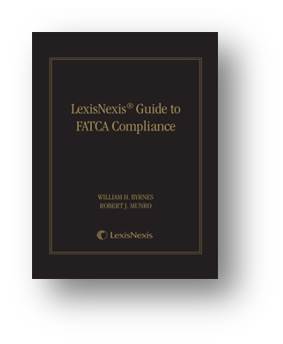
Over 400 pages of compliance analysis !! now available with the 20% discount code link in this flier –> LN Guide to FATCA_flier.
The LexisNexis® Guide to FATCA Compliance was designed in consultation, via numerous interviews and meetings, with government officials, NGO staff, large financial institution compliance officers, investment fund compliance officers, and trust companies, in consultation with contributors who are leading industry experts. The contributors hail from several countries and an offshore financial center and include attorneys, accountants, information technology engineers, and risk managers from large, medium and small firms and from large financial institutions. A sample chapter from the 25 is available on LexisNexis: http://www.lexisnexis.com/store/images/samples/9780769853734.pdf
 Contributing FATCA Expert Practitioners
Kyria Ali, FCCA is a member of the Association of Chartered Certified Accountants (“ACCA”) of Baker Tilly (BVI) Limited.
Michael Alliston, Esq. is a solicitor in the London office of Herbert Smith Freehills LLP.
Ariene d’Arc Diniz e Amaral, Adv. is a Brazilian tax attorney of Rolim, Viotti & Leite Campos Advogados.
Maarten de Bruin, Esq. is a partner of Stibbe Simont.
Jean-Paul van den Berg, Esq. is a tax partner of Stibbe Simont.
Amanda Castellano, Esq. spent three years as an auditor with the Internal Revenue Service.
Luzius Cavelti, Esq. is an associate at Tappolet & Partner in Zurich.
Bruno Da Silva, LL.M. works at Loyens & Loeff, European Direct Tax Law team and is a tax treaty adviser for the Macau special administrative region of the People’s Republic of China.
Prof. J. Richard Duke, Esq. is an attorney admitted in Alabama and Florida specializing over forty years in income and estate tax planning and compliance, as well as asset protection, for high net wealth families. He served as Counsel to the Ludwig von Mises Institute for Austrian Economics 1983-1989.
Dr. Jan Dyckmans, Esq. is a German attorney at Flick Gocke Schaumburg in Frankfurt am Main.
Arne Hansen is a legal trainee of the Hanseatisches Oberlandesgericht (Higher Regional Court of Hamburg), Germany.
Mark Heroux, J.D. is a Principal in the Tax Services Group at Baker Tilly who began his career in 1986 with the IRS Office of Chief Counsel.
Rob. H. Holt, Esq. is a practicing attorney of thirty years licensed in New York and Texas representing real estate investment companies.
Richard Kando, CPA (New York) is a Director at Navigant Consulting and served as a Special Agent with the IRS Criminal Investigation Division where he received the U.S. Department of Justice – Tax Division Assistant Attorney General’s Special Contribution Award.
Denis Kleinfeld, Esq., CPA. is a renown tax author over four decades specializing in international tax planning of high net wealth families. He is Of Counsel to Fuerst Ittleman David & Joseph, PL, in Miami, Florida and was employed as an attorney with the Internal Revenue Service in the Estate and Gift Tax Division.
Richard L. Knickerbocker, Esq. is the senior partner in the Los Angeles office of the Knickerbocker Law Group and the former City Attorney of the City of Santa Monica.
Saloi Abou-Jaoude’ Knickerbocker Saloi Abou-Jaoude’ Knickerbocker is a Legal Administrator in the Los Angeles office of the Knickerbocker Law Group concentrated on shari’a finance.
Jeffrey Locke, Esq. is Director at Navigant Consulting.
Josh Lom works at Herbert Smith Freehills LLP.
Prof. Stephen Polak is a Tax Professor at Thomas Jefferson School of Law’s International Tax & Financial Services Graduate Program where he lectures on Financial Products, Tax Procedure and Financial Crimes. As a U.S. Senior Internal Revenue Agent, Financial Products and Transaction Examiner he examined exotic financial products of large multi-national corporations. Currently, Prof. Polak is assigned to U.S. Internal Revenue Service’s three year National Research Program’s as a Federal State and Local Government Specialist where he examines states, cities, municipalities, and other governmental entities.
Dr. Maji C. Rhee is a professor of Waseda University located in Tokyo.
Jean Richard, Esq. a Canadian attorney, previously worked for the Quebec Tax Department, as a Senior Tax Manager with a large international accounting firm and as a Tax & Estate consultant for a pre-eminent Canadian insurance company. He is currently the Vice President and Sr. Wealth Management Consultant of the BMO Financial Group.
Michael J. Rinaldi, II, CPA. is a renown international tax accountant and author, responsible for the largest independent audit firm in Washington, D.C.
Edgardo Santiago-Torres, Esq., CPA, is also a Certified Public Accountant and a Chartered Global Management Accountant, pursuant to the AICPA and CIMA rules and regulations, admitted by the Puerto Rico Board of Accountancy to practice Public Accounting in Puerto Rico, and an attorney.
Hope M. Shoulders, Esq. is a licensed attorney in the State of New Jersey whom has previously worked for General Motors, National Transportation Safety Board and the Department of Commerce.
Jason Simpson, CAMS is the Director of the Miami office for Global Atlantic Partners, overseeing all operations in Florida, the Caribbean and most of Latin America. He has worked previously as a bank compliance employee at various large and mid-sized financial institutions over the past ten years. He has been a key component in the removal of Cease and Desist Orders as well as other written regulatory agreements within a number of Domestic and International Banks, and designed complete AML units for domestic as well as international banks with over three million clients.
Dr. Alberto Gil Soriano, Esq. worked at the European Commission’s Anti-Fraud Office in Brussels, and most recently at the Legal Department of the International Monetary Fund’s Financial Integrity Group in Washington, D.C. He currently works at the Fiscal Department of Uría Menéndez Abogados, S.L.P in Barcelona (Spain).
Lily L. Tse, CPA. is a partner of Rinaldi & Associates (Washington, D.C.).
Dr. Oliver Untersander, Esq. is partner at Tappolet & Partner in Zurich.
Mauricio Cano del Valle, Esq. is a Mexican attorney who previously worked for the Mexican Ministry of Finance (Secretaría de Hacienda) and Deloitte and Touche Mexico. He was Managing Director of the Amicorp Group Mexico City and San Diego offices, and now has his own law firm.
John Walker, Esq. is an accomplished attorney with a software engineering and architecture background.
Bruce Zagaris, Esq. is a partner at the Washington, D.C. law firm Berliner, Corcoran & Rowe, LLP.
Prof. William Byrnes was a Senior Manager then Associate Director at Coopers & Lybrand, before joining academia wherein he became a renowned author of 38 book and compendium volumes, 93 book & treatise chapters and supplements, and 800+ articles. He is Associate Dean of Thomas Jefferson School of Law’s International Taxation & Financial Services Program.
Dr. Robert J. Munro is the author of 35 published books is a Senior Research Fellow and Director of Research for North America of CIDOEC at Jesus College, Cambridge University, and head of the anti money laundering studies of Thomas Jefferson School of Law’s International Taxation & Financial Services Program.
Posted in Compliance, Estate Tax, Financial Crimes, information exchange, Money Laundering, OECD, Reporting, Tax Policy, Taxation, Wealth Management | Tagged: Compliance, FATCA, Internal Revenue Service, LexisNexis, tax, Tax Evasion, tax reporting | 1 Comment »
Posted by William Byrnes on January 2, 2013
In the first moments of 2013, Congress eased the fiscal cliff tax increases for taxpayers earning less than $450,000 by enacting the American Taxpayer Relief Act (Act), permanently extending the Bush-era income tax cuts for this group. … While the legislation extends the current income tax rates for taxpayers earning less than $450,000 ($400,000 for single filers) per year, it allowed the Bush-era tax cuts to expire for all higher-income taxpayers. Similarly, taxes on capital gains, dividends, and estates were increased for the wealthiest taxpayers.
How Were Income Taxes Increased by the Fiscal Cliff Compromise?
How Does the Act Impact the Current System for Tax Deductions and Exemptions?
Were Capital Gains and Dividend Rates Impacted by the Act?
How Are Estate and Gift Tax Rates Affected?
What Other Changes Were Made?
Beyond the Act: What is the “Investment Income Tax”?
Planning Under the Act: How Should Clients Plan for Higher Taxes in 2013?
Read the analysis at National Underwriters’ Advanced Markets – http://nationalunderwriteradvancedmarkets.com/articles/fc010113-a.aspx?action=16
Posted in Estate Tax, Retirement Planning, Tax Policy, Taxation, Wealth Management | Tagged: Bush Tax Cuts, Capital gain, fiscal cliff, Fiscal conservatism, income tax, tax, Tax rate, United States, United States Congress | Leave a Comment »
Posted by William Byrnes on December 17, 2012
Your small business clients are faced with the increasing likelihood of higher taxes in 2013 and beyond; those aiming to reduce the slope of the fiscal cliff next year will want to take a closer look at the benefits of a defined benefit plan. …. read our strategy article at http://www.advisorone.com/2012/12/13/fully-funded-retirement-in-10-years-a-db-plan-for
Posted in Retirement Planning, Uncategorized, Wealth Management | Tagged: Business, Compensation and Benefits, Defined benefit pension plan, Employment, Human Resources, Pension, Retirement, Small business | Leave a Comment »
Posted by William Byrnes on December 5, 2012
2013 Tax Facts on Investments in PRINT and E-Book format  provides clear, concise answers to often complex tax questions concerning investments. Pertinent planning points are provided throughout.
Organized in a convenient Q&A format to speed you to the information you need, 2013 Tax Facts on Investments delivers the latest guidance on:
- Mutual Funds, Unit Trusts, REITs
- Incentive Stock Options
- Options & Futures
- Real Estate
- Stocks, Bonds
- Oil & Gas
- Precious Metals & Collectibles
- And much more!
Key updates for 2013:
- New section on captive insurance
- New section on reverse mortgages
- Expanded section on ETFs
- Expanded section on precious metals & collectibles
- More than 30 new Planning Points, written by practitioners for practitioners, in the following areas:
- Real Estate
- Limited Partnerships
- Stocks
- Interest and Expenses
- Options
- Mutual Funds
Posted in Estate Tax, Retirement Planning, Taxation, Trusts, Wealth Management | Tagged: 2013 Tax Facts, Business, Economy, Exchange-traded fund, futures real estate, incentive stock options, Investing, Investment, Mutual fund, Precious metal, Real estate investment trust, real estate limited partnerships, stocks bonds, tax, Wealth Management | Leave a Comment »
Posted by William Byrnes on December 3, 2012
After expenses covered by Medicare are taken into account, many of your clients retiring this year are likely to incur about $240,000 per couple in out-of-pocket health care expenses during retirement. … You may be able to alleviate the retiree health-expense problem by using guaranteed income annuities or life insurance alternative funding solutions.
Posted in Insurance, Pensions, Retirement Planning, Wealth Management | Tagged: life insurance, medical expenses, Retirement planning | Leave a Comment »
Posted by William Byrnes on November 30, 2012
An increasing number of your clients are facing the novel possibility of choosing a lump sum payout from their pensions instead of the traditional annuity option. See the full article at –http://www.lifehealthpro.com/2012/08/16/when-clients-get-lump-sum-pension-offers-what-to-a
Posted in Insurance, Pensions, Taxation, Wealth Management | Tagged: Life annuity, Pension, Retirement, Retirement planning | Leave a Comment »
Posted by William Byrnes on November 28, 2012
One question financial advisors are asking themselves today is whether life settlements have returned to the fold as a viable tool in their clients’ planning strategies. Read the entire article at http://www.lifehealthpro.com/2012/09/05/life-settlements-are-they-back
Posted in Insurance, Retirement Planning, Taxation, Wealth Management | Tagged: life settlements, Retirement, Retirement planning | Leave a Comment »
Posted by William Byrnes on November 21, 2012

http://www.nationalunderwriter.com/2013-tax-facts-on-insurance-employee-benefits-269.html
Organized in a convenient Q&A format to speed you to the information you need, 2013 Tax Facts on Insurance & Employee Benefits delivers the latest guidance on:
- Estate & Gift Tax Planning
- Roth IRAs
- HSAs
- Capital Gains, Qualifying Dividends
- Non-qualified Deferred Compensation Under IRC Section 409A
- And much more!
Key updates for 2013:
- Enhanced explanation of the Disclosure Regulations for Retirement Plan Service Providers
- Expanded section on the taxation of annuities
- More than 30 new Planning Points, written by practitioners for practitioners, in the following areas:
- Life Insurance
- Health Insurance
- Federal Income Taxation
- Estate Taxation
Plus, you’re kept up-to-date with online supplements for critical developments.
Posted in Estate Tax, Pensions, Retirement Planning, Taxation, Wealth Management | Tagged: Capital gain, Deferred compensation, estate planning, Internal Revenue Code section 409A, life insurance, Pension, Roth, Roth IRA, tax | Leave a Comment »
Posted by William Byrnes on November 21, 2012
For your clients who have been playing the wait-and-see game in estate planning this year, the time for waiting is over. Absent congressional action, the current $5.12 million exemption will revert to $1 million in less than three months, and the current 35% maximum estate tax rate will jump to 55%. The entire article is available at http://www.lifehealthpro.com/2012/10/17/the-ticking-estate-tax-time-bomb-less-than-90-days
Posted in Estate Tax, Pensions, Retirement Planning, Taxation, Trusts, Wealth Management | Tagged: estate planning, Inheritance tax, tax, Tax exemption | Leave a Comment »
Posted by William Byrnes on November 19, 2012
…insurance companies have begun building annuity products in a variety of shapes and sizes, and the latest crop of deferred income annuity products could pave the way for clients seeking to maximize retirement income security in the years leading up to retirement. Read the full article on AdvisorOne – http://www.advisorone.com/2012/11/08/how-new-deferred-annuities-provide-income-early-in
Posted in Estate Tax, Pensions, Retirement Planning, Taxation, Wealth Management | Tagged: annuities, Financial services, insurance, Life annuity, Pension, Retirement, tax | Leave a Comment »
Posted by William Byrnes on November 15, 2012

Tax (Photo credit: 401(K) 2012)
With the election behind us, it is time for your clients to turn their attention to the looming tax reforms that should take shape over the next two months, and how these reforms can affect their retirement planning. Both arms of Congress will be working to reach a compromise on tax code provisions as basic as income tax rates before Jan. 1, after which the Bush-era tax cuts will expire, and rates could revert to pre-2001 levels.
Though President Obama spent little time discussing his views on tax-favored retirement accounts during his campaign, the plans he did set forth are indicative of the consequences for retirement savings. While this impact may not be immediately apparent to your clients, it is something that they need to consider as they plan for retirement this year and beyond. See the full article on National Underwriters’ Life Health Pro http://www.lifehealthpro.com/2012/11/13/retirement-planning-for-the-next-4-years-under-pre
Posted in Estate Tax, Tax Policy, Taxation, Wealth Management | Tagged: Barack Obama, Retirement, Social Security, tax | Leave a Comment »
Posted by William Byrnes on March 26, 2012
Want some free marketing material for your annuities business? Look no further than the U.S. Government Accountability Office (GAO), which recently released a report touting annuities for their ability to provide retirement income sufficiency in an increasingly uncertain environment.
The GAO recommends that retirees delay their receipt of Social Security Benefits and either draw down savings and purchase an annuity or select annuity options from their defined benefit (DB) plan instead of electing to receive their benefits in a lump sum.
According to the GAO, the shift from defined benefit pension plans to defined contribution (DC) plans like 401(k)s necessitates a heightened focus on annuities and other options for guaranteeing income during retirement . And even if workers are saving more for retirement through their DC plans, they are still at greater risk than employees with DB pensions.
Read this complete analysis of the impact at AdvisorFX (sign up for a free trial subscription with full access to all of the planning libraries and client presentations if you are not already a subscriber).
For previous coverage of annuities in Advisor’s Journal, see How Much to Allocate to Annuities: A Critical Analysis (CC 11-109) & Drama Over the “Drawbacks” of Annuities (CC 11-62).
For in-depth analysis of the taxation of annuities, see Advisor’s Main Library: A—Amounts Received As An Annuity & B—Amounts NOT Received As Annuities.
Posted in Wealth Management | Tagged: 401(k), Defined benefit pension plan, GAO, Government Accountability Office, Life annuity, Pension, Retirement, Social Security | Leave a Comment »
Posted by William Byrnes on March 23, 2012
Treasury Secretary Tim Geithner insists that the administration needs to reach a debt limit deal by the end of this week to give Congress enough time to enact the deal into law. Without a deal, the federal government will be unable to pay its debts as of August 2 of this year.
“Default is not an option,” he said on Tuesday, July 12, at the Treasury’s Women in Finance Symposium. “Failure is not an option, and they understand that—Speaker [John] Boehner and Minority Leader [Mitch] McConnell—absolutely understand we need to move in advance of the deadline on Aug. 2nd.”
Despite Geithner’s confidence that they will reach a deal, President Obama and Congressional leaders are also working on options for keeping the government’s bills paid if a deal can’t be reached by the Treasury’s August 2 debt limit deadline. “If we are unable to come together, we think it’s extremely important that the country reassure the markets that default is not an option and reassure Social Security recipients and families of military veterans that default is not an option,” said Mitch McConnell (R-K.Y.), who took part in the talks.
Read this complete analysis of the impact at AdvisorFX (sign up for a free trial subscription with full access to all of the planning libraries and client presentations if you are not already a subscriber).
For previous coverage in Advisor’s Journal, see Democrats Call Debt Limit Unconstitutional (CC 11-134), Debt Limit Standoff Boils Over (CC 11-115) and Storm Clouds over U.S. Debt (CC 11-85).
Posted in Wealth Management | Tagged: Barack Obama, Default (finance), John Boehner, Mitch McConnell, Timothy Geithner, United States Congress, United States public debt, United States Secretary of the Treasury | 1 Comment »
Posted by William Byrnes on March 21, 2012
Partners in a partnership and members of an LLC, taxed as a partnership, cannot have individual SEP IRAs (Simplified Employee Pension Individual Retirement Account) plans, according to the IRS.
Only employers are capable of implementing SEP plans for their employees. Because partners are employees of the partnership for retirement plan purposes, they cannot have an individual SEP plan. If partners in a partnership wish to use a SEP plan, the partnership as an entity must maintain and contribute to the plan for the partners.
Read this complete analysis of the impact at AdvisorFX (sign up for a free trial subscription with full access to all the planning libraries and client presentations if you are not already a subscriber).
For previous coverage of IRAs in Advisor’s Journal, see Qualified Charitable Distributions from an IRA (CC 11-03) & How Are IRA Owners Investing Their Money? (CC 11-112).
For in-depth analysis of SEPs, see Advisor’s Main Library: IRAs and SEPs.
Posted in Wealth Management | Tagged: 401(k), Business, Employment, Individual Retirement Account, Internal Revenue Service, Pension, Roth IRA, SEP-IRA | Leave a Comment »
Posted by William Byrnes on March 19, 2012
Looking to recapture its competitiveness in the domestic captive insurance business, Nevada passed Assembly Bill 74 (AB 74), which amends the state’s captive insurance law. Nevada Governor Brian Sandoval recently praised the amendment, saying it that “will make Nevada a more attractive place to do business for captive insurers.”
Generally, a captive insurance company forms as a subsidiary of a company to cover the risks of the parent company and its other subsidiaries. A captive insurance company typically does not insure risks of unrelated third parties—although some will insure their customers’ risks. Other captive insurers assume the risks of members of a trade association or group.
Read this complete analysis of the impact at AdvisorFX (sign up for a free trial subscription with full access to all of the planning libraries and client presentations if you are not already a subscriber).
For previous coverage of the application of the Health Care law to captive provided health insurance, see Tax Facts, see 252. What nondiscrimination requirements apply to employer provided health benefits?.
Questions about Captives? Contact our Panel of Experts. Benjamin Terner is our “Captive Expert” and can answer your questions relating to domestic and offshore arrangements
Posted in Wealth Management | Tagged: Brian Sandoval, Captive, Captive insurance, Financial services, insurance, Nevada, risk management, Trade association | Leave a Comment »
Posted by William Byrnes on March 16, 2012
Long-term gains yield more favorable tax costs than short-term gains. Short-term gains carry an additional 20% tax cost over long-term gains, encouraging the manufacturing of transactions designed to convert short-term to long-term gains. Unfortunately, these transactions attract undue attention from the IRS and are often disregarded by the Service. The IRS recently considered the tax treatment of one of these gain-recharacterization schemes, a basket option contract, in a generic legal advice memorandum (AM 2010-005).
The IRS altered its categorization of the contract, viewing it as if the investor purchased the securities in a margin account, paying cash equal to 10% of the value of the securities and borrowing 90% of the value from the investment bank. Just as was the case with the “option,” the investor had almost total control over investment of the securities and would reap all appreciation and income from the securities, less interest and brokerage fees.
Read this complete analysis of the impact at AdvisorFX (sign up for a free trial subscription with full access to all of the planning libraries and client presentations if you are not already a subscriber).
For in-depth analysis of options, see Advisor’s Main Library: G—Options and Futures.
Posted in Wealth Management | Tagged: Futures, Futures contract, Internal Revenue Service, IRS, Options, Recharacterisation, Security (finance), tax | Leave a Comment »
Posted by William Byrnes on March 6, 2012
A massive increase of lawsuits and IRS investigations have surrounded the Millennium Multiple Employer Welfare Benefit Plan for years, with plan participants claiming it was nothing but a fraudulent device with sole purpose of generating millions in commissions for its agent promoters. There are accusations of taking a total of $500 million from 500 clients by inducing them to participate in a plan that offered no tax or other benefits to its participants.
Several lawsuits are still pending against the Millennium Plan, but at least one aspect of the alleged scam plan has been resolved. The IRS announced on July 5 that it reached an agreement with the Millennium Multiple Employer Welfare Benefit Plan (“Millennium Plan”). After numerous fraud allegations and the IRS abusive tax shelter investigation, the Millennium Plan filed for Chapter 11 bankruptcy.
Read this complete analysis of the impact at AdvisorFX (sign up for a free trial subscription with full access to all of the planning libraries and client presentations if you are not already a subscriber).
For previous coverage of welfare benefits plans in Advisor’s Journal, see Tax Courts Holds Employee Taxable for Value of Life Insurance Owned by Welfare-Benefit & Deductions for Life Insurance Premium Payments to Welfare Benefit Plan Denied (CC 10-29).
Posted in Wealth Management | Tagged: Employment, insurance, Internal Revenue Service, IRS, Millennium Plan, tax, Tax shelter, Welfare | Leave a Comment »
Posted by William Byrnes on February 21, 2012
The August 2 debt ceiling drop-dead date is less than a month away, and some Democrats are proposing a radical solution to the problem: Ignore it. They argue that the U.S. Constitution allows the President to simply ignore the debt ceiling and pay the federal government’s bills.
Democrats and commentators in favor of ignoring the limit cite section 4 of the 14th Amendment to the U.S. Constitution, which says, “The validity of the public debt of the United States, authorized by law, including debts incurred for payment of pensions…, shall not be questioned.”
They argue that the U.S. government is bound by the Constitution to pay its bills and won’t be able to do so if the debt ceiling is respected. As a result, the law creating the debt ceiling is unconstitutional in this particular scenario because it would force the federal government to violate a provision of the U.S. Constitution. Taking on new debt isn’t just about future spending. A significant amount of any cash generated by a new debt issue is needed to service existing debt.
In short, default is unconstitutional, and the debt ceiling is unconstitutional to the extent it restricts the President from following the Constitution’s requirements.
Read this complete analysis of the impact at AdvisorFX (sign up for a free trial subscription with full access to all of the planning libraries and client presentations if you are not already a subscriber).
Posted in Wealth Management | Tagged: Constitutionality, Debt, Democratic Party (United States), Federal government of the United States, United State, United States Constitution, United States public debt, US Constitution | Leave a Comment »
Posted by William Byrnes on February 7, 2012
Are you an employee or independent contractor of your firm? If you’re doing business in California and get the classification wrong, you could be in for criminal charges and up to a $25,000 fine.
California State Bill 459—which would impose strict recordkeeping requirements and severe penalties on firms that misclassify employees as independent contractors—passed the state senate on June 2. The bill moved to the Assembly and went on to a hearing at the Assembly Committee on Labor and Employment two weeks later. The bill is expected to come to a vote in the Assembly later this summer.
Under the bill, firms that mischaracterize employees as independent contractors can be subject to fines of up to $25,000. They also will be required to keep records verifying independent contractor status for at least two years or face a fine of $500 per employee and misdemeanor criminal charges.
Read this complete analysis of the impact at AdvisorFX (sign up for a free trial subscription with full access to all of the planning libraries and client presentations if you are not already a subscriber).
For in-depth analysis of income taxation, see Advisor’s Main Library: Income Taxes.
Posted in Wealth Management | Tagged: Business, California, Employment, independent contractor, Internal Revenue Service, law, Self-employment, Vocus | Leave a Comment »
Posted by William Byrnes on February 2, 2012
The Domestic Asset Protection Trust (DAPT) is the onshore response to concerns surrounding offshore asset protection vehicles, but are the onshore and offshore varieties of asset protection equivalent? Despite the surface similarities between DAPTs and asset protection vehicles based in the Caribbean and other offshore hotspots, the degree of creditor protection offered by them can be very different.
After a brief discussion of the history of DAPTs, this article examines the battle tactics used by creditors to break DAPTs and access trust assets.
Read this complete analysis of the impact at AdvisorFX (sign up for a free trial subscription with full access to all of the planning libraries and client presentations if you are not already a subscriber).
For previous coverage of DAPTs in Advisor’s Journal, see Domestic Asset Protection Trusts: New Chart Ranks the States (CC 10-30) & The Spendthrift Clause (CC 09-32).
For in-depth analysis of DAPTs, see Advisor’s Main Library: G—Domestic Asset Protection Trusts.
Posted in Wealth Management | Tagged: Asset protection, Asset-protection trust, Business, Caribbean, Creditor, DAPT, Financial services, United States | Leave a Comment »
Posted by William Byrnes on January 11, 2012
The Financial Industry Regulatory Authority (FINRA) is targeting structured products over concerns about unsuitable sales to retail customers. In an exclusive interview with AdvisorOne (a Summit Business Media product) Bradley Bennett, enforcement chief at FINRA, said that the agency’s caseload on the recent financial crisis has eased up, and the agency is ready to renew its focus on structured products.
Structured products are often marketed to retail customers without an adequate explanation of their associated risks. “They purport to give the alchemy of lowering risk while increasing yield,” Bennett said, “but the risk needs to be explained” both to the broker-dealer’s “sales force and customers, and be suitable given the customer’s financial circumstances.”
Read this complete analysis of the impact at AdvisorFX (sign up for a free trial subscription with full access to all the planning libraries and client presentations if you are not already a subscriber).
For previous coverage of structured products in Advisor’s Journal, see SEC Warns Investors about Principal Protected Notes (CC 11-117).
For in-depth analysis of structured products, see Advisor’s Main Library: 7774. What is a structured product? How are structured products taxed?
Posted in Wealth Management | Tagged: AdvisorOne, Broker-dealer, Business, Financial Industry Regulatory Authority, FINRA, Investment Advisor, Structured product, Summit Business Media | Leave a Comment »
Posted by William Byrnes on January 10, 2012
As anticipated, the SEC will delay implementation of the RIA transition. On June 22, the SEC approved rules that will transition thousands of advisors from SEC to state regulation, but the new rules won’t be effective until June 28, 2012, almost a year later than initially expected.
Under the regulatory structure in place before the enactment of the Dodd-Frank Wall Street Reform and Consumer Protection Act, investment advisors with $25 million or more in assets under management (AUM) were regulated by the SEC, and those with less than $25 million in AUM were regulated by the states. Dodd-Frank changed the registration threshold so that advisors with between $25 and $100 million in AUM—so-called “midsize advisors”—will be required to withdraw their registration from the SEC and register with state regulators.
Read this complete analysis of the impact at AdvisorFX (sign up for a free trial subscription with full access to all the planning libraries and client presentations if you are not already a subscriber).
For previous coverage of the planned switch and in Advisor’s Journal, see Disarray at the SEC is Complicating the “Switch” (CC 11-83), Hedge Funds Must Now Register with the SEC under the New Wall Street Reform Act (CC 10-45) & Dodd-Frank Wall Street Reform and Consumer Protection Act (CC 10-35).
Posted in Wealth Management | Tagged: Consumer Protection Act, Dodd-Frank, Dodd–Frank Wall Street Reform and Consumer Protection Act, Hedge fund, Registered Investment Advisor, Regulation, SEC, Wall Street | Leave a Comment »
Posted by William Byrnes on January 3, 2012
You’ve been on a few “dates,” and you talk on the phone every couple weeks, but how well do your prospects and existing clients know you and understand your core personal investing philosophy? Small talk breaks down barriers and common interests keep the conversation moving, but taking the advisor-client relationship to the next level takes some work—and a lot of research. A recent survey gives us a head start by elucidating the communication divide that holds many advisors back from taking the big plunge with their prospects.
The survey found that HNW clients favor electronic communication media more than their advisors. Twice as many millionaires than advisors would like to use technology-enabled media—smart phone applications and social media. While 85% of millionaires are willing to communicate through social-media, e-mail, and text messages, only 43% of brokers and financial advisors share that willingness. And your millionaire clients are also more likely to use LinkedIn than you are (28% to 16%). And a third of millionaires already use social media in general as part of their professional life.
Read this complete analysis of the impact at AdvisorFX (sign up for a free trial subscription with full access to all the planning libraries and client presentations if you are not already a subscriber).
For other client development discussions in Advisor’s Journal, see Advisors’ Stairsteps of Influence (CC 11-49), Getting Your Feet Wet in the Social Media Market (CC 11-79) & Are Portfolios-To-Go Threatening Your Business? (CC 11-77).
Posted in Wealth Management | Tagged: Business, Communication, Facebook, Financial adviser, Financial services, LinkedIn, Marketing and Advertising, Social media | Leave a Comment »
Posted by William Byrnes on December 22, 2011
In a merciful move, the Treasury has again extended the FBAR filing deadline for persons with only signature authority over a foreign financial account to November 1, 2011. [Notice 2011-54]. Two previous extensions had pushed the FBAR due date to June 30, 2011, but the Financial Crimes Enforcement Network (FinCEN) and the IRS recognized the difficulty signatories were having locating the information they needed to complete the form.
Form TD F 90-22.1, Report of Foreign Bank and Financial Accounts (FBAR), must be filed annually by all U.S. citizens, residents, business entities, trusts, and estates with a financial interest in or signature authority over one or more foreign financial accounts (FFA) with an aggregate value greater than $10,000.
Read this complete analysis of the impact at AdvisorFX (sign up for a free trial subscription with full access to all of the planning libraries and client presentations if you are not already a subscriber).
For previous coverage of the FBAR in Advisor’s Journal, see Do Your Clients’ International Assets Create Criminal Tax Exposure? (CC 11-73) & IRS Provides FBAR Answers (CC 11-119).
Posted in Wealth Management | Leave a Comment »
Posted by William Byrnes on December 20, 2011
The Foreign Account Tax Compliance Act (FATCA) was designed as a comprehensive measure to combat offshore tax evasion—a noble aim. However, FATCA’s comprehensiveness is also a burden for many in the financial services industry, especially insurance carriers and producers. In comments to regulators, one foreign life insurance trade organization, the Association of International Life Offices (AILO), recently called FATCA’s requirements “onerous and disproportionate to the risk involved.”
Passed as part of H.R. 2847, the Hiring Incentives to Restore Employment Act (HIRE Act) on March 18, 2010, FATCA combats tax evasion by requiring disclosure from foreign institutions about accounts held by people, including U.S. citizens, and institutions risk being subject to U.S. tax. Many life insurance and annuity contracts are classified “accounts” under the Act, although FATCA doesn’t generally apply to property, casualty, and term life insurance contracts.
Read this complete analysis of the impact at AdvisorFX (sign up for a free trial subscription with full access to all of the planning libraries and client presentations if you are not already a subscriber).
For previous coverage of FATCA in Advisor’s Journal, see IRS Proposed FATCA Guidance Expands Offshore Compliance Initiatives (CC 10-52) & Offshore’s Limited Shelf Life (CC 10-47).
Posted in Wealth Management | Tagged: FATCA, Financial services, Hiring Incentives to Restore Employment Act, insurance, Internal Revenue Service, tax, Tax avoidance and tax evasion, United States | Leave a Comment »
Posted by William Byrnes on November 30, 2011
Despite calls for private creditors to absorb some of the cost of another round of Greek bailouts, German Chancellor Angela Merkel has backed down. Merkel met with French President Nicolas Sarkozy in Berlin on June 17, 2011 to discuss the role of private investors in the bailout. Following the meeting, the leaders announced a unified plan to deal with the Greek crisis. Chancellor Merkel is still asking private creditors to voluntarily take part in the bailout.
The Greek debt crisis spans back to early 2010, when a group of European governments—including Greece—faced funding crises that threatened European stability altogether. At the time, Greece had €300 billion in debt, bigger than its economy.
Read this complete analysis of the impact at AdvisorFX (sign up for a free trial subscription with full access to all of the planning libraries and client presentations if you are not already a subscriber).
For coverage of the U.S. debt crisis in Advisor’s Journal, see Debt Limit Standoff Boils Over (CC 11-115) & Debt Ceiling Approaching: Prepare for Impact (CC 11-100).
Posted in Wealth Management | Tagged: Angela Merkel, Berlin, Chancellor of Germany, European sovereign debt crisis of 2010–present, European Union, Greece, Greek, Nicolas Sarkozy | Leave a Comment »
Posted by William Byrnes on November 29, 2011
In addition to confirming earlier beliefs, a new academic study about the effects of increase life-spans on savings rates has inspired new intrigue.
The conclusions reached by Optimal Retirement and Saving with Increasing Longevity, by David E. Bloom, David Canning, and Michael Moore are simple enough but need some further discussion: “[A] higher level of wages leads to earlier retirement and increasing savings rates. On the other hand an increase in life expectancy leads to an increase [in] the retirement age, but less than proportionately, while reducing savings rates.”
Consequently, the importance of planning for middle-income families increases. Without a solid plan, many are left working many more years than they hoped or planned.
Read this complete analysis of the impact at AdvisorFX (sign up for a free trial subscription with full access to all the planning libraries and client presentations if you are not already a subscriber).
For previous coverage of retirement values in Advisor’s Journal, see Appealing to Your Affluent Clients’ Retirement Planning Values (CC-11-42).
Posted in Wealth Management | Tagged: David E. Bloom, Health, Life expectancy, Michael Moore, Pension, Retirement, Retirement planning, Saving | Leave a Comment »
Posted by William Byrnes on November 28, 2011
Despite the best efforts of Congressional Republicans, the ribbon-cutting for the U.S. Consumer Financial Protection Bureau (CFPB) is on schedule for next month. And unlike other Dodd-Frank progeny, this project looks like it’s going to hit the ground running.
The stated mission of the CFPB is to “make markets for consumer financial products and services work for Americans—whether they are applying for a mortgage, choosing among credit cards, or using any number of other consumer financial products.” After the mortgage debacle of the recent financial crisis and stories about predatory practices in the credit card and pay-day loan industries, who can argue with that mission statement?
Read this complete analysis of the impact at AdvisorFX (sign up for a free trial subscription with full access to all the planning libraries and client presentations if you are not already a subscriber).
For previous coverage of the fight over Dodd-Frank in Advisor’s Journal, see Is Barney Frank’s Resolve to Implement Dodd-Frank Weakening? (CC 11-95) & Republicans Look to Erode Dodd-Frank (CC 11-75).
Posted in Wealth Management | Tagged: Barney Frank, CFPB, Credit card, Dodd-Frank, Dodd–Frank Wall Street Reform and Consumer Protection Act, Financial services, Republicans, United States | Leave a Comment »
Posted by William Byrnes on November 23, 2011
Generally, life insurance policies be withdrawn without income tax consequences. However, there are circumstances where a “loan” is immediately taxable. We have covered situations where a policy is surrendered with a loan outstanding, resulting in taxable income. This article discusses another case where a policy “loan” will be treated as taxable income.
In Frederick D. Todd II et ux. v. Commissioner (T.C. Memo. 2011-123), the Tax Court considered whether a distribution from a welfare benefit fund to a fund participant was a policy loan or a taxable distribution.
For previous coverage of life insurance policies held by welfare benefit funds in Advisor’s Journal, see Deductions for Life Insurance Premium Payments to Welfare Benefit Plan Denied (CC 10-29).
Read this complete analysis of the impact at AdvisorFX (sign up for a free trial subscription with full access to all of the planning libraries and client presentations if you are not already a subscriber).
For in-depth analysis of welfare benefit funds, see Advisor’s Main Library: B—Welfare Benefit Funds.
Posted in Wealth Management | Tagged: income tax, insurance, Insurance policy, Loan, Payment, tax, Taxable income, Welfare | Leave a Comment »
Posted by William Byrnes on November 18, 2011
In recent times, federal estate tax is receiving most of the attention. Nevertheless, most of the death tax activity affecting Americans occurs at the state level.
The reality is, fewer states (twenty-two plus D.C) currently have a “death tax”—referring collectively to estate and inheritance taxes. Recently, a number of those states increased their exemption amount to exclude a large majority of their residents from the tax. One state—Ohio—is on the verge of repealing its estate tax altogether.
Read this complete analysis of the impact at AdvisorFX (sign up for a free trial subscription with full access to all the planning libraries and client presentations if you are not already a subscriber).
For previous coverage of Obama’s tax agreement, including its estate tax provisions, in Advisor’s Journal, see Obama Tax Agreement Faces Stiff Resistance in Congress (CC 10-112) and Obama Tax Agreement Passed by House (CC 10-117).
Posted in Wealth Management | Tagged: Estate tax in the United States, Inheritance tax, Ohio, Politics, tax, Taxation, United States, United States Congress | 1 Comment »
Posted by William Byrnes on November 17, 2011
We are all aware that annuities have a bad reputation in the media: High fees, high-pressure sales, and unsuitability are the predominating themes.
A recent Securities Litigation & Consulting Group white paper summarizes the sentiments of the anti-annuity press, commenting that, “[a]nnuities stand out as the investment are most likely to be unsuitable since in virtually every instance, the investor would have been better served by mutual fund or a portfolio of individual stocks.”
Annuities are neither inherently “good” nor “bad.” It follows that rational evaluation of annuities can’t be conducted in a bubble—it must focus on their application. Herein lays their value and the coup de grâce the industry and individual producers have been awaiting.
Read this complete analysis of the impact at AdvisorFX (sign up for a free trial subscription with full access to all of the planning libraries and client presentations if you are not already a subscriber).
For previous coverage of annuities in Advisor’s Journal, see How Much to Allocate to Annuities: A Critical Analysis (CC 11-109).
For in-depth analysis of the income taxation of annuities, see Advisor’s Main Library: Section 19.2 Income Taxation of Annuities.
Posted in Wealth Management | Tagged: annuities, Business, Financial services, insurance, Investing, Life annuity, Mutual fund, White paper | Leave a Comment »
Posted by William Byrnes on November 11, 2011
Failure to file an FBAR (Report of Foreign Bank and Financial Accounts) can result in harsh consequences. The report is that fines of up to $500,000 and 10 years imprisonment can be rendered. Therefore, the need to for you and your clients with foreign financial accounts (FFAs) to familiarize yourselves with the Treasury’s escalating FBAR rules. Unfortunately, understanding the FBAR rules has not always been a straightforward proposition.
Until recently, the FBAR requirements were shrouded in mystery; but with the release of the last FBAR regulations earlier this year, the rules are finally clear. Furthermore, important clarifications were made by the IRS at a June 1 webcast.
Read this complete analysis of the impact at AdvisorFX (sign up for a free trial subscription with full access to all of the planning libraries and client presentations if you are not already a subscriber). For previous coverage of the FBAR in Advisor’s Journal, see Do Your Clients’ International Assets Create Criminal Tax Exposure? (CC 11-73).
Posted in Wealth Management | Tagged: Bank Secrecy Act, FBAR, Internal Revenue Service, Report of Foreign Bank and Financial Accounts, tax, Treasury, United States, United States Treasury Department | Leave a Comment »
Posted by William Byrnes on November 8, 2011
Last year Congress finally concluded about whether indexed annuities are securities. As a security, indexed annuities were subject to regulation by the SEC by including a provision in the in the Dodd-Frank Wall Street Reform Act that defines indexed annuities as insurance products outside the agency’s jurisdiction.
This year, some states are refusing to take Congress’s “NO” for an answer. In the latest action on the issue, Illinois Secretary of State Jesse White issued an order on May 24 indirectly concluding that indexed annuities are securities under Illinois law.
Read this complete analysis of the impact at AdvisorFX (sign up for a free trial subscription with full access to all the planning libraries and client presentations if you are not already a subscriber).
For previous coverage of indexed annuities in Advisor’s Journal, see Indexed Annuities: Still Insurance (CC 10 42).
Posted in Wealth Management | Tagged: Congress, Illinois, insurance, Jesse White, Life annuity, Pension, Retirement, Wall Street | Leave a Comment »
Posted by William Byrnes on November 3, 2011
In a low-interest rate world, high-yield investments offering principal protection are enticing to investors. But the complexity of some high-end investment products has the Financial Industry Regulatory Authority (FINRA) and Securities and Exchange Commission’s (SEC) warning investors to look before they leap.
In an alert titled Structured Notes with Principal Protection: Note the Terms of Your Investment, the regulators warn investors that these structured products may not be what they seem. Although they are marketed under a variety of names with a “principal protection” component—e.g. “absolute return” and “minimum return”—the true extent of their safety is never obvious . Investors need to read the fine print to decide whether they are suitable for their investing needs and risk tolerance.
Read this complete analysis of the impact at AdvisorFX (sign up for a free trial subscription with full access to all the planning libraries and client presentations if you are not already a subscriber).
Posted in Wealth Management | Tagged: Business, Financial Industry Regulatory Authority, FINRA, Investor, SEC, Securities and Exchange Commission, Structured product, U.S. Securities and Exchange Commission | Leave a Comment »
Posted by William Byrnes on October 31, 2011
The Dodd-Frank Wall Street Reform and Consumer Protection Act (Dodd-Frank) was endorsed by President Obama as an asset providing the “strongest consumer financial protections in history.” However, almost a year after the Act was introduced, implementation of its broad reforms is slowing
The complexity of the Act is the root of it’s first problem: The bill came in at an overwhelming 2,319 pages, or 300,000 words, about half the length of the entire Christian Bible. By comparison, other paradigm-shifting financial acts were short-stories; the Federal Reserve Act was 31 pages, Glass-Steagall was 37 pages, and Sarbanes-Oxley was 66 pages long. Even the gargantuan Health Reform Act was shorter than Dodd-Frank. Consequently, even the Federal government can’t fully ascertain the Act.
Read this complete analysis of the impact at AdvisorFX (sign up for a free trial subscription with full access to all of the planning libraries and client presentations if you are not already a subscriber).
For previous coverage of the debt limit fight in Advisor’s Journal, see Storm Clouds over U.S. Debt (CC 11-85).
Posted in Taxation, Uncategorized, Wealth Management | Tagged: Barack Obama, Dodd-Frank, Dodd–Frank Wall Street Reform and Consumer Protection Act, Federal government, Federal Reserve Act, Glass–Steagall Act, Obama, Wall Street reform | Leave a Comment »
Posted by William Byrnes on October 26, 2011
Life insurance is a common tool for ensuring estates have adequate liquidity to pay estate expenses and taxes. But recent changes to the estate tax have some people questioning whether the high premiums they’re paying are worth it when their estates are no longer likely to be hit by the estate tax.
With a $5 million exclusion amount and brand-new exclusion portability provisions, far fewer households have to deal with the federal estate tax. But is allowing unneeded life insurance to lapse the best solution?
Read this complete analysis of the impact at AdvisorFX (sign up for a free trial subscription with full access to all of the planning libraries and client presentations if you are not already a subscriber).
For previous coverage of life insurance valuation in Advisor’s Journal, see Relative Policy Value of Life Insurance (CC 11-57).
Posted in Wealth Management | Tagged: Agents and Marketers, Business, Financial services, insurance, Insurance policy, Life, life insurance, tax | Leave a Comment »
Posted by William Byrnes on October 21, 2011
As an advisor, your clients look to you for competent advice in planning their charitable giving. It would be terrible to find out that the gift you thoughtful suggest cannot be deducted due to an avoidable paperwork mistake. Although the IRS sometimes forgives these minor errors, others are unforgivable, as illustrated in recent IRS email advice.
The IRS was not so forgiving with a taxpayer, who made what would otherwise qualify as a tax-deductible charitable gift. The problem was that the taxpayer “failed to get a contemporaneous written acknowledgment” from the charitable organization. In its advice the IRS said it will deny the taxpayer’s charitable deduction even if the taxpayer takes remedial measures and the charity amends its Form 990 (Return of Organization Exempt from Income Tax) to acknowledge the donation and include the information required by the Code.
Read this complete analysis of the impact at AdvisorFX (sign up for a free trial subscription with full access to all the planning libraries and client presentations if you are not already a subscriber).
For previous coverage of charitable deductions in Advisor’s Journal, see Qualified Charitable Distributions from an IRA (CC 11-03) & IRS Takes Qualified IRA Charitable Distributions off the Table for 2010 (CC 11-15).
For in-depth analysis of the charitable deduction under Section 170, see Advisor’s Main Library: B6—The Income Tax Charitable Deduction—I.R.C. §170.
Posted in Tax Policy, Taxation, Wealth Management | Tagged: Charitable organization, income tax, Internal Revenue Code, Internal Revenue Service, IRS, IRS tax forms, Standard deduction, tax | Leave a Comment »


 Annuity products are one area in which trends in contract features are constantly changing as insurance companies endeavor to more effectively meet the needs of annuity investors and with the attendant problem that beneficiaries of inherited annuities could end up with antiquated investment products.
 William Byrnes' Tax, Wealth, and Risk Intelligence