Posted by William Byrnes on July 30, 2013
Searching for some good examples of American populist rhetoric to amuse a Law and Economics class, I re-stumbled upon William Jennings Bryan’s “Cross of Gold” speech. For my non-U.S. students, the “Cross of Gold” speech is heralded as one of the best rhetorical speeches delivered in the U.S. Congress. My memory of grade school, reading Bryan’s folksy style, quickly refreshed with his opening …
“I would be presumptuous, indeed, to present myself against the distinguished gentlemen to whom you have listened if this were but a measuring of ability; but this is not a contest among persons. The humblest citizen in all the land when clad in the armor of a righteous cause is stronger than all the whole hosts of error that they can bring. “ …
And of course his crescendo against the gold standard:
“Having behind us the commercial interests and the laboring interests and all the toiling masses, we shall answer their demands for a gold standard by saying to them, you shall not press down upon the brow of labor this crown of thorns. You shall not crucify mankind upon a cross of gold.”[1]
Many years later, William Jennings Bryan made a recording of this famous speech: http://www.americanrhetoric.com/speeches/williamjenningsbryan1896dnc.htm
A week past, chatting with Professor Denis Kleinfeld as he was preparing for his course on International (Offshore) Financial Centers), he referred me author Jay Starkman’s book that includes numerous entertaining anecdotes about tax and U.S. history: The Sex of a Hippopotamus: A Unique History of Taxes and Accountancy. http://www.starkman.com/hippo/index.html (I’ve ordered a copy)
What happenstance to be reminded of Bryan’s Congressional speech in favor of the income tax. Besides having rhetorical merit near that of the Cross of Gold speech, Bryan provides a brief summary of income tax levied right ‘round the world (well, at least Europe). This opening certainly beats that of Cross of Gold:
“Mr. Chairman, if this were a mere contest in oratory, no one would be presumptuous enough to dispute the prize with the distinguished gentlemen from New York; but clad in the armor of a righteous cause I dare oppose myself to the shafts of his genius, believing that “pebbles of truth” will be more effective than the “javelin of error,” even when hurled by the giant of the Philistines.”
His income tax speech crescendo in favor of a 2% (aghast!) maximum rate lay prelude to the expatriation regimes of today:
“Of all the mean men I have ever known, I have never known one so mean that I would be willing to say of him that his patriotism was less than 2 per cent deep.”[2]
Now, for my Law & Econ class, I’m quite partial to the rhetoric of Huey P. Long, being that we share that great, sovereign, State of Louisana. Thus, I went with a couple of his quotes instead. For those of you who don’t know the folksy speeches of Huey P. Long, a good one-minuter about the (lack of) difference between Republicans and Democrats – view him here: http://www.youtube.com/watch?feature=player_embedded&v=avGl7k4OGJY
While most political economic students will know his “Every Man a King” radio address (http://www.americanrhetoric.com/speeches/hueyplongking.htm), only students of political rhetoric will have been exposed to his 1928 “Evangeline” campaign speech:
“…It is here under this oak where Evangeline waited for her lover, Gabriel, who never came. This oak is an immortal spot, made so by Longfellow’s poem, but Evangeline is not the only one who has waited here in disappointment.
Where are the schools that you have waited for your children to have, that have never come?
Where are the roads and the highways that you send your money to build, that are no nearer now than ever before?
Where are the institutions to care for the sick and disabled?
Evangeline wept bitter tears in her disappointment, but it lasted only through one lifetime. Your tears in this country, around this oak, have lasted for generations. Give me the chance to dry the eyes of those who still weep here.”
Posted in Courses, Tax Policy | Tagged: Cross of Gold speech, Evangeline, Gold standard, Huey Long, Rhetoric, United States Congress, William Jennings Bryan | 1 Comment »
Posted by William Byrnes on July 29, 2013
The debate over the fiduciary standard that will become applicable to many financial professionals may be coming to a head as the looming deadline for comments on SEC proposals has motivated some advisors to express disapproval over a perceived weakening of the potential standard. Because a heightened fiduciary standard could increase advisors’ compliance costs, while simultaneously increasing consumer confidence in the quality of their advice, it is critical that advisors know the rules of the game.
Recent indications that the SEC may deviate from its previously expressed intent to expand the traditional standard applicable to investment advisors, however, represent a curveball for advisors who are not currently subject to a strict fiduciary standard; the outcome once again seems up for grabs.
Today’s bifurcated approach to fiduciary regulation
read the full analysis at LifeHealthPro – http://www.lifehealthpro.com/2013/07/01/sec-comments-muddy-the-waters-in-fiduciary-standar
Posted in Compliance, Wealth Management | Tagged: Business, Fiduciary, Financial adviser, Financial services, Investing, SEC, TurboTax, U.S. Securities and Exchange Commission | Leave a Comment »
Posted by William Byrnes on July 26, 2013
Excerpts from the Loyola Lawyer (Fall 2012).
William H. Byrnes, IV is a pioneer in online education. ..
Byrnes has an affinity for the civil law and civilian education. He notes: “The insights I received from New Orleans and the civil law allowed me to see different perspectives. At a regular common law institution, I would have never been able to do this.”
“The problem with common law (case law) is that it implies there is only one way to solve a problem,” he says. “Thus, you seem to be stuck in a pigeonhole when a judge rules on a case. But this is not so in the civil law. The civil law really highlights that there are different types of logic that can be used to approach a problem. …”
Read the article at > Loyola Lawyer Fall 2012 <
Posted in Teaching Opportunities | Tagged: Civil law (common law), Common law, education, law, Legal Information, New Orleans, Precedent, Products, William Byrnes | Leave a Comment »
Posted by William Byrnes on July 25, 2013
The U.S. Court of Appeals for the Ninth Circuit recently affirmed the Tax Court’s position on the use of surrender charges in the valuation equation when a nonqualified employee benefit plan that holds a life insurance policy distributes that policy to a taxpayer upon winding up of the plan.
When these life insurance policies are distributed to the taxpayer-employees under such a plan, the taxpayers are responsible for paying taxes on the value of the policies. According to the IRS, the policy value equals the cash value of the policy without regard to any surrender charges. So what do your clients have to include in income if the actual cash surrender value of their life insurance policy is negative?
The Facts
Read the full analysis at ThinkAdvisor – http://www.thinkadvisor.com/2013/05/28/the-value-of-variable-life-insurance-surrender-cha
Posted in Estate Tax, Taxation, Uncategorized, Wealth Management | Tagged: Business, Cash surrender value, Cash value, Financial services, insurance, Internal Revenue Service, life insurance, term life insurance | Leave a Comment »
Posted by William Byrnes on July 23, 2013
Link to the story at the faculty page of Thomas Jefferson School of Law
Following on his lunch time CLE presentation for the San Diego County Bar Association with Procopio tax partner Patrick Martin, Associate Dean William Byrnes was invited in April to Zurich, Switzerland to deliver a week-long series of workshops on the implications of FATCA for large financial institutions on the LATAM market. The series of lectures and workshops began with a breakfast conference of the Latin American Chamber of Commerce in Switzerland, and continued through the week with banking workshops for HSBC, UBS, Credit Suisse, Julius Baer, Hinduja Bank, among others.
Professor William Byrnes’ workshop series was sponsored by Amicorp, a global company service provider, via an invitation by Thomas Jefferson international tax alumni and Swiss office managing director, Geralda Buckley.
William Byrnes stated, “I was intrigued to engage with the banks’ FATCA compliance teams in an open discussion format. The rush of back and forth Q&A and thinking on my feet felt like sixteen years ago when I was a Senior Manager with Coopers & Lybrand leading in-house workshops. Very complex issues but I’ve since been invited for other workshops so must have been well received.”
He continued, “But the best part of this lecture series was that I shared the floor with an international tax program alumni, and former federal IRS prosecutor, Robert Payne. It’s wonderful to see the positive impact that the international tax program has played in an alumni’s career.”
“After the workshops, I fielded questions from participants about Thomas Jefferson School of Law’s distance learning pedagogical leadership via video conference specific to a bank’s tax department.” William Byrnes said “I will continue to introduce Thomas Jefferson to a wider financial community via my alumni outreach, publications and subscribers, and invited lectures with the hope that embedded externships for the current JD and Master students may be established over the coming years.”
Conference information is available at:
San Diego County Bar https://www.sdcba.org/index.cfm?pg=events&evAction=showDetail&eid=11009&evSubAction=listAll
LATCAM http://www.puntolatino.ch/index.php?option=com_content&view=article&id=6240%3A160413-seminar-the-foreign-tay-compliance-act-fatca&catid=345%3Acamara-latinoamericana-de-comercio-en-suiza&Itemid=487&lang=de
Posted in Courses, FATCA | Tagged: FATCA, Hinduja Bank, HSBC, Julius Baer Group, LATAM, San Diego County Bar Association, Switzerland, Thomas Jefferson, UBS, United States Chamber of Commerce, Zurich | 1 Comment »
Posted by William Byrnes on July 23, 2013
Your clients who are nearing retirement age might often wonder why they bother maintaining the life insurance policies they have funded for years. With children grown, the need to provide for beneficiaries in the event of an untimely death has already been eliminated. Further, these policies are considered assets that can have a significant impact when determining Medicaid eligibility.
Despite this, recent proposals in several states can give older clients a reason to maintain their policies and provide peace of mind in Medicaid planning. Under these proposals, ownership of a life insurance policy can actually help clients in long-term care planning as more state Medicaid offices embrace the use of life settlements in conjunction with Medicaid coverage.
The Proposals
read the full analysis at ThinkAdvisor – http://www.thinkadvisor.com/2013/06/03/in-medicaid-planning-dont-surrender-life-insurance
Posted in Retirement Planning, Wealth Management | Tagged: Business, Financial services, insurance, life insurance, Life settlement, Long-term care, Medicaid, United States | Leave a Comment »
Posted by William Byrnes on July 22, 2013
Note: The following is an excerpt from Chapter 19 of the LexisNexis® Guide to FATCA Compliance* – The title is now shipping to customers world-wide.
In General
…
Unlike Model I, the “Swiss” Model II does not establish automatic information exchange between governments. The Swiss government has thus not agreed to automatic information exchange between governmental authorities. Instead, the Swiss government has agreed that it will ensure that the Swiss financial institutions will be able to enter into an FFI agreement with the U.S. Treasury Department to directly report to the IRS (to become a “participating FFI”). In other words, the underlying mechanics of Model II are the same as under FATCA itself. The financial institutions organized under Swiss law annually report the U.S. accountholders and their U.S. beneficial owners.
For Switzerland it has become necessary to negotiate Model II, as Swiss law prohibits financial institutions from acting on behalf of a foreign government. Article 271 (1) of the Swiss Criminal Code states that “[a]ny person who carries out activities on behalf of a foreign state without lawful authority . . .”2 commits a crime. This provision would have put financial institutions in Switzerland in an untenable position where they would have had to decide whether they want to be in conflict with the Swiss Criminal Code or with FATCA. With the Model II Agreement, Swiss financial institutions have the guarantee that they will not be prosecuted in Switzerland if they report bank information to the IRS.3
… As regards existing U.S. accounts (and U.S. accounts yet to be opened), the relevant financial institution is to obtain prior consent from the accountholder regarding the reporting of bank information to the IRS. In particular, there is a duty to proceed actively. Where the accountholder declines consent, the financial institution may not deliver information to the IRS. Without prior consent it would violate Swiss banking secrecy rules, which are still in effect. What is reported, however, are “nameless aggregates” and the number of accounts that, in FATCA terms, belong to the “Recalcitrant Accountholders”.
This information is to form the basis of an IRS group request, through which the IRS, on request, can demandcomplete information on the Recalcitrant Accountholders.4 The group request provides the IRS, after a time lag, with the information that the financial institution would have reported according to the FATCA rules had it received consent to report (see article 2 2(c) of Model II).
It is interesting how the Model II agreement governs this group request mechanism, as the agreement includes no independent regulation, but refers in this regard to provisions of the double tax convention (article 2 2(a) of Model II). Nevertheless, the Model II itself provides that the group request and the requested information are “foreseeably relevant” within the meaning of the applicable relevant double tax convention. See article 2 2(b) of Model II: “The information requested […] shall be considered information that is foreseeably relevant […] covered by the Convention […].”5 The U.S. – Switzerland IGA Article 5 Exchange of Information provides that such requests shall be made pursuant to the Protocol of the Article 26 of the U.S. – Switzerland Double Tax Agreement when the Protocol enters into force. Furthermore, such requests shall apply only to information beginning upon the IGA’s entry into force. The requested information will be considered “…information that may be relevant for carrying out the administration or enforcement of the domestic laws of the United States …, without regard to whether the Reporting Swiss financial Institution or another party has contributed to noncompliance of the taxpayers in the group.”6
…
Analysis
…
The question now is what legal implications FATCA will entail in Switzerland, especially with regard to the group request reporting. The group request provision in Model II will, in our prediction, be tested in Swiss courts once the first account data of Recalcitrant Accountholders are the subject of an IRS group request. As regards the legal issues concerning this group request, the following points should suffice.
… read the entire chapter analysis excerpt at Lexis’ FATCA Central
______
[1] Agreement between the United States of America and Switzerland for Cooperation to Facilitate the Implementation of FATCA (February 14, 2013) (“U.S. – Switzerland IGA”) available at http://www.treasury.gov/resource-center/tax-policy/treaties/Documents/FATCA-Agreement-Switzerland-2-14-2013.pdf .
[2] Article 271 (1) of the Swiss Criminal Code. Emphasis added.
[3] Art. 4 of the U.S. – Switzerland IGA.
[4] Art. 5, Para. 1 of the U.S. – Switzerland IGA.
[5] Emphasis added. Model II also includes an exchangable phrase “may be relevant”.
[6] Article 5, para. 2 of the U.S. – Switzerland IGA.
[7] Article 6 of the U.S. – Switzerland IGA.
[8] Article 9 of the U.S. – Switzerland IGA.
[9] Annex II, Art. II, Para. A – Deemed-Compliant Financial Institutions.
…
Posted in Compliance, FATCA, Taxation | Tagged: FATCA, Financial institution, Foreign Account Tax Compliance Act, Internal Revenue Service, LexisNexis, Switzerland, United State, United States Department of the Treasury | Leave a Comment »
Posted by William Byrnes on July 21, 2013
by Professor Denis Kleinfeld, Esq. (Contributing Expert Author, LexisNexis® Guide to FATCA Compliance. Author of Langer on Practical International Tax Planning. Attorney, Miami, Florida).
The U.S. Treasury announced on July 12, that due to overwhelming concern from countries around the world, the implementation of FATCA (the Foreign Account Compliance Tax Act) would be deferred from January 1, 2014 to June 30, 2014.
IRS Notice 2013-43 provides that this additional time is to:
… read Denis Kleinfeld’s entire expert analysis by linking to his article on the > LexisNexis FATCA Center <
Posted in Compliance, FATCA | Tagged: FATCA, Foreign Account Compliance Tax Act, Internal Revenue Service, tax, United State, United States Department of the Treasury, US Treasury, Withholding tax | Leave a Comment »
Posted by William Byrnes on July 18, 2013
The “irrevocable” label might have some clients feeling like they are locked into previously established irrevocable trusts for life, which might not always be the case. There are many reasons why a client might remain interested in preserving an irrevocable trust, but after the fiscal cliff deal made the generous $5 million estate tax exemption and spousal portability permanent, there are equally strong reasons why a client might prefer to terminate. …
The choice to terminate will force clients to reevaluate insurance and other trust held assets and lead to what are often long overdue replacement or reallocation discussions.
When Can an Irrevocable Trust Be Terminated?
Read the full analysis at ThinkAdvisor: http://www.thinkadvisor.com/2013/06/17/the-not-so-irrevocable-trust-unlocking-trust-asset
Posted in Estate Tax, Taxation, Trusts, Wealth Management | Tagged: $5 million, advanced markets, estate planning, Illinois, Internal Revenue Service, law, Organizations, Tax exemption, Trust law, United States, Wealth Management | Leave a Comment »
Posted by William Byrnes on July 17, 2013
Note: The following is an excerpt from Chapter 11 of the LexisNexis® Guide to FATCA Compliance* – The title is now shipping to customers world-wide.
Importance of the Income Source
In cross-border transactions, the U.S. tax system, as well as the tax systems of most other nations or jurisdictions, contains rules to determine and identify items of income (or expense) derived from U.S. sources or foreign sources-referred to from the U.S, perspective as U.S. source income or foreign source income. This is generally referred to as the source of income rules. The U.S. Internal Revenue Code (IRC) contains source of income rules.1 Tax treaties also provide and often clarify source of income rules. The source of income rules provide the basis for taxation, but the operating rules are contained elsewhere in the IRC.
The income category generally determines the source of income rules. These rules attempt to assign income to a U.S. or non-U.S. source on a statutory basis by looking at the perception of what is the predominate situs (location) of the economic activity that generates the income, and the source of legal protections that facilitate such income generation.
Certain categories of U.S. source income are subject to withholding “at source”-i.e. in the U.S. Because the U.S. has no taxing authority or jurisdiction over foreign persons, the IRC finds one or more withholding agents who are required to withhold at source in the U.S. Generally when transfers of these certain categories of income are made to persons outside the U.S., the withholding agent in the U.S. withholds a certain percentage of the funds and remits the funds to the Internal Revenue Service (IRS). The withholding rules are generally described under the Qualified Intermediary (QI) program.
FATCA Is In Addition to QI
The U.S. added the Foreign Account Tax Compliance Act (FATCA) as an additional layer over QI.2 FATCA consists of worldwide reporting and withholding rules designed to greatly reduce U.S. tax noncompliance for accounts and certain assets held offshore by U.S. taxpayers. FATCA’s withholding rules are discussed in this chapter.
GENERAL RULE FOR WITHHOLDABLE PAYMENTS 3
…. read the entire chapter analysis excerpt at Lexis’ FATCA Central
_________
1 Primarily IRC §§ 861, 862, 863, 865.
2 See Chapter 10.
3 See Chapter 12.
Posted in Compliance, FATCA, Taxation | Tagged: FATCA, Foreign Account Tax Compliance Act, Internal Revenue Service, LexisNexis, tax, Taxation in the United States, United State, Withholding tax | 1 Comment »
Posted by William Byrnes on July 12, 2013
In a major U.S. Treasury announcement about FATCA this morning (July 12, 2013) titled “Engaging with More than 80 Countries to Combat Offshore Tax Evasion and Improve Global Tax Compliance”, Treasury extended by 6 months the start of the Foreign Account Tax Compliance Act (FATCA) withholding and account due diligence requirements.
Treasury stated that “due to overwhelming interest from countries around the world, a six-month extension to will be provided to allow more time to complete agreements with foreign jurisdictions.” Boiled down, Treasury has granted a 6 month extension, to July 1, 2014, for foreign financial institutions to achieve FATCA compliance because just three days before the FATCA Registration Portal should have opened, only 7 IGA have been agreed and signed by the United States and foreign countries.
FATCA Portal Opening Delayed
Moreover, on Monday, July 15, Treasury was supposed to open its FATCA Portal that foreign institutions could begin to register with the IRS. However, the IRS released Notice 2013-43 in conjunction with Treasury’s announcement that its FATCA portal would not be available before August 19, 2013. Thus, the IRS has had to push back the other key dates for registration by an additional 6 months as well. After the FATCA registration website opens, a financial institution will be able to begin the process of registering by creating an account and inputting the required information for itself, for its branch operations, and, if it serves as a “lead” financial institution, for other members of its expanded affiliated group.
The IRS will not issue any GIINs in 2013. Instead it expects to begin issuing GIINs as registrations are finalized in 2014. The IRS will electronically post the first IRS FFI List by June 2, 2014, and will update the list on a monthly basis thereafter. To ensure inclusion in the June 2014 IRS FFI List, FFIs would need to finalize their registration by the new deadline of April 25, 2014 instead of the original October 25, 2013 deadline.
6 Month Extension for New Account Opening Procedures
FATCA withholding agents generally will be required to implement new account opening procedures by July 1, 2014 instead of January 1. For Participating Foreign Financial Institutions (“PFFI”), new account opening procedures are correspondingly extended to at least July 1, 2014, but even further to the effective date of its FFI agreement if it registers timely via the FATCA Portal.
6 Month Extension for Pre-Existing Obligations
The IRS will modify the definition of “preexisting obligation” to take into account the new extended compliance deadlines. Accordingly, the definition will be modified:
- With respect to a withholding agent other than a PFFI or a registered deemed-compliant FFI: any account, instrument, or contract maintained, executed, or issued by the withholding agent that is outstanding on June 30, 2014;
- With respect to a PFFI: any account, instrument, or contract maintained, executed, or issued by the PFFI that is outstanding on the effective date of the FFI agreement; and
- With respect to a registered deemed-compliant FFI: any account, instrument, or contract maintained, executed or issued by the FFI prior to the later of July 1, 2014, or the date on which the FFI registers as a deemed-compliant FFI and receives a GIIN.
Deadline Extension Coordination with Current and Future Intergovernmental Agreements (IGAs)
Treasury intends to include a similar change to the definition of the term “Preexisting Account” in both model IGAs. Thus, it is expected that future IGAs will define the term “Preexisting Account” to mean a Financial Account maintained as of June 30, 2014. For IGAs in force that contain the previous definition of the term “Preexisting Account,” the partner jurisdiction will be permitted under the coordination provision of the IGA to permit its FFIs to substitute the definition of the term “preexisting account” from the amended final regulations for the definition of the term “Preexisting Account” in the IGA. For IGAs concluded before the coordination provision was added, the coordination provision will apply through the operation of the most-favored nation provision once an IGA containing the coordination provision is in force.
2013 Eliminated As A FATCA Reportable Year
The final regulations provide that a PFFI will be required to file information reports on its U.S. accounts with respect to the 2013 and 2014 calendar years no later than March 31, 2015. Treasury and the IRS intend to modify these rules to require reporting on March 31, 2015, only with respect to the 2014 calendar year (for U.S. accounts identified by December 31, 2014).
Treatment of Financial Institutions Operating in Jurisdictions That Have Signed an Intergovernmental Agreement to Implement FATCA
A jurisdiction will be treated as having in effect an IGA if the jurisdiction is listed on the Treasury website as a jurisdiction that is treated as having an IGA in effect. In general, Treasury and the IRS intend to include on this list jurisdictions that have signed but have not yet brought into force an IGA. The list of jurisdictions that are treated as having an IGA in effect is available at the following address:
http://www.treasury.gov/resource-center/tax-policy/treaties/Pages/FATCAArchive.aspx.
A financial institution resident in a jurisdiction that is treated as having an IGA in effect will be permitted to register on the FATCA registration website as a registered deemed-compliant FFI (which would include all reporting Model 1 FFIs) or PFFI (which would include all reporting Model 2 FFIs), as applicable. In addition, a financial institution may designate a branch located in such jurisdiction as not a limited branch.
A jurisdiction may be removed from the list of jurisdictions that are treated as having an IGA in effect if the jurisdiction fails to perform the steps necessary to bring the IGA into force within a reasonable period of time. If a jurisdiction is removed from the list, financial institutions that are residents of that jurisdiction, and branches that are located in that jurisdiction, will no longer be entitled to the status that would be provided under the IGA, and must update their status on the FATCA registration website accordingly.
FATCA Compliance Resource
For a 400 page analysis of how to cost effectively comply with FATCA, please see “LexisNexis® Guide to FATCA Compliance” containing 25 chapters for meaningful interactions among enterprise stakeholders, and between the FATCA Compliance Officer and the FATCA advisors and vendors, as well as analysis of the compliance requirements of the current IGAs signed by Treasury.
Posted in Compliance, FATCA, Taxation | Tagged: FATCA, Foreign Account Tax Compliance Act, IGA, Internal Revenue Service, IRS, LexisNexis, United States, United States Department of the Treasury | Leave a Comment »
Posted by William Byrnes on June 27, 2013
… following on the heels of the successful hardcopy release for this critical tax compliance area in which most financial firms must begin registering with the IRS reporting portal this July until the October deadline to be included on the IRS’ December participating list … 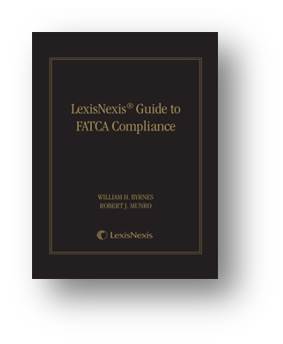
http://www.lexisnexis.com/store/catalog/booktemplate/productdetail.jsp?pageName=relatedProducts&prodId=prod19190327
“LexisNexis Guide to FATCA Compliance” has now been released in electronic format. Print orders have already been mailed to Asia, Europe, North America, and the Caribbean.
Professor William Byrnes stated, “I built the international tax & financial services graduate program with a mission of facilitating professionals to become excellent communicators of the robust and complex area of international taxation, passing on the legacy of my mentors Walter Diamond, Jacobus (“Joop”) van Hoorn, Marshall Langer and Barry Spitz.
“The FATCA Compliance Guide was designed by a list of top industry FATCA experts via numerous interviews and meetings with government and central bank officials, NGO staff, large financial institution compliance officers, investment fund compliance officers, and trust company counsel, and of course, substantial analytic writing.
“It is amazing how many contributing experts that I can leverage with modern communications technology, and organize discussions and editing among multiple persons using online platforms. This method really leverages the learning technologies used in the online international tax program these past 18 years.”
When asked about the Guide’s subject, William Byrnes replied, “Simply put, the FATCA regulations require foreign financial enterprises to report financial information about US taxpayers to the IRS. Moreover, US financial institutions must begin reporting similar financial information on foreign taxpayers to the IRS that the IRS will automatically forward to the respective foreign government. Noncompliance leads to a 30% withholding on all payments made to the non-compliant institution, which will drive such institution out of the US market rather quickly.”
“FATCA became effective on January 1, 2013, albeit withholding begins only January 1, 2014. Though FATCA was enacted 3 years ago, there is substantial industry concern that many impacted compliance departments currently do not have access to sufficient, detailed information regarding which sources of the enterprises income are foreign and which are based in the U.S. and which of their customers are U.S. (taxable) persons (e.g. dual U.S. nationals, substantially presence U.S. tax residents), and which entities have substantial U.S. ultimate beneficial owners.”
“The 400 pages of the Guide are grouped in 3 parts: compliance, regulatory analysis, and intergovernmental agreement analysis.”
Posted in book, Compliance, FATCA, Taxation | Tagged: Compliance, FATCA, Foreign Account Tax Compliance Act, IRS, tax | Leave a Comment »
Posted by William Byrnes on June 25, 2013
The J. William Fulbright Foreign Scholarship Board (FFSB), the U.S. Department of State’s Bureau of Education and Cultural Affairs (ECA) and the Council for International Exchange of Scholars (CIES), selected for the areas of comparative law and for taxation, William Byrnes for the Fulbright Specialist Roster. His Specialist Roster listing is for a five year period lasting until 2018.
“I am honored to have received this internationally recognized distinction of excellence from the Fulbright Foreign Scholarship Board and the State Department Bureau of Education and Cultural Affairs.” said Dean William Byrnes. “The academic recommendations regarding my impact in the field of distance education overseas and in the USA I think played a prominent role for the Review Committee.”
When asked about his immediate goals for the Fulbright appointment, William Byrnes replied “My goal for this Fall is to allocate time to research contextual comparative law learning, especially the social linguistic component. Afterwards, hopefully by next summer, I will be able to explore this area of pedagogy from an online learning setting.”
Read more at https://www.tjsl.edu/news-media/2013/9710
excerpted below from the TJSL News …
“I am honored that the Fulbright Foreign Scholarship Board and the State Department Bureau of Education and Cultural Affairs found my record of publication and teaching and impact on international education strong enough to select me from its applicant pool,” said Dean Byrnes. “I really owe it to the academic recommendations provided Fulbright by Professor Richard Winchester, Dean Rudy Hasl, my former Dean, John Makdisi, and my South African supervisor, Professor Alwyn DeKoker. These recommendations play a significant role for the Review Committee in its decision making process.”
“I think that my selection for this five year term, and Professor Winchester’s selection two years past as a Fulbright Scholar to Tunisia, provides testament that our national peers perceive Thomas Jefferson School of Law as an institution of high quality. I knew that I would be competing with candidates from large universities, but felt that it was worth the effort because of my particular impact on distance education the past 18 years and my international comparative background.
“Professor Winchester was the catalyst alerting me to the Fulbright opportunity. The rigorous Fulbright competitive process requires several levels of vetting of candidates’ academic publishing record, teaching experiences, and impact on international education. To make it through the first round, a candidate must receive positive recommendations from the Fulbright Specialist Review Committee. The second round includes the Committee determining by consensus who are best qualified to be Fulbright Specialists. The Fulbright Specialist Program Council then vets the Committee’s names against exclusion lists for government funds and exchanges. Finally, the names are forwarded to the Fulbright Foreign Scholarship Board for the final selection process for its specialist list.
“My goal for this opportunity is to spend time this coming academic year fleshing out some ideas regarding contextual comparative law learning that includes a social linguistic component that Professor Tiefenbrun will find familiar from her work, such as on Semiotics. I don’t know where this line of thought will lead, but at least it’s a distraction from deciphering tax regulations.”
Congratulations to Dean Byrnes from everyone at TJSL!
Posted in Education Theory | Tagged: CIES, Council for International Exchange of Scholars, Cultural Affairs, Fulbright Program, J. William Fulbright Foreign Scholarship Board, Semiotics, United States Department of State | Leave a Comment »
Posted by William Byrnes on June 24, 2013
Readers stay updated and informed with good ol’ fashioned BOOKS that SHIP FREE this week only, Monday, June 24th – Sunday, June 30th at NationalUnderwriter!
Check out my Tax Facts series (banners on the left and right column of my blog) and for free shipping click below….
FREE SHIPPING on any purchase through 06/30/2013 at NationalUnderwriter – SHOP NOW!

Posted in book, Estate Tax, Taxation | Tagged: income tax, IRS, national underwriter, tax facts | Leave a Comment »
Posted by William Byrnes on May 14, 2013
Editor’s Note: The following is an excerpt from Chapter 2 of LexisNexis® Guide to FATCA Compliance by William Byrnes and Robert Munro.
…
The over-arching requirements for FATCA [the Foreign Account Tax Compliance Act] are three-fold:
-
obtain appropriate due diligence information and documentation for account holders, investors and payees;
-
report on relevant parties such as U.S. account holders, recalcitrant account holders and non-participating foreign financial institutions (“FFIs”); and
-
coordinate withholding as appropriate and if necessary. The requirements are largely intertwined, with due diligence serving as the foundation for the reporting and withholding requirements.
Now that the final FATCA Regulations are published and a number of intergovernmental agreements (“IGAs”) have been signed, FFIs must implement practical steps to be FATCA compliant by January 1, 2014. There is no one-size-fits-all compliance plan for FFIs; however, there are many similar and consistent steps FFIs, regardless of location, can take to develop a FATCA compliance program to meet the broad goal of FATCA: to combat offshore tax evasion by U.S. persons and become FATCA compliant.
Before a FFI can become FATCA compliant, a FFI should take certain preliminary steps to determine the impact FATCA will have on the FFI as well as plan the path toward compliance in an efficient and timely manner.
Early in the process, the FFI should develop a FATCA task force or program team that will oversee the day-to-day operations to becoming FATCA compliant. The task force should include representatives from tax, anti-money laundering (“AML”) and customer on-boarding groups, technology, change management and operations as well as, potentially, other stakeholders. The task force will oversee the broad program plan for the FFI and likely report to the FATCA sponsoring executives or steering committee.
FFIs have to determine what, if any, communications they will prepare for both internal and external stakeholders concerning FATCA. An internal awareness and training program should be developed to teach FFI employees about FATCA and its importance to the FFI. The awareness program should start at the highest level to establish the necessary “tone at the top.”
The FFI may also want to prepare a list of questions, a “FAQs of FATCA,” to ensure the FFI’s clients are receiving a consistent message, regardless of where in the world they are located. FFIs should also determine what if any message they want to provide directly to clients or put on their websites, although it is very important that the FFI does not give unintentional tax advice to its clients.
Additionally, some training of FFI staff, including client-facing personnel, could assist with customers of the FFI receiving a clear and consistent message. It may likely be the FFI’s client-facing personnel are already receiving questions from customers regarding FATCA.
FFIs should take a proactive approach to minimize costs and interference with the customer experience at the FFI. With that in mind, prior to developing a FATCA compliance strategy, FFIs should conduct an assessment of the impact FATCA will have on the FFI by collecting information relating to:
- Number and activity of each legal entity and/or business line;
- Products and services offered by the business line;
- Types and volume of accounts;
- Relevant policies and procedures; and
- Identification of information technology (“IT”) systems and databases that maintain relevant information and may require updates.
The FFI should also determine what past interactions it has had with the IRS or home country tax authority relating to information reporting on their customers. FFIs may be able to leverage past reporting for FATCA compliance.
FFIs around the globe may rely on other parties to take on certain responsibilities. For example, a foreign fund may outsource some or all of its asset custody, compliance and regulatory functions, transfer agency services and/or distribution. In this case, the FATCA compliance program will only be as strong as the weakest link.
Coordinating and ensuring all relevant parties are working towards FATCA compliance will be important since a FATCA compliance failure on behalf of an agent of the FFI can be construed as a failure by the FFI itself. Asking questions of the FFI’s third-party service providers will be an important early step. If a third-party service provider is not working towards FATCA compliance, the FFI may want to re-assess their relationship and engagement with that party.
After the impact assessment is complete, the FFI will need to plan a path forward that not only makes all of the information technology systems and policy changes, but also develops a working corporate governance structure and functioning compliance program. …
Chapter contributors:
Richard Kando, CPA (New York) is a Director at Navigant Consulting and served as a Special Agent with the IRS Criminal Investigation Division where he received the U.S. Department of Justice – Tax Division Assistant Attorney General’s Special Contribution Award.
Jeffrey Locke, Esq. is Director at Navigant Consulting. Prior to joining Navigant, he served as an assistant New York state attorney general in the Criminal Prosecutions Bureau and worked in the prosecutor’s office for the United Nations in Kosovo.
Posted in Compliance, Money Laundering, OECD, Reporting, Tax Policy, Taxation | Tagged: FATCA, FFI, Foreign Account Tax Compliance Act, Internal Revenue Service, LexisNexis, Money Laundering, NFFE, tax | 1 Comment »
Posted by William Byrnes on May 10, 2013
Types of Entities
The Foreign Account Tax Compliance Act (“FATCA”) provides for withholding taxes to enforce reporting requirements on specified foreign accounts owned by specified U.S. persons or by U.S. owned foreign entities.
FATCA requires specified U.S. persons (U.S. citizen, residents and certain non-resident aliens) and specified domestic entities to report interests in specified foreign financial assets (SFFAs) if the aggregate value of those assets exceeds certain threshold. The regulations apply to domestic entities formed or availed of to hold, directly or indirectly, specified foreign financial assets. These specified entities include certain closely held corporations and partnerships that meet certain conditions and aggregation rules. Specified entities include domestic trusts if they meet certain criteria and exceed certain reporting threshold.
A U.S. owned foreign entity is an entity with one or more substantial U.S. owners. With certain exceptions, a substantial U.S. owner is any U.S. person with greater than 10% direct or indirect ownership interest in the foreign entity.
FATCA applies to U.S. persons who have specified foreign financial assets (SFFAs) whose value exceeds certain thresholds. The IRS announced in January 2013 that reporting by domestic entities with interests in specified foreign financial assets will not be required to file the IRS reporting form for FATCA, Form 8938, until after the date specified by final regulations, which will not be earlier than taxable years beginning after December 31, 2012.1
All foreign entities and foreign trusts are potentially subject to FATCA, in addition to the current Qualified Intermediary (QI) rules. Withholding rules and reporting requirements under FATCA depend upon the entity’s classification. FATCA classifies foreign entities as either financial entities or non-financial entities. Financial entities are classified as Foreign Financial Institutions (FFIs) [see infra. Chapter 7] while non-financial entities are classified as Non-Financial Foreign Entities (NFFEs) [see infra. Chapter 8].
Entities and trusts are very different under U.S. law. Entities include partnerships, limited liability companies (LLCs), international business companies (IBCs), foundations, usufructs, and corporations. In entities, the title to the property owned is not divided.
In a trust, however, U.S. law splits the ownership of the title into two parts, legal and equitable. The trustee of the trust owns the legal title for the benefit of the beneficiary, who owns the equitable title. A trust is a relationship, not an entity, and is treated differently under both the existing QI rules and FATCA.
Specified Foreign Financial Assets (SFFAs)
Financial Accounts
The most common type of SFFA that banks will encounter is a financial account such as any depository or custodial account that is maintained by an FFI.2 A financial account also includes non-publically traded equity or debt interest in a depository or custodial institution, an insurance company, or an investment entity.3 …
Moreover, a financial account includes a non-publically traded equity or debt interest in a holding company or treasury center in an expanded affiliated group [See infra. Chapter 8]. This applies if the holding company or treasury center has at least one investment entity or passive NFFE and the income of the investment entity or passive NFFE in the group exceeds 50% of the group’s aggregate income.4 …
Assets
SFFAs include assets not held in an account. Stocks and securities issued by a non-U.S. person that are held for investment are SFFAs whether they are held in an account with a FFI or not. The same holds true for capital or profits interests in a foreign partnership, any form of debt issued by a non-U.S. person, or a beneficial interest in a foreign trust, foreign estate, or foreign entity. A litany of financial instruments collectively referred to as “swaps” are also SFFAs whether held in an account or not. Options and derivative instruments that have any non-U.S. parties or are issued by a non-U.S. issuer are also SFFAs.5 …
Exemptions from SFFA Definitions
FATCA does provide exemptions. An interest in a foreign security or social insurance program is not a SFFA. A stock of precious metals held in a foreign safe deposit box is not a SFFA. Any security or partnership interest used or held in the conduct of normal trade or business is considered not to be held for investment under FATCA. Stock, however, cannot be considered to be held in the conduct of normal trade or business for purposes of FATCA. Therefore, foreign stock is a SFFA.6 …
Example of SFFA
To clarify what may be considered an SFFA, consider the following example. Mr. Smith, a U.S. person resident in the U.S., has $1 million in a Swiss bank account. He owns a partnership interest in a hedge fund established in the Cayman Islands, and directly owns 5,000 shares of a publically traded Japanese corporation, JapanCo. He also has social security benefits in a foreign country. …
1. IRS Notice 2013-10, “Information Reporting by Domestic Entities under Section 6038D with Respect to Specified Foreign Financial Assets”.
2. IRC §1471(d)(2), Treas Reg §1.1471-5(b)(1)(i), (ii).
3. IRC §1471(d)(2), Treas Reg §1.1471-5(b)(1)(iii)(A). “Investment entity” is defined in Treas Reg §1.1471-5(e)(4)(i).
4. IRC §1471(d)(2), Treas Reg §1.1471-5(b)(1)(iii)(B)(1). “Treasury center” is defined in Treas Reg §1.1471-5(e)(1)(v).
5. See generally IRS Form 8938, Statement of Specified Foreign Financial Assets.
6. See generally IRS Form 8938, Statement of Specified Foreign Financial Assets.
7. Foreign social security or social insurance programs are not specified as FFA, so they are not subject to FATCA reporting. Instructions to IRS Form 8938, Statement of Specified Foreign Financial Assets, p. 4.
Posted in Compliance, Reporting, Tax Policy, Taxation, Uncategorized | Tagged: Cayman Islands, FATCA, FFI, Finance, Foreign Account Tax Compliance Act, Internal Revenue Service, international tax, IRS, LexisNexis, Limited liability company, NFFE, tax | Leave a Comment »
Posted by William Byrnes on May 3, 2013
Over 400 pages of compliance analysis !! now available with the 20% discount code link in this flier –> LN Guide to FATCA_flier.
The LexisNexis® Guide to FATCA Compliance was designed in consultation, via numerous interviews and meetings, with government officials, NGO staff, large financial institution compliance officers, investment fund compliance officers, and trust companies, in consultation with contributors who are leading industry experts. The contributors hail from several countries and an offshore financial center and include attorneys, accountants, information technology engineers, and risk managers from large, medium and small firms and from large financial institutions. A sample chapter from the 25 is available on LexisNexis: http://www.lexisnexis.com/store/images/samples/9780769853734.pdf
Contributing FATCA Expert Practitioners
Kyria Ali, FCCA is a member of the Association of Chartered Certified Accountants (“ACCA”) of Baker Tilly (BVI) Limited.
Michael Alliston, Esq. is a solicitor in the London office of Herbert Smith Freehills LLP.
Ariene d’Arc Diniz e Amaral, Adv. is a Brazilian tax attorney of Rolim, Viotti & Leite Campos Advogados.
Maarten de Bruin, Esq. is a partner of Stibbe Simont.
Jean-Paul van den Berg, Esq. is a tax partner of Stibbe Simont.
Amanda Castellano, Esq. spent three years as an auditor with the Internal Revenue Service.
Luzius Cavelti, Esq. is an associate at Tappolet & Partner in Zurich.
Bruno Da Silva, LL.M. works at Loyens & Loeff, European Direct Tax Law team and is a tax treaty adviser for the Macau special administrative region of the People’s Republic of China.
Prof. J. Richard Duke, Esq. is an attorney admitted in Alabama and Florida specializing over forty years in income and estate tax planning and compliance, as well as asset protection, for high net wealth families. He served as Counsel to the Ludwig von Mises Institute for Austrian Economics 1983-1989.
Dr. Jan Dyckmans, Esq. is a German attorney at Flick Gocke Schaumburg in Frankfurt am Main.
Arne Hansen is a legal trainee of the Hanseatisches Oberlandesgericht (Higher Regional Court of Hamburg), Germany.
Mark Heroux, J.D. is a Principal in the Tax Services Group at Baker Tilly who began his career in 1986 with the IRS Office of Chief Counsel.
Rob. H. Holt, Esq. is a practicing attorney of thirty years licensed in New York and Texas representing real estate investment companies.
Richard Kando, CPA (New York) is a Director at Navigant Consulting and served as a Special Agent with the IRS Criminal Investigation Division where he received the U.S. Department of Justice – Tax Division Assistant Attorney General’s Special Contribution Award.
Denis Kleinfeld, Esq., CPA. is a renown tax author over four decades specializing in international tax planning of high net wealth families. He is Of Counsel to Fuerst Ittleman David & Joseph, PL, in Miami, Florida and was employed as an attorney with the Internal Revenue Service in the Estate and Gift Tax Division.
Richard L. Knickerbocker, Esq. is the senior partner in the Los Angeles office of the Knickerbocker Law Group and the former City Attorney of the City of Santa Monica.
Saloi Abou-Jaoude’ Knickerbocker Saloi Abou-Jaoude’ Knickerbocker is a Legal Administrator in the Los Angeles office of the Knickerbocker Law Group concentrated on shari’a finance.
Jeffrey Locke, Esq. is Director at Navigant Consulting.
Josh Lom works at Herbert Smith Freehills LLP.
Prof. Stephen Polak is a Tax Professor at Thomas Jefferson School of Law’s International Tax & Financial Services Graduate Program where he lectures on Financial Products, Tax Procedure and Financial Crimes. As a U.S. Senior Internal Revenue Agent, Financial Products and Transaction Examiner he examined exotic financial products of large multi-national corporations. Currently, Prof. Polak is assigned to U.S. Internal Revenue Service’s three year National Research Program’s as a Federal State and Local Government Specialist where he examines states, cities, municipalities, and other governmental entities.
Dr. Maji C. Rhee is a professor of Waseda University located in Tokyo.
Jean Richard, Esq. a Canadian attorney, previously worked for the Quebec Tax Department, as a Senior Tax Manager with a large international accounting firm and as a Tax & Estate consultant for a pre-eminent Canadian insurance company. He is currently the Vice President and Sr. Wealth Management Consultant of the BMO Financial Group.
Michael J. Rinaldi, II, CPA. is a renown international tax accountant and author, responsible for the largest independent audit firm in Washington, D.C.
Edgardo Santiago-Torres, Esq., CPA, is also a Certified Public Accountant and a Chartered Global Management Accountant, pursuant to the AICPA and CIMA rules and regulations, admitted by the Puerto Rico Board of Accountancy to practice Public Accounting in Puerto Rico, and an attorney.
Hope M. Shoulders, Esq. is a licensed attorney in the State of New Jersey whom has previously worked for General Motors, National Transportation Safety Board and the Department of Commerce.
Jason Simpson, CAMS is the Director of the Miami office for Global Atlantic Partners, overseeing all operations in Florida, the Caribbean and most of Latin America. He has worked previously as a bank compliance employee at various large and mid-sized financial institutions over the past ten years. He has been a key component in the removal of Cease and Desist Orders as well as other written regulatory agreements within a number of Domestic and International Banks, and designed complete AML units for domestic as well as international banks with over three million clients.
Dr. Alberto Gil Soriano, Esq. worked at the European Commission’s Anti-Fraud Office in Brussels, and most recently at the Legal Department of the International Monetary Fund’s Financial Integrity Group in Washington, D.C. He currently works at the Fiscal Department of Uría Menéndez Abogados, S.L.P in Barcelona (Spain).
Lily L. Tse, CPA. is a partner of Rinaldi & Associates (Washington, D.C.).
Dr. Oliver Untersander, Esq. is partner at Tappolet & Partner in Zurich.
Mauricio Cano del Valle, Esq. is a Mexican attorney who previously worked for the Mexican Ministry of Finance (Secretaría de Hacienda) and Deloitte and Touche Mexico. He was Managing Director of the Amicorp Group Mexico City and San Diego offices, and now has his own law firm.
John Walker, Esq. is an accomplished attorney with a software engineering and architecture background.
Bruce Zagaris, Esq. is a partner at the Washington, D.C. law firm Berliner, Corcoran & Rowe, LLP.
Prof. William Byrnes was a Senior Manager then Associate Director at Coopers & Lybrand, before joining academia wherein he became a renowned author of 38 book and compendium volumes, 93 book & treatise chapters and supplements, and 800+ articles. He is Associate Dean of Thomas Jefferson School of Law’s International Taxation & Financial Services Program.
Dr. Robert J. Munro is the author of 35 published books is a Senior Research Fellow and Director of Research for North America of CIDOEC at Jesus College, Cambridge University, and head of the anti money laundering studies of Thomas Jefferson School of Law’s International Taxation & Financial Services Program.
Posted in Compliance, Estate Tax, Financial Crimes, information exchange, Money Laundering, OECD, Reporting, Tax Policy, Taxation, Wealth Management | Tagged: Compliance, FATCA, Internal Revenue Service, LexisNexis, tax, Tax Evasion, tax reporting | 1 Comment »
Posted by William Byrnes on March 4, 2013
As the world becomes “smaller,” the dynamics of global financial transactions are intensifying. This is why the Foreign Account Tax Compliance Act (FATCA) is one of the most important awareness issues in today’s tax policy and compliance arena. As new developments emerge almost daily in this ever-changing environment, the importance of working knowledge is increasingly pronounced. The LexisNexis® Guide to FATCA Compliance, scheduled for release in May 2013, will be an invaluable resource of insight into FATCA principles, the reasons behind them, and the best practice steps financial institutions must follow in order to comply. Comprehensive coverage in this work, authored by Professor William Byrnes and Dr. Robert Munro, is complemented by content provided by highly qualified international contributors to render meaningful information about all aspects of FATCA.
The impact of FATCA is far-reaching: Affected financial institutions of many descriptions must navigate complex and challenging regulations to maintain compliance. In broad terms, foreign banks, brokerages, pension funds, insurance companies and a host of other foreign businesses that disburse payments to U.S. citizens and residents are all subject to FATCA compliance. As agreements between nations are consummated and other FATCA developments unfold, the importance of awareness will only grow.
– See more at: http://www.lexisnexis.com/community/taxlaw/blogs/fatca/archive/2013/02/28/lexisnexis-174-guide-to-fatca-compliance.aspx#sthash.Xtf40oCq.megzVJco.dpuf
Posted in Compliance, information exchange, Reporting, Tax Policy, Taxation | Tagged: FATCA, Financial institution, Financial transaction, Foreign Account Tax Compliance Act, Government, Internal Revenue Service, LexisNexis, United States | Leave a Comment »
Posted by William Byrnes on March 1, 2013
The LexisNexis® Guide to FATCA Compliance was designed in consultation, via numerous interviews and meetings, with government officials, NGO staff, large financial institution compliance officers, investment fund compliance officers, and trust companies, from North and South America, Europe, South Africa, and Asia, and in consultation with contributors who are leading industry experts. The contributors hail from several countries and an offshore financial center and include attorneys, accountants, information technology engineers, and risk managers from large, medium and small firms and from large financial institutions. Thus, the challenges of the FATCA Compliance Officer are approached from several perspectives and contextual backgrounds.
This edition will provide the financial enterprise’s FATCA compliance officer the tools for developing a best practices compliance strategy, starting with determining what information is needed for planning the meetings with outside FATCA experts.
This 330 page Guide contains three chapters written specifically to guide a financial institution’s lead FATCA compliance officer in designing a plan of internal action within the enterprise and interaction with outside FATCA advisors with a view of best leveraging available resources and budget [see Chapters 2, 3, and 4].
This Guide includes a practical outline of the information that should be requested by, and provided to, FATCA advisors who will be working with the enterprise, and a guide to the work flow and decision processes.
Click here to pre-order the LexisNexis® Guide to FATCA Compliance! Remember that only US customers can buy on the US Lexis store.
Chapter 1 Introduction
Chapter 2 Practical Considerations for Developing a FATCA Compliance Program
Chapter 3 FATCA Compliance and Integration of Information Technology
Chapter 4 Financial Institution Account Remediation
Chapter 5 FBAR & 8938 FATCA Reporting
Chapter 6 Determining U.S. Ownership Under FATCA
Chapter 7 Foreign Financial Institutions
Chapter 8 Non-Financial Foreign Entities
Chapter 9 FACTA and the Insurance Industry
Chapter 10 Withholding and Qualified Intermediary Reporting
Chapter 11 Withholding and FATCA
Chapter 12 ”Withholdable” Payments
Chapter 13 Determining and Documenting the Payee
Chapter 14 Framework of Intergovernmental Agreements
Chapter 15 Analysis of Current Intergovernmental Agreements
Chapter 16 UK-U.S. Intergovernmental Agreement and Its Implementation
Chapter 17 Mexico-U.S. Intergovernmental Agreement and Its Implementation
Chapter 18 Japan-U.S. Intergovernmental Agreement and Its Implementation
Chapter 19 Switzerland-U.S. Intergovernmental Agreement and Its Implementation
Chapter 20 Exchange of Tax Information and the Impact of FATCA for Germany
Chapter 21 Exchange of Tax Information and the Impact of FATCA for The Netherlands
Chapter 22 Exchange of Tax Information and the Impact of FATCA for Canada
Chapter 23 Exchange of Tax Information and the Impact of FATCA for The British
Virgin Islands
Chapter 24 European Union Cross Border Information Reporting
Chapter 25 The OECD, TRACE Program, FATCA and Beyond
Index
Posted in Compliance, information exchange, OECD, Reporting, Tax Policy, Taxation | Tagged: Canada, Chapter 11 Title 11 United States Code, Chapter 13 Title 11 United States Code, FATCA, Financial institution, Internal Revenue Service, LexisNexis, United States | 1 Comment »
Posted by William Byrnes on January 24, 2013
National Law Journal is doing a public survey that includes the category “Best Tax LLM Program” PLEASE – please – VOTE for Thomas Jefferson School of Law (I am very surprised to even be considered, but alas, now to be voted in the top class would be incredible…)
The voting begins today and below is the link for the survey. It is very long so please scroll through the questions until #63.
https://www.surveymonkey.com/s/2013BestofNLJ – question 63 – Thomas Jefferson
Voting will close February 10th and the winners will be announced in a special NLJ supplement on March 25th .
Posted in Uncategorized | Tagged: LLM Tax | 1 Comment »
Posted by William Byrnes on January 21, 2013
Treasury Advances Efforts to Secure International Participation, Streamline Compliance, and Prepare for Implementation of the Foreign Account Tax Compliance Act (January 17, 2013 U.S. Treasury Department of Public Affairs)
The U.S. Department of the Treasury and the Internal Revenue Service (IRS) on January 17, 2013 issued comprehensive final regulations implementing the information reporting and withholding tax provisions commonly known as the Foreign Account Tax Compliance Act (FATCA). Enacted by Congress in 2010, these provisions target non-compliance by U.S. taxpayers using foreign accounts. The issuance of the final regulations marks a key step in establishing a common intergovernmental approach to combating tax evasion.
These regulations provide additional certainty for financial institutions and government counterparts by finalizing the step-by-step process for U.S. account identification, information reporting, and withholding requirements for foreign financial institutions (FFIs), other foreign entities, and U.S. withholding agents.
The final regulations issued today:
Build on intergovernmental agreements that foster international cooperation. The Treasury Department has collaborated with foreign governments to develop and sign intergovernmental agreements that facilitate the effective and efficient implementation of FATCA by eliminating legal barriers to participation, reducing administrative burdens, and ensuring the participation of all nonexempt financial institutions in a partner jurisdiction. In order to reduce administrative burdens for financial institutions with operations in multiple jurisdictions, the final regulations coordinate the obligations for financial institutions under the regulations and the intergovernmental agreements.
Phase in the timelines for due diligence, reporting and withholding and align them with the intergovernmental agreements. The final regulations phase in over an extended transition period to provide sufficient time for financial institutions to develop necessary systems. In addition, to avoid confusion and unnecessary duplicative procedures, the final regulations align the regulatory timelines with the timelines prescribed in the intergovernmental agreements.
Expand and clarify the scope of payments not subject to withholding. To limit market disruption, reduce administrative burdens, and establish certainty, the final regulations provide relief from withholding with respect to certain grandfathered obligations and certain payments made by nonfinancial entities.
Refine and clarify the treatment of investment entities. To better align the obligations under FATCA with the risks posed by certain entities, the final regulations:
(1) expand and clarify the treatment of certain categories of low-risk institutions, such as governmental entities and retirement funds;
(2) provide that certain investment entities may be subject to being reported on by the FFIs with which they hold accounts rather than being required to register as FFIs and report to the IRS; and
(3) clarify the types of passive investment entities that must be identified and reported by financial institutions.
Clarify the compliance and verification obligations of FFIs. The final regulations provide more streamlined registration and compliance procedures for groups of financial institutions, including commonly managed investment funds, and provide additional detail regarding FFIs’ obligations to verify their compliance under FATCA.
Progress on International Coordination, Including Model Intergovernmental Agreements
Since the proposed regulations were published on February 15, 2012, Treasury has collaborated with foreign governments to develop two alternative model intergovernmental agreements that facilitate the effective and efficient implementation of FATCA. These models serve as the basis for concluding bilateral agreements with interested jurisdictions and help implement the law in a manner that removes domestic legal impediments to compliance, secures wide-spread participation by every non-exempt financial institution in the partner jurisdiction, fulfills FATCA’s policy objectives, and further reduces burdens on FFIs located in partner jurisdictions. Seven countries have already signed or initialed these agreements.
Today, Treasury announced for the first time that Norway has joined the United Kingdom, Mexico, Denmark, Ireland, Switzerland, and Spain as countries that have signed or initialed model agreements. Treasury is engaged with more than 50 countries and jurisdictions to curtail offshore tax evasion, and more signed agreements are expected to follow in the near future.
Additional Background on the Model Agreements
On July 26, 2012, Treasury published its first model intergovernmental agreement (Model 1 IGA). Instead of reporting to the IRS directly, FFIs in jurisdictions that have signed Model 1 IGAs report the information about U.S. accounts required by FACTA to their respective governments who then exchange this information with the IRS. Treasury also developed a second model intergovernmental agreement (Model 2 IGA) published on November 14, 2012. A partner jurisdiction signing an agreement based on the Model 2 IGA agrees to direct its FFIs to register with the IRS and report the information about U.S. accounts required by FATCA directly to the IRS.
These agreements do not offer an exemption from FATCA for any jurisdiction but instead offer a framework for information sharing pursuant to existing bilateral income tax treaties. Under both models, all financial institutions in a partner jurisdiction that are not otherwise excepted or exempt must report the information about U.S. accounts required by FATCA. Therefore, the IRS receives the same quality and quantity of
information about U.S. accounts from FFIs in jurisdictions with IGAs as it receives from FFIs applying the final regulations elsewhere, but these agreements help streamline reporting and remove legal impediments to
compliance.
Background on FATCA
FATCA was enacted in 2010 by Congress as part of the Hiring Incentives to Restore Employment (HIRE) Act. FATCA requires FFIs to report to the IRS information about financial accounts held by U.S. taxpayers,
or by foreign entities in which U.S. taxpayers hold a substantial ownership interest. In order to avoid withholding under FATCA, a participating FFI will have to enter into an agreement with the IRS to:
Identify U.S. accounts,
Report certain information to the IRS regarding U.S. accounts, and
Withhold a 30 percent tax on certain U.S.-connected payments to non-participating FFIs and account holders who are unwilling to provide the required information.
Registration will take place through an online system. FFIs that do not register and enter into an agreement with the IRS will be subject to withholding on certain types of payments relating to U.S. investments.
Posted in Compliance, Financial Crimes, Money Laundering, Reporting, Tax Policy | Tagged: FATCA, Financial institution, Internal Revenue Service, IRS, Mexico, Treasury, United States, United States Department of the Treasury | Leave a Comment »
Posted by William Byrnes on January 2, 2013
In the first moments of 2013, Congress eased the fiscal cliff tax increases for taxpayers earning less than $450,000 by enacting the American Taxpayer Relief Act (Act), permanently extending the Bush-era income tax cuts for this group. … While the legislation extends the current income tax rates for taxpayers earning less than $450,000 ($400,000 for single filers) per year, it allowed the Bush-era tax cuts to expire for all higher-income taxpayers. Similarly, taxes on capital gains, dividends, and estates were increased for the wealthiest taxpayers.
How Were Income Taxes Increased by the Fiscal Cliff Compromise?
How Does the Act Impact the Current System for Tax Deductions and Exemptions?
Were Capital Gains and Dividend Rates Impacted by the Act?
How Are Estate and Gift Tax Rates Affected?
What Other Changes Were Made?
Beyond the Act: What is the “Investment Income Tax”?
Planning Under the Act: How Should Clients Plan for Higher Taxes in 2013?
Read the analysis at National Underwriters’ Advanced Markets – http://nationalunderwriteradvancedmarkets.com/articles/fc010113-a.aspx?action=16
Posted in Estate Tax, Retirement Planning, Tax Policy, Taxation, Wealth Management | Tagged: Bush Tax Cuts, Capital gain, fiscal cliff, Fiscal conservatism, income tax, tax, Tax rate, United States, United States Congress | Leave a Comment »
Posted by William Byrnes on December 17, 2012
Your small business clients are faced with the increasing likelihood of higher taxes in 2013 and beyond; those aiming to reduce the slope of the fiscal cliff next year will want to take a closer look at the benefits of a defined benefit plan. …. read our strategy article at http://www.advisorone.com/2012/12/13/fully-funded-retirement-in-10-years-a-db-plan-for
Posted in Retirement Planning, Uncategorized, Wealth Management | Tagged: Business, Compensation and Benefits, Defined benefit pension plan, Employment, Human Resources, Pension, Retirement, Small business | Leave a Comment »
Posted by William Byrnes on December 7, 2012
Clients today assume that the tax-free status of life insurance is a given and may have even engaged in fiscal cliff planning that involves the purchase of life insurance to provide a source of tax-free investment income. Given today’s political climate, it is important for clients to realize that no tax preference is safe and that the tax benefits they have come to expect from life insurance are no exception.
read this article at Life Health Pro e-zine

Posted in Estate Tax, Insurance, Retirement Planning, Tax Policy | Tagged: Agents and Marketers, Business, Financial services, insurance, Life, life insurance | Leave a Comment »
Posted by William Byrnes on December 5, 2012
2013 Tax Facts on Investments in PRINT and E-Book format provides clear, concise answers to often complex tax questions concerning investments. Pertinent planning points are provided throughout.
Organized in a convenient Q&A format to speed you to the information you need, 2013 Tax Facts on Investments delivers the latest guidance on:
- Mutual Funds, Unit Trusts, REITs
- Incentive Stock Options
- Options & Futures
- Real Estate
- Stocks, Bonds
- Oil & Gas
- Precious Metals & Collectibles
- And much more!
Key updates for 2013:
- New section on captive insurance
- New section on reverse mortgages
- Expanded section on ETFs
- Expanded section on precious metals & collectibles
- More than 30 new Planning Points, written by practitioners for practitioners, in the following areas:
- Real Estate
- Limited Partnerships
- Stocks
- Interest and Expenses
- Options
- Mutual Funds
Posted in Estate Tax, Retirement Planning, Taxation, Trusts, Wealth Management | Tagged: 2013 Tax Facts, Business, Economy, Exchange-traded fund, futures real estate, incentive stock options, Investing, Investment, Mutual fund, Precious metal, Real estate investment trust, real estate limited partnerships, stocks bonds, tax, Wealth Management | Leave a Comment »
Posted by William Byrnes on December 3, 2012
After expenses covered by Medicare are taken into account, many of your clients retiring this year are likely to incur about $240,000 per couple in out-of-pocket health care expenses during retirement. … You may be able to alleviate the retiree health-expense problem by using guaranteed income annuities or life insurance alternative funding solutions.
Posted in Insurance, Pensions, Retirement Planning, Wealth Management | Tagged: life insurance, medical expenses, Retirement planning | Leave a Comment »
Posted by William Byrnes on November 30, 2012
An increasing number of your clients are facing the novel possibility of choosing a lump sum payout from their pensions instead of the traditional annuity option. See the full article at –http://www.lifehealthpro.com/2012/08/16/when-clients-get-lump-sum-pension-offers-what-to-a
Posted in Insurance, Pensions, Taxation, Wealth Management | Tagged: Life annuity, Pension, Retirement, Retirement planning | Leave a Comment »
Posted by William Byrnes on November 28, 2012
One question financial advisors are asking themselves today is whether life settlements have returned to the fold as a viable tool in their clients’ planning strategies. Read the entire article at http://www.lifehealthpro.com/2012/09/05/life-settlements-are-they-back
Posted in Insurance, Retirement Planning, Taxation, Wealth Management | Tagged: life settlements, Retirement, Retirement planning | Leave a Comment »
Posted by William Byrnes on November 26, 2012
… the PPACA provisions proposing an additional 3.8 percent tax on investment income will shortly become effective … and your high-income clients will need advice on how to reposition their investments today to minimize its effect. Read the full article at http://www.lifehealthpro.com/2012/07/19/preparing-clients-for-the-reality-of-ppacas-invest
Posted in Pensions, Retirement Planning, Taxation | Tagged: Patient Protection and Affordable Care Act, PPACA, tax | Leave a Comment »
Posted by William Byrnes on November 23, 2012
… While most compromise legislation has focused on allowing some of these rates to rise while maintaining current rates for lower-income groups, Congress may beable to leave most tax rates in place if they focus on capping deductions and reducing spending for all taxpayers. Of course,

US Tax Rates (Taxes on riches/wealth) (Photo credit: mSeattle)
Read the entire article at National Underwriters’ –> Life Health Pro <–
Posted in Estate Tax, Tax Policy, Taxation | Tagged: Bush Tax Cuts, tax, Tax rate | Leave a Comment »
Posted by William Byrnes on November 21, 2012

http://www.nationalunderwriter.com/2013-tax-facts-on-insurance-employee-benefits-269.html
Organized in a convenient Q&A format to speed you to the information you need, 2013 Tax Facts on Insurance & Employee Benefits delivers the latest guidance on:
- Estate & Gift Tax Planning
- Roth IRAs
- HSAs
- Capital Gains, Qualifying Dividends
- Non-qualified Deferred Compensation Under IRC Section 409A
- And much more!
Key updates for 2013:
- Enhanced explanation of the Disclosure Regulations for Retirement Plan Service Providers
- Expanded section on the taxation of annuities
- More than 30 new Planning Points, written by practitioners for practitioners, in the following areas:
- Life Insurance
- Health Insurance
- Federal Income Taxation
- Estate Taxation
Plus, you’re kept up-to-date with online supplements for critical developments.
Posted in Estate Tax, Pensions, Retirement Planning, Taxation, Wealth Management | Tagged: Capital gain, Deferred compensation, estate planning, Internal Revenue Code section 409A, life insurance, Pension, Roth, Roth IRA, tax | Leave a Comment »
Posted by William Byrnes on November 21, 2012
For your clients who have been playing the wait-and-see game in estate planning this year, the time for waiting is over. Absent congressional action, the current $5.12 million exemption will revert to $1 million in less than three months, and the current 35% maximum estate tax rate will jump to 55%. The entire article is available at http://www.lifehealthpro.com/2012/10/17/the-ticking-estate-tax-time-bomb-less-than-90-days
Posted in Estate Tax, Pensions, Retirement Planning, Taxation, Trusts, Wealth Management | Tagged: estate planning, Inheritance tax, tax, Tax exemption | Leave a Comment »
Posted by William Byrnes on November 19, 2012
…insurance companies have begun building annuity products in a variety of shapes and sizes, and the latest crop of deferred income annuity products could pave the way for clients seeking to maximize retirement income security in the years leading up to retirement. Read the full article on AdvisorOne – http://www.advisorone.com/2012/11/08/how-new-deferred-annuities-provide-income-early-in
Posted in Estate Tax, Pensions, Retirement Planning, Taxation, Wealth Management | Tagged: annuities, Financial services, insurance, Life annuity, Pension, Retirement, tax | Leave a Comment »
Posted by William Byrnes on November 15, 2012

Tax (Photo credit: 401(K) 2012)
With the election behind us, it is time for your clients to turn their attention to the looming tax reforms that should take shape over the next two months, and how these reforms can affect their retirement planning. Both arms of Congress will be working to reach a compromise on tax code provisions as basic as income tax rates before Jan. 1, after which the Bush-era tax cuts will expire, and rates could revert to pre-2001 levels.
Though President Obama spent little time discussing his views on tax-favored retirement accounts during his campaign, the plans he did set forth are indicative of the consequences for retirement savings. While this impact may not be immediately apparent to your clients, it is something that they need to consider as they plan for retirement this year and beyond. See the full article on National Underwriters’ Life Health Pro http://www.lifehealthpro.com/2012/11/13/retirement-planning-for-the-next-4-years-under-pre
Posted in Estate Tax, Tax Policy, Taxation, Wealth Management | Tagged: Barack Obama, Retirement, Social Security, tax | Leave a Comment »
Posted by William Byrnes on June 27, 2012
LexisNexis Matthew Bender has launched a online-only international title: Money Laundering, Asset Forfeiture and Recovery, and Compliance – A Global Guide.
Written by two California law professors (Professors William Byrnes & Robert Munro, Thomas Jefferson School of Law),

English: Logo of Group of working out of financial measures of struggle against money-laundering (FATF) Русский: Логотип Группы разработки финансовых мер борьбы с отмыванием денег (ФАТФ) (Photo credit: Wikipedia)
Each nation has its own chapter with sections covering:
- Anti-money laundering and counter-terrorist financing;
- Criminal and civil forfeiture;
- Compliance & risk; and
- International cooperation.
The remaining nations of the world will be covered in quarterly updates scheduled to go live in 2012 and 2013.
Because the new product spans so many practice areas, it appears on seven area-of-law pages (Accounting, Banking, Criminal, Foreign Law, International Law, International Trade, and Taxation), plus Lexis Tax Center. Just look under “Search Analysis, Law Reviews & Journals”.
This title is also available as an ebook.
Link to the Book’s Introduction: 1 Money Laundering, Asset Forfeiture and Compliance INTRODUCTION
Posted in Compliance | Tagged: Asset Forfeiture, Crime, International Law, International Trade, Money Laundering, terrorist financing, Thomas Jefferson School of Law | Leave a Comment »
Posted by William Byrnes on May 11, 2012
Business Transactions and Contract Drafting courses for India
distance learning and then 3 weeks, about 90 classroom training hours in San Diego on campus
– (International) Contract Drafting
– Business Transactional Law
– Legal Research and Writing
Individualized and group practical case studies with feedback
Contact William Byrnes wbyrnes@tjsl.edu
Or see the law school website for more information http://www.tjsl.edu/graduate/leep
Posted in Courses | Tagged: Business, Distance education, India, Legal Process Outsourcing, LPO, Research, training | Leave a Comment »
Posted by William Byrnes on May 8, 2012
Business Transactions and Contract Drafting courses for Brazilians
11 – 27 June (3 weeks, about 90 classroom training hours) in San Diego on campus
Partners include OAB, AGU, UNAFE, and APAMAGIS
– (International) Contract Drafting
– Business Transactional Law
– US Legal Research and Writing
– Intro to US Law
Individualized and group practical case studies with feedback
Contact William Byrnes wbyrnes@tjsl.edu
Or see the law school website for more information http://www.tjsl.edu/graduate/leep
Posted in Courses | Tagged: Brazil, business law, contract drafting, law, Law school, legal research, Legal writing | Leave a Comment »
Posted by William Byrnes on March 26, 2012
Want some free marketing material for your annuities business? Look no further than the U.S. Government Accountability Office (GAO), which recently released a report touting annuities for their ability to provide retirement income sufficiency in an increasingly uncertain environment.
The GAO recommends that retirees delay their receipt of Social Security Benefits and either draw down savings and purchase an annuity or select annuity options from their defined benefit (DB) plan instead of electing to receive their benefits in a lump sum.
According to the GAO, the shift from defined benefit pension plans to defined contribution (DC) plans like 401(k)s necessitates a heightened focus on annuities and other options for guaranteeing income during retirement . And even if workers are saving more for retirement through their DC plans, they are still at greater risk than employees with DB pensions.
Read this complete analysis of the impact at AdvisorFX (sign up for a free trial subscription with full access to all of the planning libraries and client presentations if you are not already a subscriber).
For previous coverage of annuities in Advisor’s Journal, see How Much to Allocate to Annuities: A Critical Analysis (CC 11-109) & Drama Over the “Drawbacks” of Annuities (CC 11-62).
For in-depth analysis of the taxation of annuities, see Advisor’s Main Library: A—Amounts Received As An Annuity & B—Amounts NOT Received As Annuities.
Posted in Wealth Management | Tagged: 401(k), Defined benefit pension plan, GAO, Government Accountability Office, Life annuity, Pension, Retirement, Social Security | Leave a Comment »
Posted by William Byrnes on March 23, 2012
Treasury Secretary Tim Geithner insists that the administration needs to reach a debt limit deal by the end of this week to give Congress enough time to enact the deal into law. Without a deal, the federal government will be unable to pay its debts as of August 2 of this year.
“Default is not an option,” he said on Tuesday, July 12, at the Treasury’s Women in Finance Symposium. “Failure is not an option, and they understand that—Speaker [John] Boehner and Minority Leader [Mitch] McConnell—absolutely understand we need to move in advance of the deadline on Aug. 2nd.”
Despite Geithner’s confidence that they will reach a deal, President Obama and Congressional leaders are also working on options for keeping the government’s bills paid if a deal can’t be reached by the Treasury’s August 2 debt limit deadline. “If we are unable to come together, we think it’s extremely important that the country reassure the markets that default is not an option and reassure Social Security recipients and families of military veterans that default is not an option,” said Mitch McConnell (R-K.Y.), who took part in the talks.
Read this complete analysis of the impact at AdvisorFX (sign up for a free trial subscription with full access to all of the planning libraries and client presentations if you are not already a subscriber).
For previous coverage in Advisor’s Journal, see Democrats Call Debt Limit Unconstitutional (CC 11-134), Debt Limit Standoff Boils Over (CC 11-115) and Storm Clouds over U.S. Debt (CC 11-85).
Posted in Wealth Management | Tagged: Barack Obama, Default (finance), John Boehner, Mitch McConnell, Timothy Geithner, United States Congress, United States public debt, United States Secretary of the Treasury | 1 Comment »
Posted by William Byrnes on March 21, 2012
Partners in a partnership and members of an LLC, taxed as a partnership, cannot have individual SEP IRAs (Simplified Employee Pension Individual Retirement Account) plans, according to the IRS.
Only employers are capable of implementing SEP plans for their employees. Because partners are employees of the partnership for retirement plan purposes, they cannot have an individual SEP plan. If partners in a partnership wish to use a SEP plan, the partnership as an entity must maintain and contribute to the plan for the partners.
Read this complete analysis of the impact at AdvisorFX (sign up for a free trial subscription with full access to all the planning libraries and client presentations if you are not already a subscriber).
For previous coverage of IRAs in Advisor’s Journal, see Qualified Charitable Distributions from an IRA (CC 11-03) & How Are IRA Owners Investing Their Money? (CC 11-112).
For in-depth analysis of SEPs, see Advisor’s Main Library: IRAs and SEPs.
Posted in Wealth Management | Tagged: 401(k), Business, Employment, Individual Retirement Account, Internal Revenue Service, Pension, Roth IRA, SEP-IRA | Leave a Comment »
Posted by William Byrnes on March 19, 2012
Looking to recapture its competitiveness in the domestic captive insurance business, Nevada passed Assembly Bill 74 (AB 74), which amends the state’s captive insurance law. Nevada Governor Brian Sandoval recently praised the amendment, saying it that “will make Nevada a more attractive place to do business for captive insurers.”
Generally, a captive insurance company forms as a subsidiary of a company to cover the risks of the parent company and its other subsidiaries. A captive insurance company typically does not insure risks of unrelated third parties—although some will insure their customers’ risks. Other captive insurers assume the risks of members of a trade association or group.
Read this complete analysis of the impact at AdvisorFX (sign up for a free trial subscription with full access to all of the planning libraries and client presentations if you are not already a subscriber).
For previous coverage of the application of the Health Care law to captive provided health insurance, see Tax Facts, see 252. What nondiscrimination requirements apply to employer provided health benefits?.
Questions about Captives? Contact our Panel of Experts. Benjamin Terner is our “Captive Expert” and can answer your questions relating to domestic and offshore arrangements
Posted in Wealth Management | Tagged: Brian Sandoval, Captive, Captive insurance, Financial services, insurance, Nevada, risk management, Trade association | Leave a Comment »
Posted by William Byrnes on March 16, 2012
Long-term gains yield more favorable tax costs than short-term gains. Short-term gains carry an additional 20% tax cost over long-term gains, encouraging the manufacturing of transactions designed to convert short-term to long-term gains. Unfortunately, these transactions attract undue attention from the IRS and are often disregarded by the Service. The IRS recently considered the tax treatment of one of these gain-recharacterization schemes, a basket option contract, in a generic legal advice memorandum (AM 2010-005).
The IRS altered its categorization of the contract, viewing it as if the investor purchased the securities in a margin account, paying cash equal to 10% of the value of the securities and borrowing 90% of the value from the investment bank. Just as was the case with the “option,” the investor had almost total control over investment of the securities and would reap all appreciation and income from the securities, less interest and brokerage fees.
Read this complete analysis of the impact at AdvisorFX (sign up for a free trial subscription with full access to all of the planning libraries and client presentations if you are not already a subscriber).
For in-depth analysis of options, see Advisor’s Main Library: G—Options and Futures.
Posted in Wealth Management | Tagged: Futures, Futures contract, Internal Revenue Service, IRS, Options, Recharacterisation, Security (finance), tax | Leave a Comment »
Posted by William Byrnes on March 6, 2012
A massive increase of lawsuits and IRS investigations have surrounded the Millennium Multiple Employer Welfare Benefit Plan for years, with plan participants claiming it was nothing but a fraudulent device with sole purpose of generating millions in commissions for its agent promoters. There are accusations of taking a total of $500 million from 500 clients by inducing them to participate in a plan that offered no tax or other benefits to its participants.
Several lawsuits are still pending against the Millennium Plan, but at least one aspect of the alleged scam plan has been resolved. The IRS announced on July 5 that it reached an agreement with the Millennium Multiple Employer Welfare Benefit Plan (“Millennium Plan”). After numerous fraud allegations and the IRS abusive tax shelter investigation, the Millennium Plan filed for Chapter 11 bankruptcy.
Read this complete analysis of the impact at AdvisorFX (sign up for a free trial subscription with full access to all of the planning libraries and client presentations if you are not already a subscriber).
For previous coverage of welfare benefits plans in Advisor’s Journal, see Tax Courts Holds Employee Taxable for Value of Life Insurance Owned by Welfare-Benefit & Deductions for Life Insurance Premium Payments to Welfare Benefit Plan Denied (CC 10-29).
Posted in Wealth Management | Tagged: Employment, insurance, Internal Revenue Service, IRS, Millennium Plan, tax, Tax shelter, Welfare | Leave a Comment »
Posted by William Byrnes on February 21, 2012
The August 2 debt ceiling drop-dead date is less than a month away, and some Democrats are proposing a radical solution to the problem: Ignore it. They argue that the U.S. Constitution allows the President to simply ignore the debt ceiling and pay the federal government’s bills.
Democrats and commentators in favor of ignoring the limit cite section 4 of the 14th Amendment to the U.S. Constitution, which says, “The validity of the public debt of the United States, authorized by law, including debts incurred for payment of pensions…, shall not be questioned.”
They argue that the U.S. government is bound by the Constitution to pay its bills and won’t be able to do so if the debt ceiling is respected. As a result, the law creating the debt ceiling is unconstitutional in this particular scenario because it would force the federal government to violate a provision of the U.S. Constitution. Taking on new debt isn’t just about future spending. A significant amount of any cash generated by a new debt issue is needed to service existing debt.
In short, default is unconstitutional, and the debt ceiling is unconstitutional to the extent it restricts the President from following the Constitution’s requirements.
Read this complete analysis of the impact at AdvisorFX (sign up for a free trial subscription with full access to all of the planning libraries and client presentations if you are not already a subscriber).
Posted in Wealth Management | Tagged: Constitutionality, Debt, Democratic Party (United States), Federal government of the United States, United State, United States Constitution, United States public debt, US Constitution | Leave a Comment »
Posted by William Byrnes on February 7, 2012
Are you an employee or independent contractor of your firm? If you’re doing business in California and get the classification wrong, you could be in for criminal charges and up to a $25,000 fine.
California State Bill 459—which would impose strict recordkeeping requirements and severe penalties on firms that misclassify employees as independent contractors—passed the state senate on June 2. The bill moved to the Assembly and went on to a hearing at the Assembly Committee on Labor and Employment two weeks later. The bill is expected to come to a vote in the Assembly later this summer.
Under the bill, firms that mischaracterize employees as independent contractors can be subject to fines of up to $25,000. They also will be required to keep records verifying independent contractor status for at least two years or face a fine of $500 per employee and misdemeanor criminal charges.
Read this complete analysis of the impact at AdvisorFX (sign up for a free trial subscription with full access to all of the planning libraries and client presentations if you are not already a subscriber).
For in-depth analysis of income taxation, see Advisor’s Main Library: Income Taxes.
Posted in Wealth Management | Tagged: Business, California, Employment, independent contractor, Internal Revenue Service, law, Self-employment, Vocus | Leave a Comment »
Posted by William Byrnes on February 2, 2012
The Domestic Asset Protection Trust (DAPT) is the onshore response to concerns surrounding offshore asset protection vehicles, but are the onshore and offshore varieties of asset protection equivalent? Despite the surface similarities between DAPTs and asset protection vehicles based in the Caribbean and other offshore hotspots, the degree of creditor protection offered by them can be very different.
After a brief discussion of the history of DAPTs, this article examines the battle tactics used by creditors to break DAPTs and access trust assets.
Read this complete analysis of the impact at AdvisorFX (sign up for a free trial subscription with full access to all of the planning libraries and client presentations if you are not already a subscriber).
For previous coverage of DAPTs in Advisor’s Journal, see Domestic Asset Protection Trusts: New Chart Ranks the States (CC 10-30) & The Spendthrift Clause (CC 09-32).
For in-depth analysis of DAPTs, see Advisor’s Main Library: G—Domestic Asset Protection Trusts.
Posted in Wealth Management | Tagged: Asset protection, Asset-protection trust, Business, Caribbean, Creditor, DAPT, Financial services, United States | Leave a Comment »
Posted by William Byrnes on January 11, 2012
The Financial Industry Regulatory Authority (FINRA) is targeting structured products over concerns about unsuitable sales to retail customers. In an exclusive interview with AdvisorOne (a Summit Business Media product) Bradley Bennett, enforcement chief at FINRA, said that the agency’s caseload on the recent financial crisis has eased up, and the agency is ready to renew its focus on structured products.
Structured products are often marketed to retail customers without an adequate explanation of their associated risks. “They purport to give the alchemy of lowering risk while increasing yield,” Bennett said, “but the risk needs to be explained” both to the broker-dealer’s “sales force and customers, and be suitable given the customer’s financial circumstances.”
Read this complete analysis of the impact at AdvisorFX (sign up for a free trial subscription with full access to all the planning libraries and client presentations if you are not already a subscriber).
For previous coverage of structured products in Advisor’s Journal, see SEC Warns Investors about Principal Protected Notes (CC 11-117).
For in-depth analysis of structured products, see Advisor’s Main Library: 7774. What is a structured product? How are structured products taxed?
Posted in Wealth Management | Tagged: AdvisorOne, Broker-dealer, Business, Financial Industry Regulatory Authority, FINRA, Investment Advisor, Structured product, Summit Business Media | Leave a Comment »
Posted by William Byrnes on January 10, 2012
As anticipated, the SEC will delay implementation of the RIA transition. On June 22, the SEC approved rules that will transition thousands of advisors from SEC to state regulation, but the new rules won’t be effective until June 28, 2012, almost a year later than initially expected.
Under the regulatory structure in place before the enactment of the Dodd-Frank Wall Street Reform and Consumer Protection Act, investment advisors with $25 million or more in assets under management (AUM) were regulated by the SEC, and those with less than $25 million in AUM were regulated by the states. Dodd-Frank changed the registration threshold so that advisors with between $25 and $100 million in AUM—so-called “midsize advisors”—will be required to withdraw their registration from the SEC and register with state regulators.
Read this complete analysis of the impact at AdvisorFX (sign up for a free trial subscription with full access to all the planning libraries and client presentations if you are not already a subscriber).
For previous coverage of the planned switch and in Advisor’s Journal, see Disarray at the SEC is Complicating the “Switch” (CC 11-83), Hedge Funds Must Now Register with the SEC under the New Wall Street Reform Act (CC 10-45) & Dodd-Frank Wall Street Reform and Consumer Protection Act (CC 10-35).
Posted in Wealth Management | Tagged: Consumer Protection Act, Dodd-Frank, Dodd–Frank Wall Street Reform and Consumer Protection Act, Hedge fund, Registered Investment Advisor, Regulation, SEC, Wall Street | Leave a Comment »
Posted by William Byrnes on January 3, 2012
You’ve been on a few “dates,” and you talk on the phone every couple weeks, but how well do your prospects and existing clients know you and understand your core personal investing philosophy? Small talk breaks down barriers and common interests keep the conversation moving, but taking the advisor-client relationship to the next level takes some work—and a lot of research. A recent survey gives us a head start by elucidating the communication divide that holds many advisors back from taking the big plunge with their prospects.
The survey found that HNW clients favor electronic communication media more than their advisors. Twice as many millionaires than advisors would like to use technology-enabled media—smart phone applications and social media. While 85% of millionaires are willing to communicate through social-media, e-mail, and text messages, only 43% of brokers and financial advisors share that willingness. And your millionaire clients are also more likely to use LinkedIn than you are (28% to 16%). And a third of millionaires already use social media in general as part of their professional life.
Read this complete analysis of the impact at AdvisorFX (sign up for a free trial subscription with full access to all the planning libraries and client presentations if you are not already a subscriber).
For other client development discussions in Advisor’s Journal, see Advisors’ Stairsteps of Influence (CC 11-49), Getting Your Feet Wet in the Social Media Market (CC 11-79) & Are Portfolios-To-Go Threatening Your Business? (CC 11-77).
Posted in Wealth Management | Tagged: Business, Communication, Facebook, Financial adviser, Financial services, LinkedIn, Marketing and Advertising, Social media | Leave a Comment »
Posted by William Byrnes on December 22, 2011
In a merciful move, the Treasury has again extended the FBAR filing deadline for persons with only signature authority over a foreign financial account to November 1, 2011. [Notice 2011-54]. Two previous extensions had pushed the FBAR due date to June 30, 2011, but the Financial Crimes Enforcement Network (FinCEN) and the IRS recognized the difficulty signatories were having locating the information they needed to complete the form.
Form TD F 90-22.1, Report of Foreign Bank and Financial Accounts (FBAR), must be filed annually by all U.S. citizens, residents, business entities, trusts, and estates with a financial interest in or signature authority over one or more foreign financial accounts (FFA) with an aggregate value greater than $10,000.
Read this complete analysis of the impact at AdvisorFX (sign up for a free trial subscription with full access to all of the planning libraries and client presentations if you are not already a subscriber).
For previous coverage of the FBAR in Advisor’s Journal, see Do Your Clients’ International Assets Create Criminal Tax Exposure? (CC 11-73) & IRS Provides FBAR Answers (CC 11-119).
Posted in Wealth Management | Leave a Comment »


